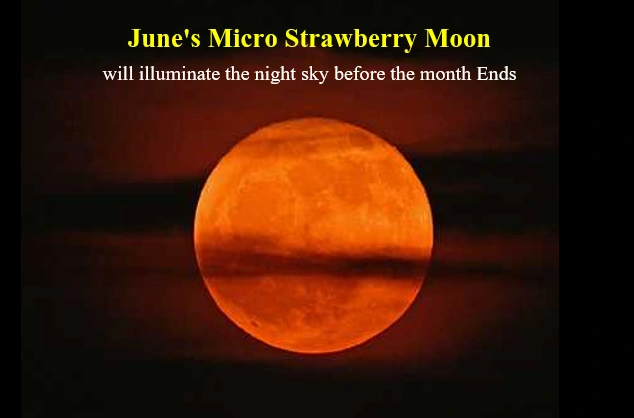

Skywatchers still have an opportunity to witness June’s micro Strawberry Moon before the month comes to a close. The celestial event, known for making the Moon appear slightly smaller than usual, is expected to draw interest from astronomy enthusiasts and casual observers alike.
This year’s Strawberry Moon is classified as a “micro moon” because it reaches its full phase while positioned farther away from Earth in its orbit. Although the size difference may not be immediately obvious to everyone, the event remains one of the most talked-about lunar occurrences of June.
What Makes the Strawberry Moon Special?
The Strawberry Moon is the traditional name assigned to June’s full moon. Contrary to what the name might suggest, the Moon does not actually appear pink or red like a strawberry. Instead, the title has historical roots linked to the strawberry harvesting season observed by Native American tribes and early agricultural communities.
For generations, full moons throughout the year have carried seasonal names tied to weather patterns, farming cycles, and natural events. The June full moon became known as the Strawberry Moon because it coincided with the short strawberry-picking season in parts of North America.
Today, the term continues to be widely used by astronomers, skywatchers, and media outlets around the world. Every year, the Strawberry Moon becomes a notable astronomical event, particularly for people interested in lunar photography and nighttime observation.
Why This Year’s Event Is a Micro Moon
This year’s Strawberry Moon is being described as a micro moon due to the Moon’s position in relation to Earth during its full phase.
A micro moon occurs when the Moon reaches full illumination while near apogee, the point in its orbit where it is farthest from Earth. Because the Moon is slightly farther away than usual, it appears somewhat smaller and dimmer compared to a typical full moon.
The opposite of a micro moon is a supermoon, which happens when the Moon is closer to Earth and therefore appears larger and brighter in the sky. While supermoons often attract greater public attention because of their dramatic appearance, micro moons remain scientifically significant and visually interesting for astronomy enthusiasts.
Experts note that the size difference between a regular full moon and a micro moon can be subtle. Many casual observers may not immediately notice the change without comparing photographs or previous lunar events. However, experienced skywatchers and photographers often appreciate the unique qualities of a micro moon, especially when viewing conditions are ideal.
Best Ways to Observe the Micro Strawberry Moon
People hoping to view the micro Strawberry Moon are encouraged to look toward the sky shortly after moonrise. During this period, the Moon can appear larger because of the “moon illusion,” an optical effect caused by the Moon’s position near the horizon.
Clear weather conditions are important for the best viewing experience. Observers located away from bright city lights generally have a better chance of seeing the Moon clearly and appreciating its subtle features.
Rural areas, open fields, beaches, and elevated locations are often considered ideal places for lunar observation. Photography enthusiasts may also attempt to capture the Moon alongside landscapes, buildings, or natural scenery to create visually striking images.
Binoculars or telescopes are not necessary to enjoy the event, but they can help reveal more details on the lunar surface, including craters and darker volcanic plains known as maria.
Also read: Eid Ul Fitr 2026: Moon sighting time and its significance
The Science Behind Lunar Distance
The Moon does not orbit Earth in a perfect circle. Instead, it follows an elliptical path, meaning its distance from Earth changes throughout the month.
At its closest point, known as perigee, the Moon appears larger and brighter. At apogee, the farthest point, the Moon looks slightly smaller. When a full moon coincides with apogee, the result is a micro moon.
Although the variation in size is relatively small from the perspective of the human eye, the actual distance difference can be significant. This changing distance is a normal part of the Moon’s orbit and contributes to the variety of lunar appearances observed during the year.
Astronomers often use events such as micro moons and supermoons to educate the public about lunar science, orbital mechanics, and the relationship between Earth and its natural satellite.
A Popular Event for Skywatchers
Lunar events continue to attract global attention because they are easy to observe without specialized equipment. Unlike eclipses or meteor showers that may require precise timing or specific conditions, full moons are generally accessible to millions of people around the world.
The Strawberry Moon has become especially popular on social media, where photographers and astronomy fans frequently share images and observations. The combination of seasonal naming traditions and astronomical significance helps maintain public fascination with full moon events.
In recent years, interest in skywatching has grown considerably, with many people turning to astronomy as both a hobby and a relaxing outdoor activity. Events like the micro Strawberry Moon encourage people to spend time outside and engage with the natural world.
Final Opportunity Before June Ends
As June nears its conclusion, the micro Strawberry Moon represents one of the final major celestial highlights of the month. While it may not appear as dramatic as a supermoon, the event still offers a unique opportunity to observe the Moon in a different phase of its orbital cycle.
Skywatchers hoping to catch a glimpse of the lunar event should monitor local weather conditions and plan to observe the Moon soon after it rises. With favorable viewing conditions, the micro Strawberry Moon can provide a memorable nighttime experience for both experienced astronomy enthusiasts and casual observers.

A versatile writer mainly works on trending news, daily updates from politics, business, crime, current affairs and entertainment.