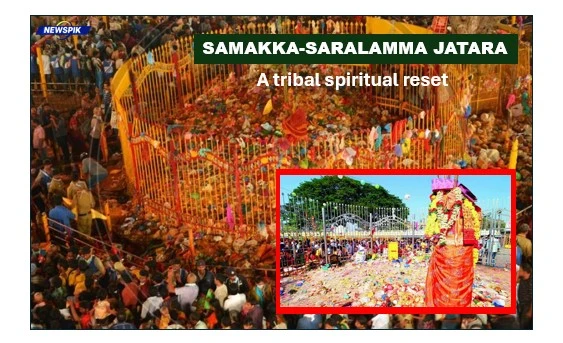

In the thick forests of Medaram in Telangana’s Mulugu district unfolds one of the largest tribal congregations in the world-the Samakka-Saralamma Jatara, which is held once every two years. This is no ordinary festival. It is not about temples or idols or priests, but about nature and memory and faith combined. To millions of devotees, especially from Adivasi communities, the Jatara is a profound spiritual reset-an act of returning to roots, balance, and moral courage.
The Gods of the Woods
Samakka and her daughter Saralamma do not come under the standard Hindu pantheon of gods. They are believed to be the spirits of tribal warriors who lived, fought against all odds, and ultimately submerged in nature. As a Koya tribal woman, Samakka is believed to have led a tribal revolt against oppressive taxation levied by medieval rulers. The defiance, sacrifice, and disappearance of a young lady into the forest metamorphosed her living spirit into a symbol of resistance and righteousness. Saralamma, who fought along with her, is continuity with courage and filial strength.
Their worship discourages idolization. However, holy symbols such as bamboo poles, vermilion, turmeric, and the forest come to symbolize divinity. The absence of idols made of stone emphasizes that divinity is not distant, created, or abstract but present in land and memory. The worship discourages idolization.
Medaram: Where Nature Is Consecrated?
The Jatara is located at Medaram, which is an area resembling a spiritual city created temporarily. Rivers, anthills, and roads are part of the religious geography. By doing so, the forest becomes an actor in religious rituals and is not merely a setting. This spatial location is a representation of indigenous cosmology that relates humans to spirits and nature.
The devotees trek for miles barefoot, with some of them having offerings of jaggery, coconuts, and bangles. Of course, their offerings are not extravagant but symbolic, which are all forms of thanksgiving and covenants redeemed. This trek is a symbol of humility and endurance, much like what Samakka and Saralamma had experienced.
Kerala Latin Catholic Bishops’ Council Announces New Leadership
Rituals of Equality and Collective Power
One of the most extreme features of the Samakka-Saralamma Jatara is its egalitarian character. The priestly class, mediators of the divine, has no role in this festival. Anyone, without restriction, can pray. Caste, in the presence of the mass of humanity, is irrelevant. The rituals, according to tribal practices, feature women as principal devotees, vow-taking, and bearers of tradition.
Beating of drums, chanting, and the forward movement of the crowd—not in disorganized chaos but in communion—are some of the aspects of the ritual.” This is how Saberwal describes the return of the symbols of Samakka and Saralamma in the forest, and the return symbolized through ritual. It is
A Spiritual Reset for the Marginalized
For tribal societies, Jatara is more than a festival—a way to retrieve their identity. Thus, in a situation where indigenous knowledge and practices are viewed with disdain and relegated to being part of mainstream narratives, Samakka-Saralamma Jatara offers a religiosity of defiance, resilience, and so-called self-worth.
The devotees look for answers to personal woes such as disease, debt, and childlessness, but also to collective justice. The goddesses are not sought for their role as miracle workers, but for their role as moral witnesses standing against exploitation. It is in this way that the Jatara is an outlet of emotional unloading and psychological rebirth.
Festival of harvest Pongal being celebrated by Tamil people across globe
Beyond Religion: A Living Cultural Archive
The Jatara is essentially an oral history archive through music and knowledge of the ecosystem. Ballads speak of battles and migrations as well as ethics. The meeting is an oral history transfer without the aid of any books. The raw spiritual is even attractive to non-tribal members because they sense an existent faith which is unstructured.
Recently, there has been greater state recognition and provision, though the heart of Jatara remains stubbornly, and gloriously, organic. This is the power of Jatara, at least, its appeal: it refuses to be fully institutionalized.
Conclusion: Returning to Balance
While Samakka–Saralamma Jatara is re-entry into the world, which is not one of escape but strengthened for life. It reminds devotees that spirituality can be earthy, resisting, and collective. In paying its respects to the forest-dwelling warrior mothers, the Jatara initiates a reset-one reconnecting to land, memory, and the sheer audacity to stand against injustice. At an age of fragmentation, it calls to remember who we are, and where we come from!

A versatile writer mainly works on trending news, daily updates from politics, business, crime, current affairs and entertainment.









