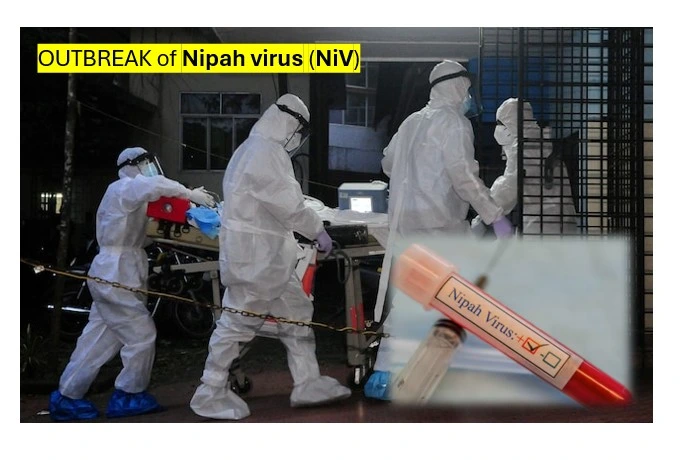

The sound of silence in the corridors of health care facilities across West Bengal is a familiar but horrifying shadow. Hundreds of doctors and support staff work 24/7 to stop the spread of an outbreak of Nipah virus (NiV) — which kills up to 75% in infected patients—as of late January 2026.
What started with a handful of “undiagnosed fevers” has exploded into an increasingly high-stakes medical operation. Two nurses in the Barasat area, near the border with Bangladesh, are still on ventilator support and said to be critical. Their fight has sparked a huge contact-tracing drive that now covers over 150 people across three districts: North 24 Parganas, Purba Bardhaman and Nadia.
The Ghost in the System: How the Outbreak Started
The situation in West Bengal now highlights the most insidious characteristic of the Nipah virus — that it is adept at camouflaging itself as something else. In December 2025, an old woman was hospitalized in Barasat with ARDS. She died within days, but because her symptoms resembled those of a deadly flu or pneumonia, no Nipah test was done.
Only when health workers who had treated her started showing seizures and disorientation did the alarm sound. This is the kind of “silent” entry in the healthcare system that epidemiologists dread. Whereas Covid-19 is an explosive spreader with a lower mortality rate, Nipah has been something of a slow-burning fire that frequently kills most of those it infects, including some of the doctors and nurses trying to save them.
Investigating the Transmission Routes
The zoonotic source is also being investigated as the trigger, though its not a priority at this time because of human-to-human transmission. Two hypotheses have evolved as follows:
- Direct Exposure: One of the infected nurses had visited a social function in a village less than two miles from the Bangladesh border, where attendees told reservoir, an area that is known for fruit bat exposure.
- Tainted Food: The authorities are looking into the consumption of raw date palm sap. In the area, bats frequently lick sap or pee next to the collection jars’ mouth holes, depositing viral loads that a human can easily become infected by.
A Race Against Time: Follow contact tracing and isolation efforts
“Containment” is a Herculean task in an overcrowded state like West Bengal. The government has taken a three-tier defense approach to keep the virus at bay from India’s bustling metropolis of Kolkata.
The 150-Person Web
I’ll concentrate on “Close Contact List” mainly. These can also be the family members of nurses as well as ambulance drivers and other hospital staff. They have been put under a stringent home quarantine, with health workers calling in twice a day to check for the tiniest spike in temperature.
Strengthening the “A.E.S.” Surveillance
Since Acute Encephalitis Syndrome (AES) is the primary symptom of Nipah, even conditions in Tamil Nadu and Kerala have alarmed governments. They are ordering all primary healthcare centers to immediately inform them of any patient with “fever and confusion.” This national vigilance is the only guarantee of catching “spillover” cases before they grow into local clusters.
The BSL-4 Lockdown
Samples from presumed cases are no longer processed in local laboratories. They are flown to the National Institute of Virology (NIV) in Pune, which has some of Asia’s only Biosafety Level 4 (BSL-4) labs. Does the virus not run the risk of accidentally getting out during testing?
The Medical Frontline: Treating Without a Cure
The one factor about this crisis that is most ‘human’ is what it’s like inside the isolation wards. There is no approved vaccine or antiviral for Nipah at present. Treatment is purely “supportive.”
2026: Hope Trials and Ribavirin
Although there is no “silver bullet,” the medical community is not powerless.
- Monoclonal Antibodies: The patients in critical condition are being tested for experimental treatments, which were earlier tried in Kerala too.
- The Oxford Breakthrough: In late 2025, the University of Oxford began the first PII trial of a Nipah vaccine anywhere (ChAdOx1 NipahB) – in Bangladesh. While it is not yet available for the general public, data from these trials are helping doctors understand how to better activate an immune response.
Living with the “Flying Fox”
One challenge of the Nipah virus is that its natural host – fruit bat (Pteropus species) -is an integral part of the ecosystem. We can’t just “get rid of” the source or we’ll destroy the ecology. Instead, health experts are promoting “Risk-Based Behavior.”
he Global Perspective: A Critical Pathogen
Nipah has been identified as a priority disease by the World Health Organization (WHO) Research and Development Blueprint. Its pandemic potential is high, because even though at the moment it requires close contact to spread from person to person, a small mutation that made it more airborne could thrust it onto everyone’s doorstep.
The response in West Bengal this week is closely being monitored by organizations like the World Health Organization and regional public health bodies as a test case in One Health — the concept that human health can never be disentangled from the health of animals, plants and the environment around us. In deploying wildlife experts with the epidemiologists, the team is attempting to map what they call the “spillover” event so they can stop such an outbreak from happening again.
Six Physical Signs of Reduced Blood Flow That Should Not Be Ignored
Conclusion: A Test of Resilience
As the sun descends over the North 24 Parganas, the atmosphere is fraught yet professional. The lessons from the 2018 and 2023 outbreaks in Kerala are being implemented here: transparency, rapid isolation and high-quality intensive care.
The next 14 days — the virus’s maximum incubation period — would be the “make or break” period. If no new cases arise from the 150 quarantined contacts, authorities can claim that the containment has been successful. For now, it’s all about the two brave women who are currently battling for their lives, offering a shocking wake-up call to the fact that those on the medical frontline of care are taking an enormous risk and suffering mightily daily.

A versatile writer mainly works on trending news, daily updates from politics, business, crime, current affairs and entertainment.