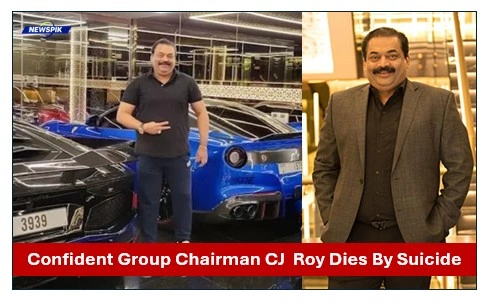

Dr.C.J. Roy sudden death news left Indian business community in disbelief on January 30th, 2026. The Chairman of the Confident Group and its founder was found dead of a self-inflected gunshot at his office in Bengaluru near Richmond Circle. The shootout happened with I-T officials at the spot, in what had become a fast and furious end to a life that was synonymous with the “Bengaluru Dream”.
and dreaming of a man he never worked for was not Roy the builder; it was him, the visionary who created a multi-billion-rupee empire by developing forgotten lands on the city’s outskirts. What he went on to accomplish — pioneering a seamless model for commercial-real-estate operations in one of the most competitive real estate markets in the world, and doing so without taking on debt — is a reminder that entrepreneurship has its costs.
The Sarjapur Gamble: The Bet on the Periphery
In 2001 the epicenter of Bangalore’s real estate was focussed on central parts. Developers were vying for few available and high-cost plots in M.G. Road or Koramangala. C.J. Roy instead set the eyes far on the silent, dust-filled lands of Sarjapur. Back then, an acre was selling for a paltry ₹6 lakh—a value that mirrored lack of belief among the public that the area would get connected to anything and anyone.
- Roy saw what others did not: a strategic halfway point between the developing tech hubs of Whitefield and Electronic City. Despite strong opposition from both his company directors and members of his family, he spent heavily buying close to 200acre.
- Timing the Boom: As Sarjapur Road turned into a leading IT corridor, land values didn’t simply grow; they ballooned.
- The Results: A few hundred investments of ₹6 lakh per acre grew to properties worth between ₹8,000 and ₹10, 000 per sq.foot—the foundation of the Confident Group’s wealth.
- Expansion: After tasting success, he adopted the same format in Devanahalli (near airport) and other major cities of Kerala.
A Unique Business Model: The Zero-Debt Concept
C.J. Roy was an exception to the rule in an industry known for being highly leveraged and riddled with stalled projects. He had popularized a “zero-debt” model of doing business and claimed that his sprawling conglomerate, which encompassed real estate, hotels, education and aviation in addition to newspapers and TV channels, did not owe anything at all to any bank.
These were basic tactics, but they were applied with discipline:
- Clear Titles: He made sure every project was legally “bulletproof,” prioritizing transparency to build a sense of “buyer confidence”—the literal inspiration for his brand name.
- International Expansion: He grew the brand in UAE and USA, going international but not growing fat.
- Diversification: In addition to buildings, he dabbled in international trade and insurance and even owned a fleet of private jets and a helicopter.
The Showman: Media, Movies, And Supercars
Roy was smarter about branding than most of his fellow students. Rather than relying primarily on traditional advertising, he leveraged entertainment to promote his brand. Having sponsored well-known reality series including Idea Star Singer and Bigg Boss Malayalam, he has become a household name in South India.
He was legendary for his generosity, frequently showing up on camera to give luxurious apartments and cash prizes away to winners. Even his foray into film production was grand, with big-budget movies such as the Mohanlal-starrer Casanovva (2012) and the historical epic Marakkar: Lion of the Arabian Sea (2021).
One of the most tangible indicators of his success was his “dream garage.” Roy started with a modest Maruti 800 in 1994 and created a personal fleet that boasted of as many as 12 Rolls-Royces, a Bugatti Veyron and a Koenigsegg Agera. It was a poetic full-circle moment when he recently spent lakhs to trace and buy back his first Maruti car — and offered a reward of ₹10 lakh if someone could help him find it.
Pune Techie Kills Himself in the Office Bathroom While Using a Cell Phone Charger
The Last Act: Pressure and Controversy
C.J. Roy’s last days were the subject of great scrutiny. A team of Income Tax officials from Kerala began searching his premises in December ’25. He had been summoned back from Dubai the day he died to help investigators.
From family accounts and police reports:
- The Incident: Officials were at his office building the afternoon of January 30 when Roy excuse himself and went into a room to collect documents, reports say.
- The Shot: A single blast from his licensed firearm sounded a short time later. The victim was taken to Narayana Hospital but he died while being brought.
- Family Allegations: Roy’s brother has accused the central agency for the “unbearable pressure” and harassment that led him to commit suicide, saying his deceased kin had “zero debt” and no mandatory reason for taking such a step.
The tragedy has set off a heated discussion on the issue of entrepreneur mental health and the practices used by investigative agencies. Although the I-T department has not submitted its detailed report, police have filed the case as a suicide and are investigating what lead to the tragic incident.

I am a versatile content writer from the MP region, covering politics, business, crime, current affairs, entertainment, video games, and sports with clear insights, engaging analysis, and timely, reader-focused updates.