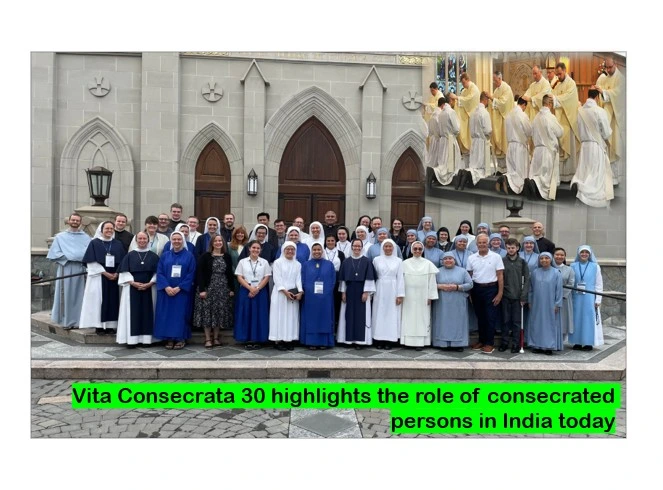

On the 30th anniversary of Pope John Paul II’s Post-Synodal Apostolic Exhortation Vita Consecrata (1996), the Indian religious life has come to an interesting juncture which would have least been anticipated by post-conciliar renewal theorists. A document written to herald in the new millennium has become, in 2026, a prophetic mirror and survival guide for thousands of consecrated men and women.
In an Indian environment, which is in reality, a seamless blur between sacred and secular, the ideas of Communion and Mission are not simply theological abstractions: they represent the very air that sustains a religious presence for over 1.4 billion people amidst an assortment of languages and cultures (and challenges!)!
A Prophetic Legacy in Changing Times
Thirty years back, Vita Consecrata changed the image of religious life from “doing” to “being.” It nudged the needle away from a purely instrumental understanding of religious orders (merely useful in providing education or health care) toward what he called a “Trinitarian” understanding.
Today, in India, it is crucial that the shift takes place. For generations, the “sweat and sacrifice” of religious brothers and sisters had constructed the bones of the nation’s swamps, scrub forests, remote tribal belts or urban slums. But as we steer our way through the 2026 cycle, there is immense pressure on those traditional structures. As local forms of harassment are increasing, the misuse of anti-conversion laws and social service activity has become easy, bureaucracy is the deciding factor of any social work, we find it increasingly difficult to simply “act” as a religious person without being looked upon suspiciously.
“The story of religious life in India is truly a glorious one — but it’s not complete. The next chapter is ours to write in the choices that we make in small ways, in faithful living day after day and facing prophets with courage!”
This “prophetic” element is about being a counter-cultural witness. In a materialistic culture, Propert speaks about the sharing of God’s goods; in an individualized ethos, Obedience speaks about listening to the Spirit together; and in a sexualized society, Chastity is seen as having a heart that is wide enough for all to love but not own.
The Interior Architecture: Commotion as Spectator
Communion is the “house and school of communion,” as Vita Consecrata expresses it. In the Indian Church, where religious communities are frequently composed of members from half a dozen different states, languages and castes living together is itself the first work of mission.
The Challenge of Diversity
India is the miniature of the universal Church. Sisters from Kerala, Jharkhand or Meghalaya may live in a community in Bengaluru. When such beings live in harmony, they are a “living laboratory” of unity in diversity. However, this communion is fragile. We need to be truthful about the “fractures” that are still there:
- Regionalism and Caste: Undercurrents that influence community appointments and decision-making.
- Generational Gaps: The tension between traditional “institutional” styles and the Gen Z’s folks’ “liquid” spirituality.
- Clericalization: The call for a horizontal and synodal relationship between the clergy, religious, and laity.
For a real communion in 2026, we need what Pope Francis calls “domestic dialogue,” a synodality that no longer remains in meeting rooms but enters into the heart of the community. Without our connection rooted in deeper communion, we are left with ”activism” instead of mission; without that, we have lost direction and only inward-staring at “sterile” community.
In the Indian context today, formation needs:
- Intellectual: Confronting the increasingly sophisticated social and political challenges of a divided world.
- Emotional: Developing the resilience and maturity to be persecuted and handle personal crises.
- Spiritual: Transitioning from “a ritualism that doesn’t have anything anymore to do with Gospel,” to a “mysticism of open eyes.”
Hope as the Engine of the Future
Ahead in 2026 and beyondWhile a shortage of vocations may not have reached India with the same intensity it has in some other parts of the world, in future, “the crisis of vocations is overintroduced”; instead, quality will become a new priority. The “great history that remains to be written” will also depend on the capacity of the consecrated to maintain themselves as “experts in communion.”
Pilgrims of Hope is what we are to be. In a society where religious liberty is constantly under challenge, the joy of consecrated life is a political statement. It declares that there is a force more powerful than the State, and love stronger than hatred, and it speaks to a future more certain than tonight’s headlines.
Read also
- Sabarimala Chief Priest Taken Into Custody in Temple Gold Theft Case
- Ramayan mela at CR park Delhi, Dates and other Details Explained
- The Religious Figure Behind Luxury Cars at Magh Mela
Conclusion: A Call to Authenticity
Vita Consecrata at 30 is not about looking to the past in “nostalgia,” but to look forward with an “evangelical intensity.” For the consecrated in India, the mission remains simple: to live as a “city on a hill” – not visible for our buildings, but for being luminous with joy and committed to serving others.
And as we progress, the question is not “How many of us are there?” but “Whose are we?” By belonging utterly to God, we belong more completely not less to the people of India.

A versatile writer mainly works on trending news, daily updates from politics, business, crime, current affairs and entertainment.