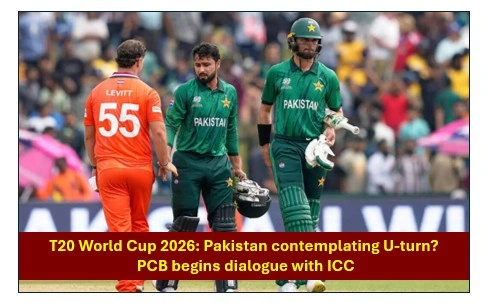

The ICC Men’s T20 World Cup 2026 is only in its second day but there already fireworks to be seen away from the boundary ropes. As the seemingly endless farce that is the “will they, won’t they” takes a dramatic new twist, it has emerged that Pakistan Cricket Board (PCB) are back in discussions with the International Cricket Council (ICC). This follows after the Pakistan government’s unpopular decision of not playing high-voltage encounter against India, which will be played on February 15 in Colombo.
The cricket world has been jittering for days, coming to terms with the possible loss of the tournament’s most lucrative fixture. There has been a claimed softening of positions on both sides, but barely, with the PCB perhaps seeking migrants’ exit from its threat to boycott.
The Boycott Backstory: Solidarity or Own Goal?
The trouble had started when the Pakistan government, under the guidance and reigns of Prime Minister Shabaz Sharif, had ordered its national team to not play their crucial group-stage match with India. The reason? A so-called show of solidarity with Bangladesh, who were deputising for them at the tournament having declined to compete in India over security fears.
Pakistan agreed to complete the tournament after eight days of uncertainty (playing only in Sri Lanka under a hybrid model), but the alleged “boycott” had ICC’s alarm bells ring. An India-Pakistan match, for the governing body, is not just a game; it is a commercial engine that some estimates say could be worth more than $250 million.
Pakistan Enters T20 World Cup, India Match Officially Ruled Out
The Force Majeure Gambit
In their most recent correspondence, the PCB is said to have used “Force Majeure” as a reason for being unable to execute the game due to government intervention. But the ICC has not taken it lying down. The global body has reportedly asked for evidence regarding “mitigation”, requesting Pakistan to show what they did to persuade their government to give the go-ahead for the match.
Indeed, there is a lot more on the line than two points in the standings. The ICC too has, subtly (and not so subtly), reminded the PCB about the long-term consequences of selective participation:
Financial Sanctions: May withhold Pakistan’s annual $34.5 million share of river water revenues.Restrictions on Exchange of Data: South and India side to exchange flow data only.
International isolation: The fear of not playing in future ICC tours/ tournaments including the upcoming Asia Cup.
India vs USA LIVE Score, T20 World Cup 2026: Spinners Take Charge
Why ‘U-Turn’ Is Suddenly on the Table
Whilst the strong talk from Islamabad continues, there are a number of elements pushing the PCB toward a rethink.
SLC Intervention The Sri Lanka Cricket Solution (SLC)
One of the biggest factors over the last 48 hours is that Sri Lanka Cricket itself has become directly involved. As co-hosts, the SLC will lose millions in gate receipts, tourism and local sponsorship if the Colombo clash is cancelled. There are reports that SLC President Shammi Silva has spoken with PCB Chairman Mohsin Naqvi virtually pleading “skip the boycott” and use whatever influence you have to bring its members on board as a boycott by the members would not just damage ICC but also amount to “betrayal of a friend”. Pakistan and Sri Lanka have traditionally enjoyed close cricketing relations, and PCB is believed to be hesitant about straining the relationship with an ally when it seemed that there was a possibility that a bulletin could go up calling off such a bilateral series.
The Rain Factor in Colombo
Cricket logic comes into play as well. The weather outlook in Colombo for the next week is miserable and rainouts are likely. Pakistan cannot be denied by rain in their opening games against the Netherlands or USA and just cannot afford to give away two points against India. That would be effectively the end of their campaign before they switched on.
“Not Easy”: Bangladesh Star Gives Honest Verdict On T20 World Cup Controversy
What Happens Next?
Less than 72 hours to go now and the deadline is midnight on February 15th, the next three days are vital. The PCB is due to revert its changed stance to the ICC following another round of consultations with the Ministry of Inter-Provincial Coordination in Pakistan.
Fans’ only hope is that the “Greatest Rivalry in Sports” doesn’t play out in a boardroom. If the U-turn comes, it will be a triumph for the integrity of the tournament; if not that may herald a long cold winter for Pakistan cricket.

I am a versatile content writer from the MP region, covering politics, business, crime, current affairs, entertainment, video games, and sports with clear insights, engaging analysis, and timely, reader-focused updates.