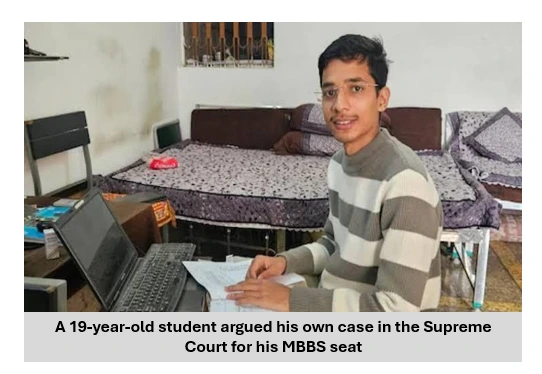

A 19-year-old aspiring medical student presented a very unique case to the Supreme Court of India by arguing on his own behalf to gain entry into an MBBS program. The young man made his argument before a bench of judges without the assistance of a senior counsel, creating a spectacle with the manner in which he presented his argument and the clarity with which he presented his position was extraordinarily impressive.
Legal experts familiar with the court have noted that the situation is not typical since, in most instances, petitioners for educational admission (particularly high-stakes educational applications) are represented by experienced counsel.
Admissions to MBBS programs in India are governed by extremely competitive centralized processes and very short deadlines. As a result, a minor error in documentation, such as incorrect category classification, can prevent individuals from being admitted, resulting in a need for them to seek urgent relief from the court.
The young man in this case argued that the loss of admission would result in irreparable academic loss to him, as he would not be able to regain admission for another year and would have to start all over again in the admissions process.
Bench Listens Patiently
At the hearing, the judges gave a student the opportunity to present his position even though they could not make a final decision at that time. The judges were noted to have interacted patiently with the student, asking him questions to clear up factual and procedural doubts.
At the conclusion of the hearing, the court did not order anything but sought input from other institutions to verify the student’s claims. If the court is satisfied there is prima facie merit, it may issue an interim direction.
The judges stated that admissions must be conducted fairly but must also comply with the rules in place.
Legal and Academic Implications
Petitions related to education comprise a large portion of the urgent matters before the Supreme Court during the counselling period. Courts consider two competing interests when evaluating such cases:
- Administering fair admission procedures will protect meritorious students from administrative error
- The admissions process will follow established timelines
Legal practitioners indicate that to be successful in self-representing at this level requires substantial confidence and preparation as there is a considerable degree of procedural complexity in appearing before a constitutional court.
A Story of Determination
Many observers view this case as an example of what determination an 18-year-old student has used to seek out future education by going to trial in front of the Indian Supreme Court.
The experience of going through an extremely complex and costly process by going to trial at the Supreme Court of India has shed light on several issues regarding access to justice;
These matters will take time to be resolved, but they will all ultimately depend on the outcome of this young student’s case in regards to securing a medical seat or permanent career path.

A versatile writer mainly works on trending news, daily updates from politics, business, crime, current affairs and entertainment.