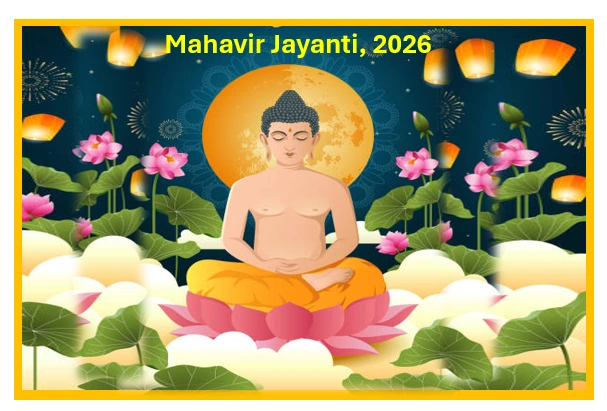

When the rays of the sun finally reach the old tower of the Jain temples in India this April, there will be a great silence on the millions of followers. It is Ahimsa (non-violence) and Aparigraha (non-attachment) silence. Every year the birth anniversary of Mahavir, the 24th Tirthankara, Vardhaman Mahavir, is observed on 31 march, 2026, a spiritual celebration that rings much farther than the Jain community can itself.
The ancient lessons of Lord Mahavir are being rejuvenated in the modern world that is characterized by worldwide strife and ecological fear. It is not a religious festival only but a Civic Reset as the values of Live and Let Live are being reenacted in the 21 st century with regard to the issues of the 21 st century.
The Prince Who Chose the Forest: the Legacy of Vardhaman
In the 6 th century BCE, Lord Mahavir was born in Kundalagrama (present-day Bihar) as the son of King Siddhartha and Queen Trishala. His heart had been troubled though he was born to the lap of luxury. At last, at 30 years of age, he threw aside his crown and family and even his clothing to search the ultimate truth in subjecting himself to extreme penance.
He reached Kevala Jnanais (omniscience), after 12 years of quietness and deep meditation. He did not then lead a reclusive life; he spent the next 30 years barefoot in the Indian subcontinent preaching a radical philosophy: that all living souls, to the small insect and the high tree, are equal and capable of liberation.
The Age of Climate Change and Ahimsa
The most prominent humanized aspect of Mahavir Jayanti 2026 is that it is in line with the international sustainability movement. The Jain philosophy of Ahimsa Paramo Dharma (Non-violence is the highest religion) has changed. The community is working on the environmental Ahimsa in 2026.
In such cities as Mumbai, Ahmedabad and Indore, the ancient Rath Yatra (chariot procession) is being substituted by Green Processions. Devotees are committing to get rid of single-use plastics, and to become vegans, and understand that that violence towards the Earth is violence towards the soul.
Mahavir did not simply instruct us to not strike someone; this is what Mahendra Jain, a volunteer at a community kitchen in Delhi tells us. He made us understand that we are violent in our consumption. When I steal beyond my need, then I am robbing the future. Our Jayanti is of Less is More.
Read also: Samakka-Saralamma Jatara: A tribal spiritual reset
Compassion prayers The Rituals of Compassion: How the Day Unfolds
The day starts with the Prabhat Pheri (early morning processions) and the Abhishek the ritual bathing of the idol of Lord Mahavir. Nevertheless, the real beating of the festival is Dana (charity).
- Jivdaya: This is the act of having mercy on all living things. On this day, Jain faiths all over India release animals trapped in slaughterhouses and finance hundreds of Panjrapoles (animal shelters).
- Community Feasts: Massive vegetarian food is held where the rich and the poor sit on equal terms to eat. The food is highly Sattvic, cooked prior to sunset, and free of root vegetables, and respects the life of every organism.
- The Five Vows: To most young Jains, Mahavir Jayanti 2026 is a day when they may renew the five-fold path:
- Ahimsa (Non-violence)
- Satya (Truthfulness)
- Asteya (Non-stealing)
- Brahmacharya (Chastity)
- Aparigraha (Non-attachment)
Anekantavada: The Philosophy of Dialogue
The philosophy of Anekantavada (the theory of manifoldness) introduced by Mahavir is more topical than ever in a world polarized by the influence of social media conflicts and the so-called echo chambers. Lord Mahavir preached that truth is multi-dimensional and that no one way of seeing things amongst humans is absolute.
A number of inter-faith dialogues are being held in Jaipur and Bengaluru universities in this Jayanti. It is aimed at utilizing Anekantavada as a conflict resolution instrument people should listen to the other party, not with aggression. It is a religious remedy of the contemporary cancel culture.
Read also: The Spiritual Importance of Kamada Ekadashi on 29th March 2026
The Message for 2026
With the evening lamps (Deepaks) burning and the Navkar Mantra being chanted in the air, it becomes evident that the message Mahavir Jayanti 2026 is sending: Peace is not the lack of war; it is the availability of compassion in all thoughts, words, and actions.
The birth of Vardhaman Mahavir was not the birth of just a prince, but it was the birth of a conscience. When the community gathers to take the last meal of the day the prayer is not to increase personal wealth, but it is “Parasparopagraho Jivanam” which means that all life is connected through mutual support and interdependence.

A versatile writer mainly works on trending news, daily updates from politics, business, crime, current affairs and entertainment.