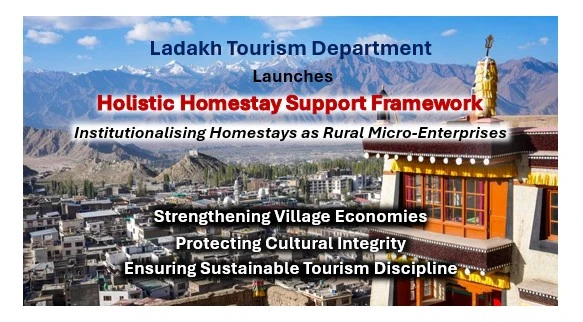

A new chapter in sustainable travel has started in the rugged and high altitude desert in Ladakh where the air is thin and the culture is an old one. The Ladakh Tourism Department publicly introduced the Holistic Homestay Support Framework on March 5, 2026, which is a visionary program aimed at turning the traditional hospitality of the region into a professional, world-class model of a micro-enterprise.
The framework, which was unveiled by the Administrative Secretary of Tourism, Sanjit Rodrigues, at the State Institute of Hotel Management (SIHM) in Leh, is much more than a set of guidelines. It is a commitment to the local community that the gains of tourism will be anchored on the soil of the mountain villages as the tourism increases.
The Framework From Expansion to Excellence: The Heart of the Framework over the years, Ladakh has recorded increased number of visitors in search of the offbeat experience. Nevertheless, the Department of Tourism realized that high growth should be combined with quality and sustainability. The new structure is an important strategic change where the number of additional beds is no longer a goal but rather the desire to see each stay impressively embody the full spirit of Ladakhi heritage.
According to Secretary Rodrigues, this is why homestays should not be seen just as a place to stay, but as a planned rural business at launch. They are the foundations of the village economy and they are the ones who develop sustainable livelihoods and at the same time they are the ones who preserve our delicate ecological and cultural identity.
This comprehensive style transcends the provision of a roof and a meal. It incorporates the local economy whereby the homestays would be encouraged to purchase the supplies of the village farmers and craftsmen so that the rupee of the traveler would be spent in the immediate community.
The 21-Day Change: Upskilling the Keepers of Culture
The main component of this system is a strict 21 days training program designed exclusively to the homestay operators. The training has been developed in partnership with the SIHM Ladakh and the Firgun Social Initiative Foundation and is meant to close the interlude between the simplicity of the rural setting and the standards of modern hospitality.
The Pillars of the Training Program are:
- Operational Excellence: Learning how to keep a house, hygienically clean, and guests without losing the coziness of a usual house.
- Eco-Stewardship: Host training to train guests on water conservation and waste management- very important in the high altitude ecosystem.
- Digital Integration: Assistance to rural families in finding their way through the online booking portal and social media to address the global audience directly.
- Cultural Preservation: Promotion to use traditional Ladakh architecture and local foods (such as Thukpa and Skyu) as the major attraction.
This intensive development has already been identified by the government under the central scheme of Pradhan Mantri Janjahyati Unnat Gram (PM-JUNGA) with 111 homestays already identified in 19 villages to be the first cluster of such intensive development.
Read also:
- India Travel Mart 2026 – Bhopal – India’s Travel & Tourism Mart
- Japan Visa Makes Multi-Country Travel Easier for Indian Tourists
Constructing a Unified System of the Last Mile
Government registration and quality assurance has been one of the biggest challenges to rural entrepreneurs. The Holistic Homestay Support Framework proposes a system of unified but departmental driven processes.
Incentives and Infrastructure
The government is providing non-fiscal and fiscal incentives to facilitate the process:
- Winter-Friendly Upgrades: Financial aid on installation of insulated, winter friendly flush toilets- a requirement to encourage Ladakh as an all year round destination.
- Maintenance Grants: Grants on the repair of old furniture, fittings and cutlery to create an appearance of authenticity.
- Ongoing Mentoring: This is a more comprehensive framework compared to workshops that are run occasionally as it incorporates a “development cycle” and the ongoing monitoring and mentoring support to make sure that standards are not compromised after the initial training.
A great number of stakeholders took part in the event including All Ladakh Tour Operators Association (ALTOA) and even representatives of the Ladakh scouts indicating that there was a general agreement among the inhabitants of the region that the future of the Ladakh economy was to be held by the local inhabitants of the region.

A versatile writer mainly works on trending news, daily updates from politics, business, crime, current affairs and entertainment.









