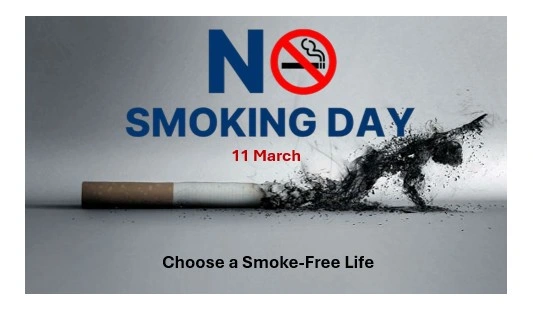

Millions of individuals in India and the rest of the world will stop to celebrate No Smoking Day on Wednesday March 11, 2026. This day is not just another day on the calendar of health events since it is a critical intervention to the almost 100.2 million smokers in India who are seeking an escape route to a cycle that takes the lives of more than a million a year in the country.
The event 2026 theme is A smoke-free life starts with a smoke-free day, is centered on the immediacy of the present moment. It is out of the overwhelming “forever” and challenges the smokers to dedicate the 24 hours of clean air. It is a day meant to think of, to sympathize with, and the silent truth that every long time win starts with one, rough morning.
The Silent Pandemic: The Mumbai Tobacco Landscape in 2026
Although India has achieved a lot in terms of tobacco control which has surpassed the WHO target with a projected 43 per cent reduction in prevalence since 2010; the task is still enormous.
- The Numbers: About 9.3 percent of adult Indians smoke.
- The Gender Gap: The gap is still very high, as about 16.7 percent of men are smoking and 1.4 percent of women.
- The Economic Burden: Pipe use incurs the Indian economy an estimated down of ₹1.77 lakh crore each year in terms of both health costs and lost productivity.
In addition to the classic cigarette and bidi, there is the increased cases of stealth nicotine addiction in 2026. Although e-cigarettes are banned because of the 2019 prohibition, there is an increasing trend in urban youth to engage in the habit of vaping, which is usually promoted by the pretence of being made up of a less harmful form. These devices usually represent the high-dose nicotine delivery system, and according to the public health experts, these systems have acquired the habit of hijacking the growing brain, and the No Smoking Day is more than ever pertinent to the young generation.
Also read: Six Physical Signs of Reduced Blood Flow That Should Not Be Ignored
The Human Journey: Why Leaving is a Battle of the Brain
It is necessary to comprehend No Smoking Day in order to comprehend the so-called con artist nicotine. After a few seconds after having inhaled, it takes the nicotine to activate the brain to release dopamine, which is the chemical of pleasure and reward. A decreasing of those levels an hour later results in the brain causing a physical desire, which forms a vicious cycle, extremely difficult to get out of.
The initial 72 hours are quite difficult. It is during this time that nicotine withdrawal highest, as is manifested in irritability, lack of concentration and high cravings. The No Smoking Day is well timed to give a collective starting day and leave people with an impression that it is not a lone battle on the dark side, but a bigger movement is going on.
Read more: How to Improve Your Digestive Health: Complete Guide
Government and Community: The “Yellow Line” and Beyond
The battle against tobacco in India in 2026 has many aspects. The Yellow Line Campaign, which establishes a literal visible position 100 yards around schools where tobacco sales are hard and fast tabooed, has been strengthened this year with an even tougher local policing of it.
Also, the Ministry of Health has increased the dimensions of the National Tobacco Cessation Helpline (1800-11-2356), where counseling is provided in various regional languages. To the needy, Nicotine Replacement Therapy (NRT) is now as obtainable as possible and even listed on the essential drugs list of the country so that financial status will not be a factor in smoking quit.

A versatile writer mainly works on trending news, daily updates from politics, business, crime, current affairs and entertainment.