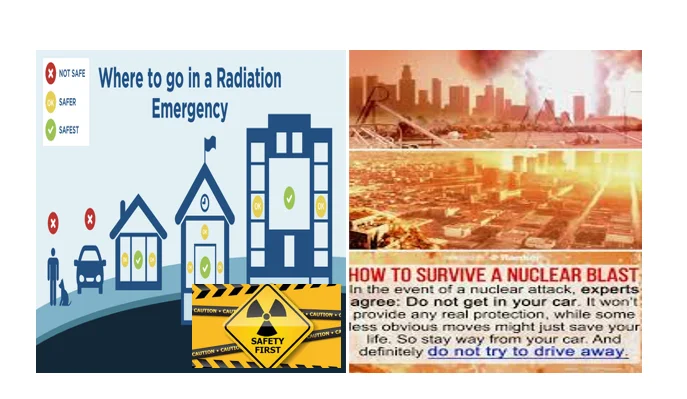

The amount of distance that would be safe from an explosion [of nuclear bombs] will vary according to multiple factors: (i) yield (size) of the bomb, (ii) whether it detonates aboveground (airburst) or belowground (groundburst), (iii) weather conditions, and (iv) surrounding terrain. The atomic bombings of both Hiroshima and Nagasaki provide historical examples of how massive destruction has occurred as a result of even smaller nuclear bombs.
Modern-day nuclear bombs are, as a general rule, many times more powerful than either of the bombs dropped on Hiroshima and Nagasaki; thus, danger zones are predicted to extend much further than those created by the two bombs referenced above.
Immediate Blast Zone (0-5 km)
Approximately 0-5 km from a typical nuclear detonation, the following is expected to occur:
- Massive destruction resulting from the blast wave
- Collapse of all types of structures
- Creation of firestorms and extreme heat
- Exceedingly low chance of survival without specialized shelter
This area is commonly referred to as the “fireball” and “severe damage” zones. Even heavily reinforced structures will likely be unable to survive the tremendous pressure exerted on them.
Severe Damage Zone (5-10 km)
At a 5-10 km distance from a typical nuclear detonation, the following is expected to occur:
- Serious injuries due to flying debris
- Possibility that one’s skin will be burned (third degree)
- Significant damage to many structures, but not complete destruction of them
- Survival becomes likely, especially if one is inside a sturdy building, or below ground level (i.e. in an underground structure), therefore, an immediate shelter location is imperative.
Moderate Damage Zone (10-20 km)
- Structural damage (broken windows)
- The possible effects of burns depend upon the visibility of the blast
- Debris will cause injury
- There is a chance that everyone will be able to survive, especially if they “duck and cover” quickly, and do not suffer any exposure to thermal flash.
The fallout risk extends far beyond:
- The greatest long-term threat from any type of nuclear explosion is radiation from radioactive fallout.
- Depending on wind speed and direction, fallout can travel many hundreds or even thousands of kilometers away from the site of the explosion. Fallout will contaminate the air, water and food of the regions in which it falls.
- Exposure can last anywhere from a few days to many weeks.
- If you are faraway, you are not necessarily safe unless you have protection.
- Distance is not the sole factor in determining your safety, and distance alone is not a good estimate of how far away might be “safe”.
- No single distance can be called “safe”, and the area you are in can be either more or less dangerous based upon the size of the bomb detonated.
- As the size of the bomb increases, all radius estimates of the area of destruction will also increase.
- Moreover, when wind is blowing towards an area, that area can be much more dangerous than areas that are closer to the explosion.
- Lastly, the landscape can either shield you from the explosion (mountains or buildings) or increase your danger from the explosion (urban areas, open flat terrain).
In general, to maximise your odds of survival if you are at least:
- 20-30 km away from the explosion: you will avoid the deadly effects of the blast, but still be in danger of receiving the devastating long-term effects of fallout.
- 50+ km away from the explosion: your immediate chance of survival is still possibly low, but you may still be at risk for long-term illness due to falling debris.
Read also: Controlled Explosions Aid Recovery in Sierra Nevada Avalanche
Remain sheltered for at least 24–48 hours after fallout
Preparedness guidance from organizations such as the World Health Organization (WHO), and the Federal Emergency Management Agency (FEMA) indicates that being within a suitable building significantly increases your likelihood of survival, even if you are relatively close to the explosion.
Conclusion
- 5 km Distance: Very improbable survival
- 5 – 20 km Distance: Potential for survival with access to a safe shelter
- 20-50 km Distance: Less likely to be safe from the blast; however, fallout is still an issue.
- More than 50 km: Fairly safe; however, your safety will depend upon the direction and flow of the wind, etc. and your distance from exposure to radiation.
While the best course of action is more than just distance, it will also include immediate access to well-shielded shelter and access to good information.

A versatile writer mainly works on trending news, daily updates from politics, business, crime, current affairs and entertainment.









