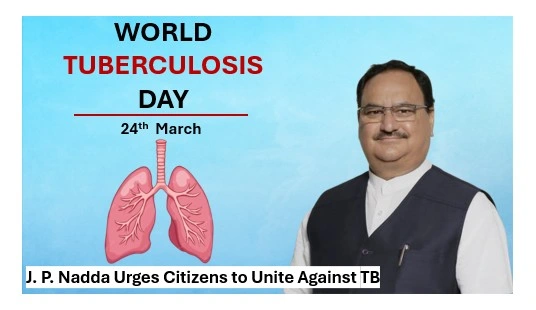

The air in the capital of India is heavy with the smell of a mission that needs to be fulfilled as the world celebrates the World Tuberculosis Day. In the speech celebrating the event, Union Health Minister JP Nadda addressed all citizens, not as a policy maker, but as a fellow citizen and called upon the nation to institute a national Jan Andolan (People Movement) to become TB-Free India.
These are ambitious targets: the target that the world is aiming to achieve in the elimination of Tuberculosis is 2030, but India is aiming at 2025. Nadda was saying it all with that message, as we had just still nine months to run on that clock, and the government can supply the medicine, but the community can only supply the cure.
A Mission Beyond Medicine: The force behind the Ni-kshay Mitra
Tuberculosis has been a bane to the Indian healthcare scene that has been unnecessarily shrouded in the stigma. In a speech to a meeting of health workers, survivors, and policymakers at Vigyan Bhawan, Nadda has pointed out that TB is a social rather than a medical problem.
Our most sophisticated diagnostic equipment, our most successful drug regimens, we have it all, Nadda said, and his voice was calm with certitude. However, the real battle line in this fight is not the hospital ward, but the home. A patient can miss a dose, but it is the neighbor who makes sure that he or she does not. It is the employer who does not dismiss an employee because of cough.
The Minister put on the agenda the success of the Pradhan Mantri TB Mukt Bharat Abhiyaan, namely the Ni-kshay Mitra program. This special program enables individuals, NGOs, and the corporate houses to adopt TB patients and accord them with the nutritional support. Over 1.5 million Ni-kshay Mitras have till now registered and offer human safety net to the fight against the disease.
To a patient, the gift of a monthly food basket by a stranger is not just about calories, it sends a message to the patient that they are not alone. It is this human touch that Nadda is hoping will be the ultimate kill to the bacteria.
Read more: Union Health Minister urges citizens to adopt better oral hygiene
Air-based innovations: Reduced regimens and AI Diagnostic
At the same time, although the movement is driven by human touch as its soul, technology is its backbone. Minister Nadda explained the enormous progress that the country has achieved in modernizing TB care.
The implementation of BPaLM regimen has become a game changer. The six-month course of DR-TB has been reduced to a more manageable period of six months instead of the arduous response that was a 18-24 months treatment of Drugs-Resistant TB (DR-TB). This extreme saving of time is essential since it would greatly decrease the dropout rate, the stage at which the patients feel improved and cease taking their pills, unknowingly producing even more aggressive and resilient strains of the bacteria.
Additionally, India currently implements AI-driven chest X-rays in rural health and wellness clinics. These handheld devices are able to identify possible cases of TB within a few seconds and the sputum may be immediately tested. The government is also reducing the time wasted on diagnosis by taking the lab to the village and in the process, has resulted in shorter time taken by the disease to spread in families.
The Stigma: The Final Taboo
Although this was without a doubt the most touching aspect of the speech of the Minister, his entreaty to put an end to the social isolation of TB patients was most touching. He told about survivors who had managed not only to endure the physical suffering of the disease, but also the mental agony caused by being ostracized by their communities.
A new program called TB Mukt Panchayat by Ministry of Health has been implemented to recognize those villages which have zero-TB. This is a local competition that is making the fight a local issue. Village heads (sarpanches) are being trained to detect the symptoms and make sure that all the people within their jurisdiction are screened.
Read also: No Smoking Day 2026 Choosing the “Smoke-Free Life”
Nutrition: The Silent Healer
Nadda also pointed out the significant connection between malnutrition, poverty and TB. The government has already released more than 3500 crore in the bank accounts of TB patients under the Ni-kshay Poshan Yojana to assist them to purchase nutritious food.
Nevertheless, the Minister called on the private sector to do better. He encouraged tech giants and manufacturing centers in India to consider TB screening as a part of their employee wellness routine, and as such, the urban population that is frequently crowded together will not be exposed to it.
I am a versatile content writer from the MP region, covering politics, business, crime, current affairs, entertainment, video games, and sports with clear insights, engaging analysis, and timely, reader-focused updates.