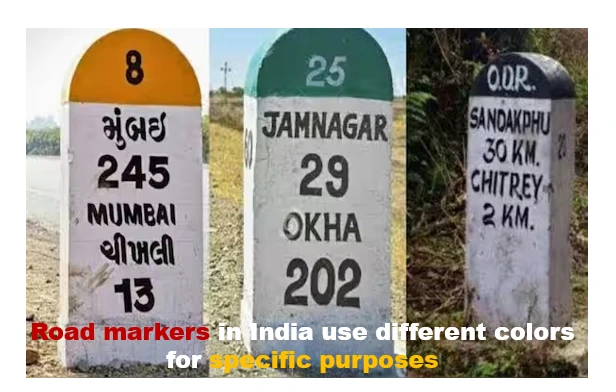

These colour codes aren’t made up; they tell you what kind of road you’re on and what’s coming up. Here is a full guide on how to read highway and road signs.
In this day and age of GPS and guidance, you’ve probably driven past hundreds of highway landmarks without giving them a second thought. People often don’t notice the colours or the fact that the numbers on the landmarks change as the places get closer.
But those colours aren’t just any old ones. Milestones in India’s road network are marked with a code that lets you know what kind of road you’re on, like a national highway, a state route, or a smaller district road.
India does have one of the world’s biggest road networks, with more than 63 lakh kilometres of roads. The colour marking helps arrange that size so that it can be read, from major routes to small country roads.
Yellow: Roads across the country
A National Highway is marked by a stone with white writing on a yellow base.
These are the main roads in the country that connect the country’s ports, industry areas, and big towns. The National Highways Authority of India and the national government take care of them. They are designed for fast, long-distance travel.
Green: Roads in the state
A State Highway is marked by a green top with white writing on it.
These roads connect towns and cities within the same state and often lead to National Highways. They are run by state governments and are the main way that people and goods move around in the area, especially for trade and regular travel between cities. They might not always be as big as national roads, but that’s where most trips start and end.
Orange: Village and country roads
Rural or town roads are marked with an orange top with white writing on it.
Accessibility plans like the Pradhan Mantri Gram Sadak Yojana often cover these parts. The goal of these plans is to connect rural areas to the main road network. They aren’t as wide or far-reaching as roads, but they are very important because they link towns to stores, schools, and health care.
Read also: Highway vs Expressway Explained: Know the Real Difference and Driving Rules
Streets in cities and towns are black, blue, or white
Milestones that are black, blue, or just plain white are often used to mark city streets, district routes, or neighbourhood streets.
Because these roads are taken care of by local or district officials, there isn’t a single, unified system here. You’re no longer on a big route, though; the idea is that you’re now on a more neighbourhood network.
The less well-known markers: What’s to come
- Some milestone colours do more than just show what kind of road it is; they also serve as subtle hints or signs of what’s to come.
- When there is a train crossing close, a red marking tells cars to slow down and be careful.
- A blue sign can show how close you are to an airport, which can help you find your way and get to other places.
- A brown sign is often used near ports or the coast, especially on paths that move a lot of goods.
There may be a dark marking that points to a bridge or other large building ahead as a warning sign for cars.
Even though these aren’t always the same across the country, they show up often enough to be recognisable, especially for people who move a lot.
Read also: Punjab govt issues final notification for four-laning
Why these colours are important
Milestone signs may seem out of date in this day and age of GPS and live guidance. But they are used for something else. They tell you what kind of trip you’re taking. The colours show you what the road is like, whether you’re going along a national path, cutting through a state route, or going into the country.
That setting can make a difference for truck drivers, long-distance tourists, and even people who just drive to work every day. Painting a block of colour on the side of the road can sometimes be the most effective method.

I am a versatile content writer from the MP region, covering politics, business, crime, current affairs, entertainment, video games, and sports with clear insights, engaging analysis, and timely, reader-focused updates.









