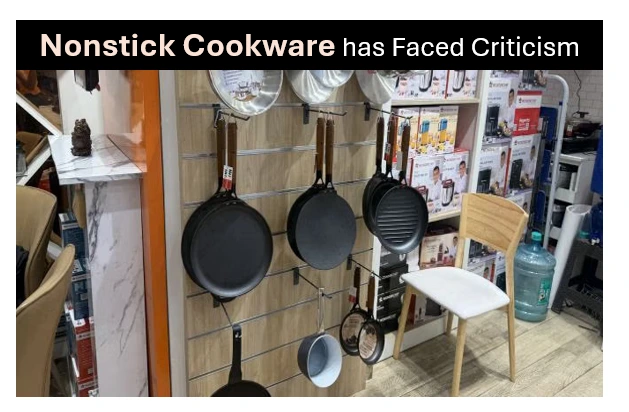

Because of a long-running campaign against non-stick pans, brands like Prestige, Hawkins, and WonderChef have introduced new ideas, such as adding clay, cast iron, and stainless steel pans to their lines.
The first rows of kitchenware at the Reliance Jio Mart in Noida’s Sector 18 are made up of black cast iron pans and kadhais and bright ceramic pans and kadhais. The non-stick pans, which used to be the most popular item, are now stacked at the back. It wasn’t always like this, though.
As the face of “healthy cooking,” non-stick pan made its way into Indian kitchens. Food didn’t stick to the surface, it took less oil to cook, and it was easy to make dosas and chillas. They quickly became a sign of wealth and were soon a must-have in every home. But that order in the kitchen is changing now.
Now that study has linked its use to cancer and other health problems, it is at the center of a health discussion. PFOA, or perfluorooctanoic acid, is a chemical used in Teflon non-stick coatings. Over the years, several studies have shown that it can be harmful to your health. This has made people more aware of non-stick pans. Of course, producers have found a way around this by moving beyond just tools.
Because it is better for the earth, the West has switched to clay. Non-stick coating goes into the environment when it wears off and gets washed away. It can take up to 100 years for this coating to break down. “Once they are scraped off, ceramic coatings take 25 to 30 years to break down,” said Ravi Saxena, CEO of WonderChef.
Early in the 2000s, the non-stick business got more attention in the West. This was especially true after the Environmental Protection Agency started looking into PFOA around 2004–2006. Regulatory measures like the EPA’s 2010–2015 PFOA Stewardship Program, which urges big producers to stop using the chemical, are also part of the argument.
Indian market for non-stick cookware
The Indian market for non-stick cookware is worth about Rs 1,500 crore, and local companies make up about 40% of the sales.
Some of the biggest names in the branded market are Prestige, Hawkins, and WonderChef. Talk about how safe nonstick cookware has, according to brands, slowed or stopped sales over the last two years. A big reason for this slowdown is the rising number of social media health experts who talk about a possible link between non-stick pans and cancer and other health problems.
Even though there has been a long-running campaign against non-stick cookware, brands have come up with new ways to cash in on the movement by making products out of pottery, cast iron, stainless steel, and appliances.
“This mess, which was made by YouTubers and content creators spreading false information, doesn’t affect our business because we also work with ceramic, cast iron, and steel,” Saxena said. Saxena and famous chef Sanjeev Kapoor co-founded WonderChef in 2009.
The company began by making pressure cookers and dishes that didn’t stick.
Read also: Why Modular Kitchen is Preferable to Make Your Kitchen a Unique One
Not a Enemy
An Indian nutritionist named Nida Fatima Hazari receives at least one question a week from her clients in Hyderabad about non-stick cookware. But her view isn’t set in stone like a lot of health stars on Instagram and YouTube. She doesn’t think non-stick is the bad guy that people often make it out to be.
She says that most non-stick cookware is safe as long as it is used properly, on low to medium heat, and with a pan that is in good shape.
Hazari says that cooking that doesn’t stick has real, useful benefits. It’s easier to clean, uses less oil, and makes cooking at home easier every day, all of which help people eat better.
New study shows that microplastics and nanoplastics are now common in the world and don’t just come from food. Over time, kitchen tools like non-stick pots may add to this contact in a quiet way.
Hazari says that the real danger with non-stick cookware is not normal use, but bad use, such as heating an empty pan too long, cooking on high heat too often, or using scratched and peeling kitchenware over and over.
These activities can damage the covering and release fumes that might make you feel like you have the flu for a short time. “Replace broken pans and use non-stick carefully,” is her easy advice.
Read also: Smart Home Remodels on a Budget
The CEO of Tramontina India, Aruni Mishra, agrees with Hazari
His opinion is that the talk about non-stick is important, but the peg is wrong. The Brazilian company Tramontina has been making home goods for 115 years. In 2024, they came to the Indian market.
Mishra stresses that good non-stick cookware is safe for everyday use as long as it is made well and used the right way. He says the real problems are caused by two things: “poor-quality products and improper usage.”

I am a versatile content writer from the MP region, covering politics, business, crime, current affairs, entertainment, video games, and sports with clear insights, engaging analysis, and timely, reader-focused updates.