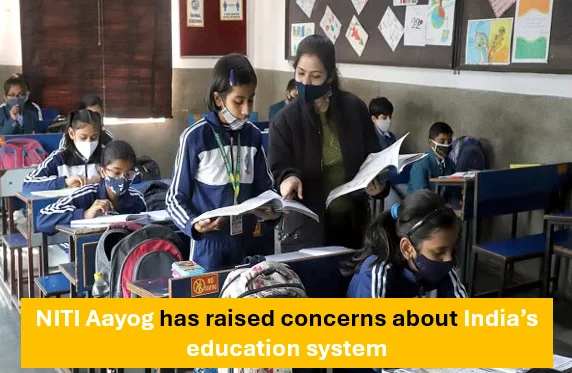

A new study from NITI Aayog shows that about 1.04 lakh schools only have one teacher, 35% have less than 50 students and only 58.4% of higher secondary schools have students.
India has nearly reached full enrollment in primary school, but its school system still faces many structural problems. There are over one lakh single teacher schools, a severe lack of teachers, high dropout rates after Class 10 and poor learning outcomes, even though more kids are going to private schools.
School Education System in India: Temporal Analysis and Policy Roadmap for Quality Enhancement
These results are from a new NITI Aayog study, “School Education System in India: Temporal Analysis and Policy Roadmap for Quality Enhancement,” released on Thursday. The study says that India has 14.71 lakh schools that serve 24.69 crore children. However, it warns that access alone has not led to better learning or school stability.
The Unified District Information System for Education (UDISE), the Annual Status of Education study (ASER) 2024, the National Achievement Survey (NAS) 2017 and 2021, and the PARAKH Rashtriya Sarvekshan 2024 were all used to make the study.
India’s school system is not well organized
One of the biggest worries is that India’s school system is not well organized. The number of secondary schools in the country drops sharply from 7.3 lakh (Classes 1–5) to just 1.42 lakh (Classes 9–10). The study says that only about 5% of schools in India offer learning from Grades 1 to 12.
Kids often have to switch schools after the fifth, eighth, or tenth grade because of this. These changes make it harder for students to stay in school and move up to better classes.
At the higher intermediate level, the Gross Enrollment Ratio (GER) is only 58.4 percent across the country. It is one of the worst places to live in, along with Bihar (38.1%), Meghalaya (39.7%), Nagaland (39.8%), and Assam (43.5%).
Another big problem is that there aren’t enough teachers. It is said in the study that India has about 1.01 crore teachers, but “significant shortfalls in teacher availability continue to affect the delivery of quality education, particularly in rural and underserved regions.”
Every year, more than 2.08 lakh elementary school spots are open in Bihar alone. There are also 36,035 secondary school spots open and 33,035 senior secondary school spots open. There are also big gaps in Jharkhand, Madhya Pradesh, and Karnataka.
In the study, it is said that more than 7% of all schools, or 1.04 lakh schools, only have one teacher. These teachers are expected to be in charge of more than one school level, as well as office tasks and lunchtime food. About 14% of expected teaching days are lost to activities unrelated to school, such as polls and surveys.
The rising number of very small schools has also been brought to NITI Aayog’s attention. In India, more than one third of schools have fewer than 50 kids, and many of them run with very little staff and equipment.
The study also says that teachers are not well prepared. NITI Aayog’s SATH-E program found that “many teachers score below 60–70 percent in subject papers of the grades they teach,” which means they don’t know enough about basic subjects like English, Hindi, Mathematics, and Science.
Only about 10 to 15 percent of people who take the Central Teacher Eligibility Test (CTET) and State TETs get scores higher than 60 percent. The average grade in math at the elementary school level is just 46%.
The study also talks about how parents are moving their kids more and more toward private schools because they think those schools have better control, teach in English, and help students get jobs. The number of students in government schools has dropped from 71% in 2005 to 4924% in 2024-25, while 44.01% of all secondary schools are now private.
However, the study shows that private schools don’t always do a better job. It was discovered that 35% of class 5 students in low cost private schools can’t read a class 2 textbook and 60% can’t figure out a simple division problem.
It also says that private schools aren’t regulated well enough and that many low cost schools don’t have the right facilities, trained teachers, or control. It says that parents pick schools based on proxies like English medium instruction or digital boards” instead of how well their children learn.
read also
- Union Education minister praises NEP 2020 to facilitate AI and technology
- Union Education Minister Dharmendra Pradhan addresses the need for collaboration
Suggestions from NITI
NITI Aayog has suggested a set of changes to government, education, infrastructure and technology to address these problems.
Moving from the present triangular school system to a “cylindrical” plan built around combination schools that teach grades 1 through 12 is one of its main suggestions.
The study says that a cylinder shaped structure allows students to move through the primary, upper primary, secondary and higher secondary stages within a consistent institutional framework, reducing unnecessary changes and promoting better academic development.
According to the study, kids should be taught at their own level rather than just by grade, and the focus should shift from textbook completion to foundational mastery. It’s interesting that NITI Aayog also supports using AI in schools, though they warn against using it too much. It says AI should help teachers instead of replacing them and suggests teaching AI skills starting in upper primary school.
The NITI Aayog study says that improvements that are done one at a time will not be enough and suggests a Sushikshit Bharat Abhiyaan to bring about the changes. Small changes won’t be enough.to meet the needs of a resurgent India, school education will have to be changed all the way through, it says.

I am a versatile content writer from the MP region, covering politics, business, crime, current affairs, entertainment, video games, and sports with clear insights, engaging analysis, and timely, reader-focused updates.