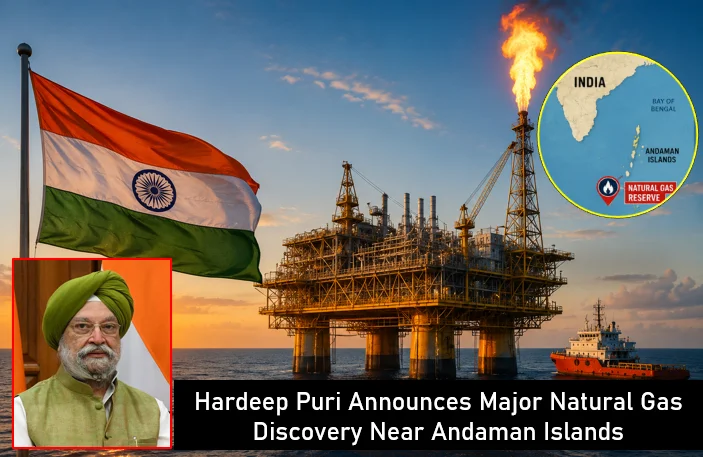

In June 2026 India took a huge stride towards achieving energy self-sufficiency. Union Minister for Petroleum and Natural Gas Hardeep Singh Puri announced the successful natural gas discovery in the deep sea of the Andaman Sea. State-owned Oil India Limited (OIL) made the breakthrough in a well named “Sri Vijayapuram-3” about 15 kilometers out to sea off the eastern coast of the Andaman Islands.
The prospect of stronger optimism has flooded India’s energy sector with the announcement. A working, highly active hydrocarbon system, right on the doorstep, could change the country’s long-term economic and strategic future, especially since it imports over eighty-five percent of its crude oil and a tremendous amount of its natural gas.
Unlocking the Secrets of the Sri Vijayapuram-3 Well
How the discovery was made illustrates the tremendous technological development involved in today’s deepwater exploration. Well Sri Vijayapuram-3 was drilled in waters about 355m deep. The exploratory drill was driven down to a target depth of more than 1,900 meters, deep into the Eocene old geological formation. It was at this depth below the surface that initial production testing confirmed the natural gas’s existence, which was clear and undeniable.
During the production tests, the viability of the reservoir could be seen in the form of continuous flaring, which was shared in social media by Minister Puri. When perforated, the exploratory well showed an immediate and rapid pressure increase and began to produce gas at a steady rate. It is not a low pressure pocket, but is a very encouraging pressure reaction to the geologists, showing that the reservoir has excellent structural features and favorable flow rates. OIL is currently in a new scientific stage, and it is gathering much more gas to carefully analyze the chemical composition, water content, and overall calorific properties of the gas, as well as conducting detailed isotope studies to determine the exact organic origin of the gas.
Read also: Oil India achieves highest-ever daily oil and gas production
The Rising Potential of the Andaman Frontier
The find at Sri Vijayapuram-3 is not the only good luck. It is the second successful gas-bearing well of Oil India in the drilling campaign in the Andaman Basin. The two exploratory wells have so far yielded viable hydrocarbons in this particular offshore push, of three that have been drilled. The high strike rate is quite unusual in the frontier basins, noted for their high cost, low rate and dry holes.
With the success of the Sri Vijayapuram-2 well, which found clean gas with an impressive 87 per cent methane content in late 2025, this is the latest achievement. Combined, these two findings in a row is incontrovertible evidence for an active, functioning petroleum system under the Andaman Sea.
The Samudra Manthan Mission Begins to Pay Off
The infrastructure to make these aggressive offshore explorations possible is the “Samudra Manthan Mission” — the National Deep Water Exploration Mission that Prime Minister Narendra Modi had announced during his 2025 Independence Day speech. This national mission is specifically aimed at transcending the shallow water drilling and systematically charting the vast unexplored deepwater and ultra-deepwater maritime economic zone of India.
Until now, India did not have dedicated specialized equipment and deep-sea technology to operate safely in high-pressure environments at the bottom of the sea. The central government has been actively seeking partnerships for technical frameworks with leading global deepwater operators, such as Petrobras, TotalEnergies, BP, Shell and ExxonMobil.
Read also: Which Country Is Called the Land of Black Gold and Why It Earns That Title
Could the Andaman Sea Become India’s Guyana?
In the energy sector, the progressive events in the Andaman Sea have come to be reminiscent of Guyana, the South American country whose economy has been revolutionised virtually overnight over the last decade by the discovery of huge offshore oil fields by international oil corporations.
Based on a comprehensive seismic survey, preliminary estimates from industry suggest that the Andaman Basin may contain 307 to 370 million metric tons of hydrocarbons, equivalent to oil. These are preliminary estimates and not commercial reserves per se, but the twin discoveries at Sri Vijayapuram prove the opportunity is huge, say public sector executives. In the wake of these achievements, Oil India has already embarked on an ambitious appraisal program, reprocessing older data and acquiring almost 600 square kilometers of new 3D seismic mapping to identify where the next set of wells for production should be sunk.
A Critical Shield Against Global Supply Shock
This is not just a discovery for commercial benefit with profits for the company; it is also of long strategic importance. India is one of the most rapidly expanding major economies, and its energy demand is exploding at a rapid rate, making the Indian government’s fiscal position vulnerable to the ups and downs of global energy markets and intricate geopolitical conflicts. Natural gas is considered as the major link fuel for India to shift to cleaner energy options because it has much lesser carbon emissions than traditional coal or heavy fuel oils.

I am a versatile content writer from the MP region, covering politics, business, crime, current affairs, entertainment, video games, and sports with clear insights, engaging analysis, and timely, reader-focused updates.