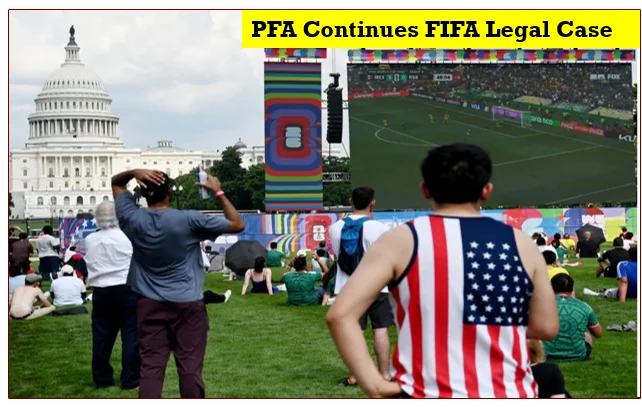

The Professional Footballers’ Association (PFA) has decided to continue its legal proceedings against FIFA despite a newly signed agreement between the world governing body and global players’ union Fifpro. While the memorandum of understanding (MOU) introduces significant governance changes, the PFA says major concerns remain regarding the future international football calendar beyond 2030.
The development comes as FIFA faces scrutiny over scheduling plans, the expansion of major tournaments, and ticket pricing issues during the opening days of the 2026 World Cup.
PFA Refuses to Withdraw Claims Against FIFA
The PFA is continuing its legal challenge against FIFA even after Fifpro agreed to drop its own complaints following a new deal with the governing body.
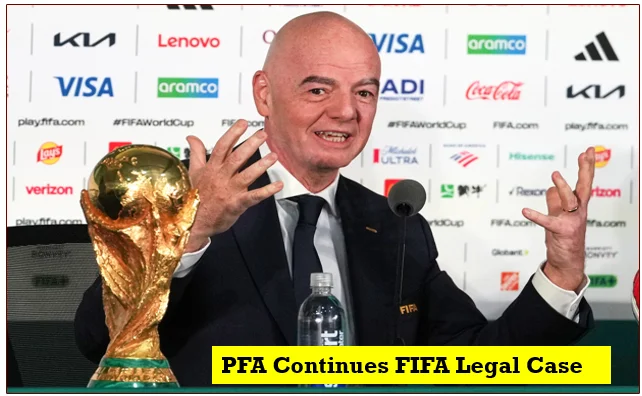
FIFA President Gianni Infantino announced the agreement during a pre-World Cup press conference. Under the MOU, Fifpro will gain representation in negotiations with FIFA and receive veto rights on matters related to player welfare and reforms to the transfer system.
In exchange, Fifpro has withdrawn its legal actions against FIFA, including a complaint filed with the European Commission two years ago that alleged FIFA had abused its dominant position and breached European Union law.
Calendar Issues Remain Unresolved
Despite welcoming elements of the agreement, the PFA is not prepared to end its own legal action.
The union is seeking detailed assurances from FIFA regarding plans for the global football calendar after 2030 before considering any withdrawal of its claims. Alongside the European Commission proceedings, the PFA also has an active case against FIFA in the Brussels Court of Commerce.
According to information obtained by The Guardian, the organization believes the current MOU does not sufficiently address future scheduling concerns.
Post-2030 Football Calendar Emerging as Key Battle
Attention is already turning toward football’s international calendar beyond the current decade.
Although the issue is expected to become one of the sport’s major debates after the 2026 World Cup, FIFA is reportedly delaying extensive discussions with stakeholders until after next year’s presidential election, when Infantino is expected to seek another four-year term.
Concerns Over Club World Cup Expansion
The PFA is particularly worried about FIFA’s proposal to expand the Club World Cup to 48 teams.
The union also fears significant disruption from staging the 2034 World Cup in Saudi Arabia during the European winter, a move that could create scheduling complications across domestic competitions.
These concerns are especially relevant for PFA members because the Premier League calendar is widely considered one of the most demanding in world football.
A PFA source said: “We have achieved some big wins, but at the same time cannot cave in on such important matters as the calendar. The MOU is significant and brings important governance changes, but we need a solution on the calendar too before we can drop our claim.”
FIFA Ends India Broadcast Uncertainty With Major World Cup Deal
Opening Ceremony Draws Positive Reaction
The 2026 World Cup opening ceremony received a warm reception from observers.
Performances by Shakira and Burna Boy featured prominently, while a giant FIFA World Cup display served as the centerpiece of the event.
Much of the entertainment showcased local performers, adding a regional flavor to the ceremony.
Empty Seats Raise Questions Over Ticket Prices
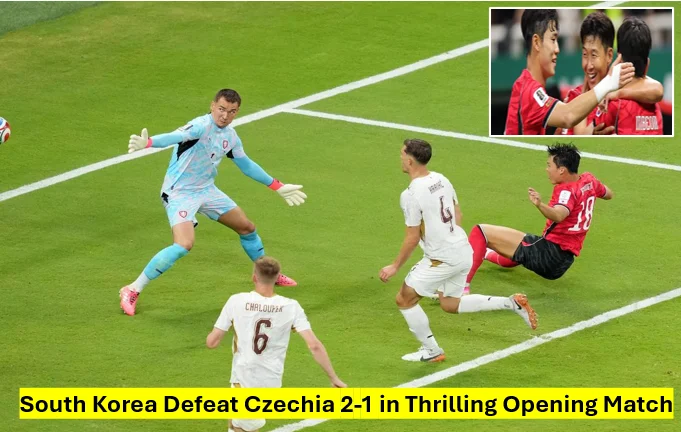
While the tournament has generated significant interest, concerns emerged following Thursday’s match between South Korea and Czechia in Guadalajara.
FIFA reported an attendance of 44,985 spectators, but visible sections of empty seats inside the stadium renewed debate over ticket pricing and demand during the first 48-team World Cup.
Contrasting Attendance Figures
The concerns stood in contrast to the opening match, where more than 80,000 spectators attended the game between co-hosts Mexico and South Africa at Azteca Stadium.
The sight of vacant rows in the 46,000-capacity Guadalajara venue, located in a city known for its strong football culture, has intensified criticism of FIFA’s commercial approach to the tournament.
Several supporters attending the match attributed the empty seats to high ticket costs and criticized FIFA’s pricing structure.
Infantino Defends FIFA’s Pricing Strategy
Speaking on Wednesday, Infantino defended the organization’s ticket pricing policy.
He argued that ticket prices were comparable to those charged at other major sporting events despite complaints from supporters who believe attending matches has become too expensive.
FIFA has stated that more than six million tickets have already been sold for the tournament. Infantino previously said demand across the Americas had exceeded expectations by “a factor of 10 or more”.
However, Football Supporters Europe (FSE) has warned that what it described as “extortionate” pricing risks preventing ordinary fans from attending matches. According to FSE, ticket prices for the 2026 tournament are five times higher than those seen at the 2022 World Cup in Qatar.
Reuters has contacted FIFA for comment.
World Cup 2026: Early Storylines Emerging
With two matches completed and 102 still to be played, the tournament has already produced several talking points.
Mexico and South Korea opened their campaigns with victories, while South Africa and Czechia suffered defeats. The opening days have also seen five goals scored and three red cards issued.
One statistic attracting attention is that the tournament’s red-card total is already only one short of the entire number recorded during the 2022 World Cup in Qatar.
Co-Hosts Prepare for Day Two
Following Mexico’s appearance on the opening day, the remaining co-host nations are scheduled to begin their campaigns on day two.
Canada will face Bosnia & Herzegovina in Group B, while the United States will take on Paraguay in Group D. The latter match is scheduled for the early hours of Saturday for viewers in the United Kingdom.
Conclusion
The PFA’s decision to maintain its legal action against FIFA highlights continuing tensions over the future direction of football’s international calendar. While FIFA and Fifpro have reached a landmark governance agreement, unresolved questions surrounding tournament expansion and scheduling beyond 2030 remain a significant point of contention. Meanwhile, the opening days of the 2026 World Cup have generated discussion both on and off the pitch, from attendance figures and ticket prices to early tournament statistics.

I am a versatile content writer from the MP region, covering politics, business, crime, current affairs, entertainment, video games, and sports with clear insights, engaging analysis, and timely, reader-focused updates.