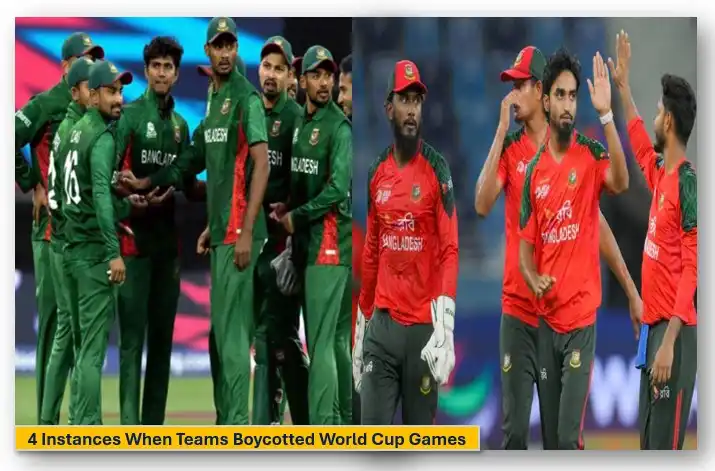

The World Cup is often celebrated as a unifying party planet-wide, where countries come together and put aside their differences to compete for glory. But the history of international sports is also a metaphor for something very real: It is an arena filled with geopolitics and security concerns, moral quandaries and metaphors. The gravity of global events has seen the importance of the game overshadowed on numerous occasions, forcing some leading teams to take the heartbreaking decision to walk away.
From the high-pressure melting pots of the Cricket World Cup to FIFA’s early continental disputes, here are four occasions in history when teams boycotted World Cup matches.
England’s defiance of Harare (Cricket World Cup, 2003)
The 2003 Cricket World Cup held in South Africa, Zimbabwe and Kenya was thought of by some as the “most political” since its inception. England’s decision to boycott their group match in Harare against Zimbabwe was the main fall out.
The Conflict: Security fears and moral opposition to the regime of President Robert Mugabe contributed to the decision. The Tony Blair-led British government put huge pressure on the ECB (England and Wales Cricket Board) to cancel the match as a protest against issues such as human rights abuses and lack of democracy in Zimbabwe.
The Aftermath: Even though the ICC insisted that the ground was safe, England defaulted on the fixture. Those 4 points were given to Zimbabwe, a defeat that ultimately meant England failed to qualify for the super sixes. For the Zimbabwe team it was a bittersweet victory that underscored the deepening gulf between sport and politics.
India Squad Announcement For T20 World Cup 2026 LIVE Updates
The Black Caps vetoed in Nairobi (Cricket World Cup, 2003)
England were left to deal with the Zimbabwe situation while New Zealand had its own in Kenya. The Black Caps’ first game was to be in Nairobi, but they never left.
The Threat: After a deadly terrorist attack against an Israeli-owned hotel in Mombasa several months earlier, the New Zealand government issued a travel advisory warning of a “real and significant threat from terrorism” in the Kenyan capital. The players, who were concerned for their safety, had united to refuse the journey.
The Result: Kenya were granted a walkover by the ICC. The boycott sent ructions through the tournament – with those handy points, Kenya was gifted passage to World Cup semi-final, who remains one of cricket’s most gripping underdog stories.
India’s 2011 World Cup-Winner’s Major Instruction To Ajit Agarkar On Shubman Gill
Australia-West Indies Mesozoic Park (Cricket World Cup, 1996)
Challenges Before the start of the new millennium, South Asia’s 1996 World Cup came in for a jolt when Australia and West Indies (the world’s top two teams) refused to fulfill their fixtures in Sri Lanka.
The Catalyst: In January 1996, only weeks before the start of the tournament, a huge bomb exploded outside the Central Bank in Colombo killing nearly 100 people and injuring more than 1,400. Both teams refused to send their squads to the island nation, citing an “unacceptable risk” of suicide attacks.
The Result: Sri Lanka were awarded points for both games as no ball was bowled. Arjuna Ranatunga’s “snub” was to prove an inspiration for the Lankan team. Fired by that perceived slight, they played an innovative style of cricket and skittled Australia in the final in Lahore to lift their first World Cup.
FIFA World Cup, 1938 South American ”Cold War”
Although security is now a modern obsession for boycotters, the early years of the World Cup were shaped as much by continental honour and competition for who should host. The 1938 World Cup in France bombarded by a simliar sunlight was boycotted by the powerhouse of South America.
The Dispute: At the time, there was an implicit agreement that tournaments would rotate between Europe and South America. Following the militiamen-invaded Cups of 1930 (Uruguay) and 1934 (Italy), it was widely expected that the return to America would come for the third tournament in 1938. At the time FIFA instead awarded it to France, sparking outrage in Argentina and Uruguay.
The Fallout: Both countries pulled out of the tournament in protest at “Euro-centrism.” This boycott meant the World Cup in 1938 would be one of the most unbalanced ever, with just Brazil and Cuba from the Americas. It would be another 12 years, and a global war, before the World Cup returned to South American soil in 1950.

I am a versatile content writer from the MP region, covering politics, business, crime, current affairs, entertainment, video games, and sports with clear insights, engaging analysis, and timely, reader-focused updates.