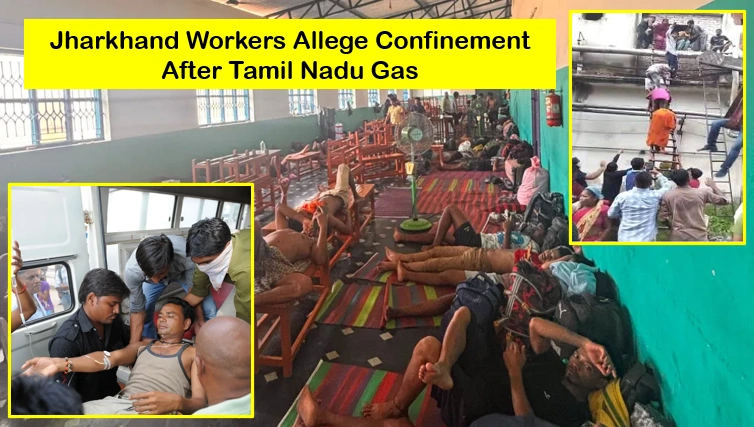

Nearly a week after a deadly ammonia gas leak at a seafood export unit in Tamil Nadu claimed 15 lives, around 40 Adivasi workers from Jharkhand employed at the facility have alleged that they have been confined by local authorities since the incident occurred. According to the workers, they have been staying inside a private marriage hall arranged by the district administration and are unable to leave despite repeatedly expressing their desire to return home.
The allegations have now prompted intervention from the Jharkhand government, bringing renewed focus to the condition of migrant labourers caught in the aftermath of industrial disasters. The workers say they are anxious, uncertain, and desperate to travel back to Jharkhand as soon as possible.
Workers Claim They Have Been Kept at Marriage Hall Since Incident
The controversy surfaced days after the ammonia gas leak at the seafood export facility in Tamil Nadu. The leak resulted in the deaths of 15 people and triggered emergency measures in the area. In the aftermath of the incident, around 40 workers from Jharkhand were reportedly shifted to a private marriage hall by the district administration.
The workers now allege that they have effectively been confined there since the day of the accident. According to their statements, they have not been allowed to return home despite their repeated requests.
Many of the labourers are Adivasi workers who had travelled from Jharkhand to Tamil Nadu for employment opportunities at the seafood export unit. They said the uncertainty surrounding their stay has caused growing stress among the group.
One worker said they had been informed that permission to leave would only be granted after coordination between Tamil Nadu authorities and the Jharkhand government was completed.
Workers Say They Want Immediate Return to Jharkhand
The stranded workers described increasing anxiety as days passed after the gas leak incident. Several among them reportedly expressed concern for their families back in Jharkhand and said they were struggling emotionally while remaining away from home after witnessing the aftermath of the tragedy.
A worker said they had been told they would be allowed to leave only after coordination with the Jharkhand government.
The labourers also claimed they had little clarity about how long they would be required to remain at the marriage hall. According to the workers, the situation has left them feeling helpless and frustrated.
The demand from the group remains straightforward — safe transportation back to their home state at the earliest possible time.
Also read: Fire Panic on Udaipur Intercity Express Leads to Tragic Accident in Madhya Pradesh
Jharkhand Government Intervenes After Allegations Surface
The claims made by the workers have now drawn the attention of the Jharkhand government. State authorities reportedly intervened after learning about the allegations of confinement and the workers’ desire to return home.
The development has added another dimension to the aftermath of the Tamil Nadu industrial disaster, shifting public attention not only to the gas leak itself but also to the treatment and welfare of migrant labourers following such incidents.
The involvement of the Jharkhand government highlights the challenges often faced when workers from one state are employed in industrial sectors located in another part of the country. Coordination between governments becomes particularly important during emergencies involving injuries, fatalities, or displacement of labourers.
Ammonia Gas Leak Claimed 15 Lives
The ammonia gas leak at the seafood export unit has already emerged as a major industrial tragedy due to the number of deaths reported. Fifteen people lost their lives in the incident, making it one of the most serious workplace-related disasters reported in the region in recent times.
Although investigations and administrative actions surrounding the gas leak continue to attract attention, the allegations by the Jharkhand workers have introduced concerns regarding post-disaster management and labour handling procedures.
The workers’ statements suggest that even after surviving the incident, many continue to face uncertainty about their safety, movement, and future arrangements.
Questions Raised Over Migrant Worker Welfare
The incident has once again brought attention to the broader issue of migrant worker welfare in India. Labourers from states such as Jharkhand, Odisha, Bihar, and West Bengal frequently travel to industrial hubs in southern and western India in search of employment opportunities.
However, industrial accidents and emergency situations often expose the vulnerabilities faced by these workers. Communication barriers, administrative confusion, and limited support systems can leave migrant labourers in difficult situations following crises.
In this case, the workers alleged they were unable to freely leave the accommodation where they had been placed after the gas leak. Their statements have raised questions about whether sufficient communication and transparency existed between officials and the labourers involved.
Labour rights observers have long argued that interstate migrant workers require stronger protections, especially during emergencies involving factories, hazardous materials, or industrial accidents.
Also read: Mumbai Rain Havoc: Wall Collapse, Flooded Roads and Train Disruptions
Growing Concern Among Families Back Home
The uncertainty surrounding the workers’ situation has reportedly also caused concern among families in Jharkhand. Many families depend financially on relatives working outside the state, particularly in industrial and manufacturing sectors.
The gas leak tragedy and subsequent allegations of confinement have therefore created both emotional and economic anxiety for those connected to the workers.
For the labourers staying at the marriage hall, the immediate priority remains returning safely to their villages and reconnecting with their families after days of uncertainty.
Industrial Accidents and Administrative Response Under Scrutiny
Industrial accidents involving hazardous substances often trigger large-scale emergency responses from local administrations. Authorities typically prioritize medical treatment, evacuation, and containment measures after such incidents.
However, the Tamil Nadu gas leak case is now drawing attention to another aspect of disaster response — how surviving workers are accommodated, informed, and assisted in the days following a tragedy.
The allegations by the Jharkhand workers suggest that while safety measures may have been implemented, communication regarding movement restrictions and travel arrangements may not have been adequately explained to the labourers.
As a result, what authorities may have considered a temporary administrative arrangement has reportedly been perceived by workers as confinement.
Focus Remains on Safe Return of Workers
For now, the central issue remains the workers’ demand to leave Tamil Nadu and return to Jharkhand. The intervention by the Jharkhand government is expected to play an important role in determining the next steps regarding transportation and coordination with Tamil Nadu authorities.
The situation continues to highlight the fragile position of migrant workers during times of crisis. While investigations into the ammonia gas leak continue, attention has increasingly shifted toward ensuring the safety, dignity, and rights of the labourers affected by the incident.

A versatile writer mainly works on trending news, daily updates from politics, business, crime, current affairs and entertainment.