There are train journeys you take simply to get from one place to another. And then there are journeys that feel like stepping into a nature documentary — where every turn of the track reveals a story older than civilization itself. The Sakleshpur–Subramanya Ghat line in Karnataka belongs firmly to the second category.
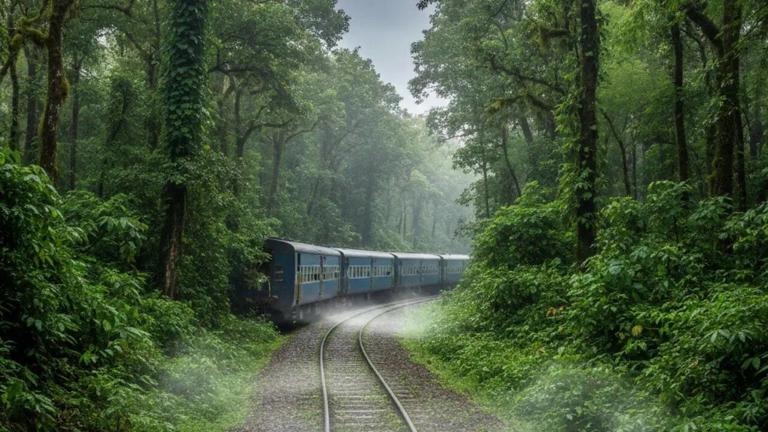
Often celebrated as India’s most cinematic and wildest train route, this stretch of railway doesn’t just pass through forests — it passes through the heart of tiger country. For anyone who has taken this journey, the experience becomes a memory worth holding onto for a lifetime.
Also read:
- Quitting Life at 9: What Are We Missing About Our Children’s Mental Health?
- A man in Tokyo hides his wife’s $3.8 million lottery win while living in style
- What do teens need most from their parents?
A Route That Lives Up to Its Name: The “Green Route”
Part of the historic Hassan–Mangalore railway line, the section between Sakleshpur and Subramanya Road has earned a name that travellers swear is the most accurate description possible — the Green Route.
At dawn, the train begins its gentle slide out of Sakleshpur station. The morning air is crisp, the light golden, and within minutes the outside world transforms. Concrete and towns disappear, replaced by towering trees, thick undergrowth and an endless sea of green.
This is the Western Ghats — one of the world’s eight “hottest hotspots” of biodiversity. It is a place where the forest feels alive, breathing, watching. Every curve of the track introduces a new layer of wilderness.
Where Tigers Still Roam Freely
The route cuts straight through the Bisle Reserve Forest and the outer edges of the Kudremukh landscape, two of India’s richest wildlife habitats. These forests are home to:
Bengal tigers
Leopards
Elephants
Sambar deer
Gaur
Wild boar
And countless species of birds, reptiles and insects
Knowing that tigers and leopards roam these woods — sometimes only a few hundred meters from the tracks — gives the entire journey a quiet thrill.
You may or may not spot them, but the idea that these majestic animals move silently through the undergrowth as your train winds through their territory adds a special kind of excitement. It’s the closest many people will ever come to travelling through a true tiger landscape.
A Railway Built to Respect the Forest
One of the most fascinating aspects of this route is how thoughtfully the railway line is designed. Instead of carving aggressively through the forest, the tracks weave in harmony with the landscape.
This 52-km stretch includes:
Nearly 50 bridges
10+ tunnels, some long, silent and dripping with moisture
Steep curves and mist-covered hill slopes
Streams running parallel to the tracks
Slivers of sunlight breaking through the thick canopy
Every few minutes, the scenery changes. One moment you’re passing over a valley so deep you can’t see the bottom; the next, you’re inside a dark tunnel, listening to the echoing roar of the train.
It’s dramatic, peaceful and humbling all at once.
Not a Wildlife Safari — A Journey of Respect
While the route is filled with wildlife, this journey is not designed as a safari. In fact, one of the most beautiful aspects is the sense of respect built into the experience.
You aren’t meant to go hunting for wildlife sightings. The idea is simple:
the train is a silent visitor passing through a delicate ecosystem.
The forest canopy grows so thick in some parts that even at noon, the sunlight struggles to reach the ground. Vines hang from trees like natural curtains. Ferns grow in clusters. Mist often settles between the trunks, giving the landscape an eerie, ancient beauty.
And the animals? They know these forests far better than any passing train. They remain hidden, unbothered, moving quietly through the shadows.
Moments You Won’t Find on Any Other Train Route
What truly sets this journey apart is its complete sense of isolation and immersion.
Mobile networks vanish for long stretches, leaving travellers with nothing but nature’s raw soundtrack — the distant roar of a waterfall, the whistle of wind through leaves, the rhythmic clank of the train.
Stations are tiny, silent outposts, often surrounded by nothing but forest.
Sometimes, the train slows down not for passengers, but for elephants crossing the tracks.
There are countless stories — especially among railway workers — about tigers spotted during the monsoon, when the forest is at its greenest and wildest. Whether travellers see one or not, the idea that these big cats might be watching from somewhere nearby adds to the adventure.
This journey is less about what you see and more about what you feel.
A Train Journey That Stays With You
The Sakleshpur–Subramanya Ghat line is not a regular train ride. It is a reminder of why India’s natural landscapes are so special — ancient, untouched and teeming with life.
As the train approaches Subramanya Road, the dense jungle slowly opens up again. Light returns. Mobile signals reappear. Civilization creeps back into view. But something inside you has shifted.
You have crossed through one of India’s last remaining wild corridors — a place where forests still rule, where animals move freely, and where nature remains beautifully untamed.
It is, without doubt, India’s wildest, most thrilling and most unforgettable train journey.

I craft sharp movie reviews and trend analysis, known for deep research, clear insights, and compelling storytelling across the latest in film and pop culture.