
In India, on Monday night, something out of the ordinary happened. As a response to the Hayli Gubbi volcano in Ethiopia, a huge cloud of volcanic ashes traveled into and through western India and towards the north. What started as an eruption thousands of miles away caused haze and visibility issues in the atmosphere, compromised flights, and created widespread intrigue – some even feared it – by multiple Indian states.
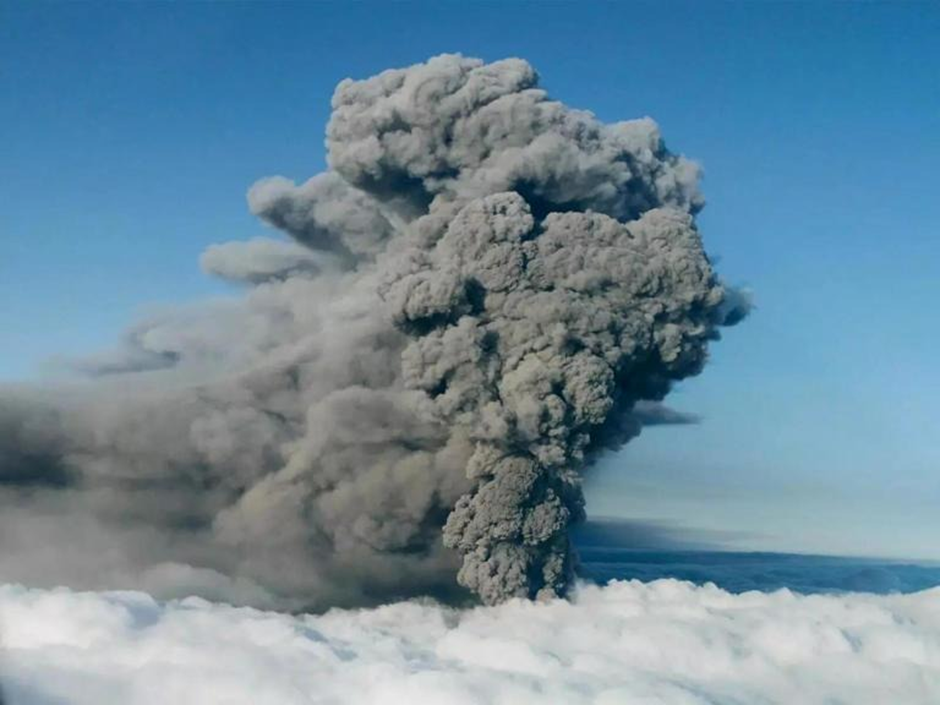
The first signs occurred around 5:30pm off the coast of Jamnagar, Gujarat, when meteorological satellites detected a grey layer forming in the atmosphere at high distances. Over the next several hours, the plume continued to travel at great speed through Rajasthan, the western regions of Maharashtra, Delhi, Haryana, and Punjab before moving towards the foothills of the Himalayas.
Meteorological agencies monitored the plume and radar detection patterns as it made its way through Indian airspace, In fact, as reported by IndiaMetSky Weather, the ash plume traveled from anywhere between 15,000 feet to 25,000 feet at certain points – with layers developing up to 45,000 feet – and since this was in line with commercial air traffic patterns, it presented a serious issue of potential delays, diversions and cancellations.
Also read: India’s Wildest Train Journey
Ash from a volcano this far away presents many questions. How does something like this travel so far? Is it going to impact air quality in India? Which Indian regions will be impacted most?
Here’s a breakdown of everything that happened – and what it means for the people of India.
Where Did the Ash Come From? The Eruption of Hayli Gubbi
The ash traveled from the Hayli Gubbi volcano situated in Ethiopia’s Afar region – which is one of the most seismically active places on Earth. The Toulouse Volcanic Ash Advisory Centre (VAAC) reported that this volcano erupted on Sunday around 8:30am GMT with explosive force. Interestingly enough, Hayli Gubbi had remained dormant for nearly 10,000 years.
Even though the volcanic eruption had been stopped by Monday, the volcano ash cloud remained suspended in the upper atmosphere, continuing to drift long after the volcanic activity had quietened on the ground.
How Did Volcanic Ash Travel All the Way to India?
Typically, volcanic eruptions only affect the regions close to the source of the eruption, however, powerful eruptions are capable of propelling ash to the stratosphere and thus ash can be carried for thousands of kilometers.
There were several factors that helped the Ethiopian ash plume to reach India:
1. Strong upper-level winds
Jet stream winds in the upper atmosphere can be as fast as 100-150 km/h and can work like a high-speed conveyor belt. These winds took the ash straight to the Indian subcontinent.
2. The altitude of the ash plume
As the ash was between 25,000 and 45,000 feet, it was able to escape from rain clouds and surface wind mixing, therefore, the ash particles were still intact and they could have traveled over a long distance.
3. Dry atmospheric conditions
The weather over the Arabian Sea and northwestern India has been mostly dry for the past few days, thus there was nothing to cleanse the air of ash.
4. The eruption’s location in the Rift Valley
The geologically active Rift Valley is known for sometimes directing the eruptions upward with great power, hence, ash can go beyond the high atmospheric layers.
These combined forces led the ash plume to travel a direct route from East Africa to the Indian mainland.
Which Indian Cities Were Impacted?
By Monday night, the volcanic plume had covered a vast area of northwest India. The areas with the highest impact were:
· Gujarat
· Rajasthan
· Northwest Maharashtra
· Delhi-NCR
· Haryana
· Punjab
· Western Uttar Pradesh (light)
Weather tracking visuals depicted a huge streak of ash extending from the Arabian Sea to northern India.
IndiaMetSky Weather wrote:
“An enormous ash plume is visible extending from the Hayli Gubbi volcano area to Gujarat. The cloud is moving at around 100-120 km/h towards North India.”
In the late evening, Delhi and its neighboring areas reported darkened skies and low visibility, however, there were no signs of panic as the ash remained at high altitudes.
Will People See Ashfall on the Ground?
Experts believe that ashfall on the plains is improbable.
Most of the ash is in the mid-to-upper atmosphere, which is quite far from the ground.
Small amounts of particles may be deposited in isolated areas; however, the quantity is not even close to what is found near active volcanic zones.
Well, residents may notice:
· A dusty or hazy appearance in the sky
· Sunlight appearing slightly dim or scattered
· A faint burning smell in sensitive areas (due to sulfur dioxide)
· Meteorologists likened the appearance of the sky to that of a mild dust storm without the suffering and other health problems caused by dust or pollution close to the ground.
· Conclusion: A Rare Atmospheric Event, Largely Safe for India
The Ethiopian ash cloud drifting into India is a rare and fascinating event —one that demonstrates how deeply interconnected the Earth’s atmosphere is. A volcanic eruption several thousands of kilometers away was able to influence skies, flights, and weather talks in northwest India just within 48 hours.
While the ash plume generated eye-catching visuals and concerns, experts are of the opinion that the event poses little danger to the public with only a few ground-level areas affected and no significant air quality risk.
The bigger problem is in the field of aviation where authorities, who are monitoring and rerouting flights, have to wait until the time when the skies will be clear again.
This incident is a reminder of the immense power that nature has – and the fragile way in which the global wind systems are capable of carrying the consequences of that power from one continent to another within a few hours.
While the ash plume produced spectacular visuals and raised concerns, experts agree that the event is mostly harmless for the public, with a limited ground-level impact and no major risk to air quality.
The bigger challenge is in aviation management, where authorities are still closely monitoring and rerouting flights until the skies are clear again.
This incident is a powerful reminder of nature’s immense power – and how sensitive global wind systems can be that they can transfer the impact to other continents in just a few hours.

I craft sharp movie reviews and trend analysis, known for deep research, clear insights, and compelling storytelling across the latest in film and pop culture.









