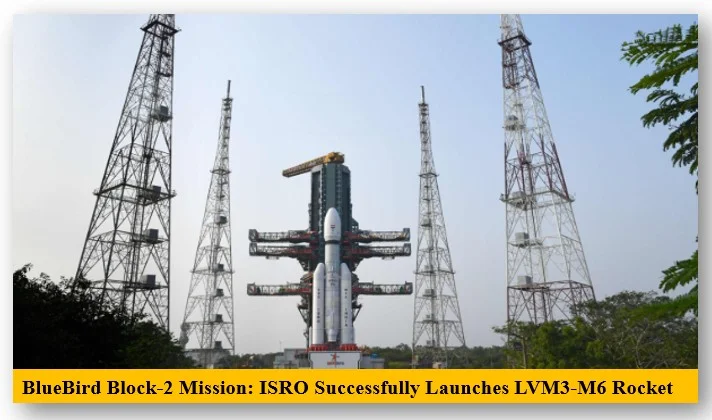
On Wednesday, the space agency in India, Indian Space Research Organisation (ISRO) was able to launch its heavy-lift rocket LVM3-M6, which carried the next generation of the BlueBird satellite, BlueBird Block-2, into Low Earth Orbit (LEO) space. The mission is the heaviest payload launched by ISRO into LEO, and it highlights the increasing importance of India in the commercial space services of the world.
The second launch pad in the Satish Dhawan Space Centre in Sriharikota was used, and the launch occurred at 8.54 a.m. after a successful 24-hour countdown.
Redbull in ISRO Launch History LEO Payload
The BlueBird Block-2 satellite (weight in orbit: 6,100 kg) was the heaviest satellite to launch into LEO, exceeding the LVM3-M5 mission of November with its 4,400 kg record, and the ISRO record. According to the officials of ISRO, the satellite was released after 15 minutes of the liftoff, as usual.
This successful launch proves the increased lift capacity of the LVM3, also referred to the Gaganyaan-class launch vehicle, which is the key to future missions of human spaceflight and commercial missions of India.
Business Mission Important to the World
This operation was done on a commercial basis between NewSpace India Limited (NSIL) and AST SpaceMobile of the U.S. NSIL is the commercial wing of ISRO, its work is to implement contracts of satellite launches in the international arena.
AST SpaceMobile is creating the first-ever mobile cellular network with direct space connectivity to regular smartphones without specialised devices in the world. One of the major components of this global constellation is the BlueBird Block-2 satellite.
Space to Mobile Direct
The BlueBird Block-2 spacecraft will provide the 4G and 5G voice, video, text and data services to mobile phones globally, including remote and underserved localities. It has a 223-square-metre phased-array antenna, one of the largest commercial communications satellites to have been launched into LEO, and has an orbit of approximately 600 km.
The satellite is based on the previous launch of five BlueBird satellites by AST SpaceMobile in September 2024, which allowed maintaining connectivity in the United States in some areas and in some international locations.
State-of-the-art Launch Vehicle Performance
The LVM3 is a three-stage launcher with a cryogenic upper stage, measuring 43.5 metres, and is designed and developed by the Liquid Propulsion Systems Centre, ISRO. To provide the large thrust required to launch it, the rocket incorporates two strong S200 solid rocket boosters (developed at the Vikram Sarabhai Space Centre).
ISRO reported that all the propulsion stages worked perfectly, which confirmed the soundness of the LVM3 platform regarding heavy and complicated commercial missions.
Give India a Boost in Space Ambitions
Prior to the launch, the ISRO Chairman V. Narayanan came to Tirumala Temple and took the blessings of the temples to get successful missions. Following the launch, the officials viewed the mission as a step toward enhancing India’s credibility as a partner of choice for international satellite players to launch their satellites.
With AST SpaceMobile partnering with over 50 mobile operators worldwide, the successful launch of the BlueBird Block-2 makes India a key provider of next-generation connectivity. It also strengthens ISRO’s capability to compete with existing world-leading launch companies in the space industry.
With the satellite-based internet and mobile connectivity emerging as a key element in the digital inclusion of the global population, the ISRO LVM3-M6 mission indicates the growing presence of India in the determination of the future of global communications in space.

I am a versatile content writer from the MP region, covering politics, business, crime, current affairs, entertainment, video games, and sports with clear insights, engaging analysis, and timely, reader-focused updates.