

After missing much of the global artificial intelligence (AI) stock rally, Indian equities are once again attracting investor interest. As volatility linked to AI-driven markets increases worldwide, India is emerging as a comparatively stable destination, supported by easing inflation concerns, a steady rupee and improving earnings expectations.
AI-Driven Market Swings Shift Investor Focus Toward India
The recent surge in AI-related stocks created strong gains in markets such as South Korea and Taiwan, leaving India behind for much of the year due to its limited exposure to AI-focused companies.
However, with growing concerns over the sustainability of the AI trade, global investors are gradually shifting attention back to Indian equities. In June, the NSE Nifty 50 Index outperformed the MSCI Emerging Markets Index by its widest margin since November, while foreign investor outflows fell to their lowest level in four months.
xAI Work-Culture Row Gets Worse After Engineer Claims 36-Hour Shift
Lower Volatility Makes India an Attractive Market
Compared with several major global benchmarks, the Indian market has experienced relatively limited price swings.
During the first half of 2026, the NSE Nifty 50 Index recorded moves of 1% or more on roughly one-third of trading days. This was lower than the MSCI Emerging Markets Index and only slightly higher than the S&P 500 Index.
The benchmark posted 38 trading sessions with gains or losses of at least 1% during the first six months of 2026. By comparison:
- MSCI Emerging Markets Index: 59 sessions
- MSCI Asian Index: 59 sessions
- S&P 500 Index: 32 sessions
- South Korea’s Kospi Index: 79 sessions
Experts See India as a Diversifier Amid AI Uncertainty
Maxence Visseau, Chief Investment Officer at Arkevium Capital in Dubai, said India’s stability reflects its limited participation in the AI trade.
According to Visseau, the firm maintains a neutral stance on India and uses it as a portfolio diversifier.
He said, “India’s calm comes down to one thing: It sits outside the AI trade.”
He added, “India works as an AI hedge inside the EM complex.”
Improving Macroeconomic Conditions Support Market Outlook
Although Indian equities have remained among the weaker-performing global markets this year, several macroeconomic factors have started improving.
The rupee has stabilized after previously touching a record low, while easing tensions in the Middle East have reduced oil prices. Lower energy costs have eased inflation concerns and improved expectations for India’s economic growth, according to a government report released at the end of June.
Google’s Agent Smith: The AI Tool Changing How Engineers Work
Earnings Season Adds to Optimism
Market participants are also looking ahead to the upcoming corporate earnings season, which is scheduled to begin with Tata Consultancy Services Ltd. on Thursday.
Sandip Sabharwal, founder of research house Asksandipsabharwal.com in Mumbai, believes falling commodity prices have significantly improved India’s outlook.
He said, “The fall in commodity prices has altered the macro outlook for India almost overnight.”
Sabharwal further stated, “Lower commodity prices, improving capital flows and stable interest rates create an environment where earnings upgrades are likely to exceed downgrades over the coming quarters.”
Morgan Stanley Highlights India’s Defensive Growth Story
In a note to clients last month, analysts at Morgan Stanley, including Ridham Desai, described India as a “much larger macro asset class.”
The analysts said more stable inflation in recent years has supported equity valuations and positioned India as a defensive growth market that is better equipped to absorb global shocks than in the past.
Over the last decade, the Nifty 50 has nearly tripled in value and delivered annual gains exceeding 10% in six different years.
India Volatility Index Continues to Decline
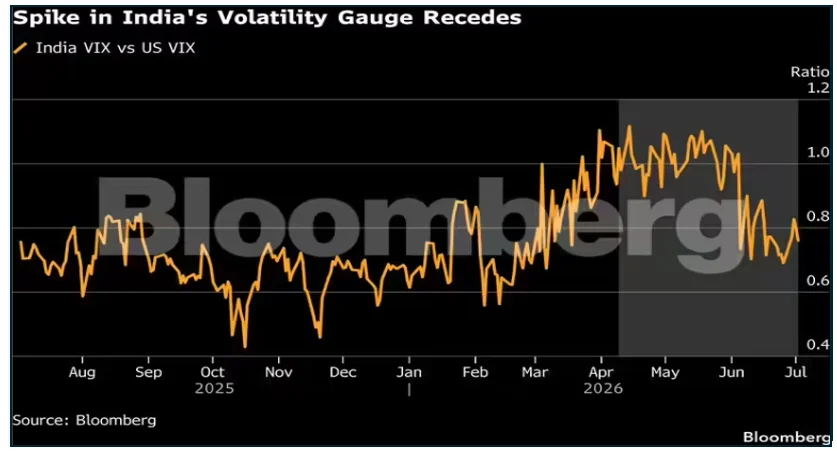
The India NSE Volatility Index fell for a third consecutive month in June.
By Friday, the index had dropped below its one-year average and reached its lowest level since February. This marked a significant improvement from April, when it climbed to a one-year high relative to the Cboe Volatility Index shortly after the Nifty 50 declined to a low.
Analysts Remain Positive on Indian Equities
Kruti Shah, a quantitative analyst at Equirus Securities, sees a “bullish undertone” in the Nifty 50 and prefers call spreads to position for further gains. She also believes the upcoming earnings season could produce positive surprises.
Ben Powell, Chief Investment Strategist for the Middle East and Asia Pacific at BlackRock Investment Institute, said India had previously been held back by higher energy prices, expensive valuations and limited AI exposure.
He stated, “As those pressures have eased, investors may look beyond AI-heavy markets. That could put India back on investors’ radar as a differentiated opportunity within emerging markets.”
Anthropic Launches 10 New AI Bots for Banking-Focused Business Solutions
Conclusion
As uncertainty surrounding AI-driven markets grows, India is increasingly being viewed as a comparatively stable investment destination. Improving macroeconomic indicators, easing commodity prices, declining volatility and expectations of stronger corporate earnings have renewed investor interest, positioning Indian equities for closer attention in the months ahead.

A versatile writer mainly works on trending news, daily updates from politics, business, crime, current affairs and entertainment.