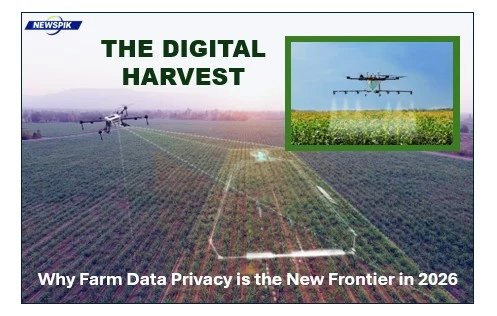

For years, land, seed and intuition was a farmer’s most valuable tool. But as we slog through 2026, a fourth asset has emerged in the spotlight: data. From GPS-directed autonomous tractors to soil sensors equipped with the artificial intelligence (A.I.) needed to spot a nutrient deficit before the human eye can pick out a wilted leaf, today’s farm is automotive byproduct: a behemoth producer of data.
As these “Smart Farming” technologies — commonly referred to as Agriculture 4.0 — offer to solve global food security and fatten razor thin margins, they have also spawned a profound crisis of trust. With the average farm producing more than 500,000 data points daily, the question is no longer only how to grow more food, but who owns and who can use and channel that information.
The Transparency Gap: The True Owners of the “White Gold”
Anonymity of data ownership is the key reason attributing to growing concerns over privacy. The farmer who “turns the key” on a modern harvester today is likely turning on data collection automatically, too. From detailed crop yields and moisture levels to the precise coordinates of a farm, this information is sent directly to the cloud servers of Agricultural Technology Providers (ATPs).
The “Click-Wrap” Dilemma
The most common point of entry for farmers into the digital ecosystem is a “click-wrap” agreement — those long, complicated digital contracts in which one click saying “I Agree” gives the provider sweeping usage rights. Now these contracts are at the center of the fray, with all parties arguing over their fate by 2026.
- Secondary Use: Lots of providers retain the right to aggregate “anonymized” data and sell it to third-party analysts, equipment makers or — in at least one instance, recently — hedge funds.
- The Yield Risk: If a land-leasing company — or its competitor or the general public — somehow gets access to historical yield data from a farm, that farm opposes all possible forms of predatory rent hike, for example, some unfair market advantage.
- Little Recourse: Unlike data such as personal financial information, agricultural “raw†data oftentimes lacks clear legal protection under traditional patent or copyright laws.
Cybersecurity on the Back Forty: A High-Stakes Target
As farms have become more connected, so too have they also become more vulnerable. In 2026, agriculture is no longer a “low tech” sector out of the cybercriminals’ reach. The data risk in smart farming runs much deeper than mere digital files; it can cause physical, catastrophic failures.
“Thieves don’t kill fields,” spoke one farmer in the community group to which my brother and I belonged, “But a hacker could.” If someone hacks their way into a precision irrigation system, they are not just stealing passwords — they can literally kill an entire season of crops by shutting off the water right when it is needed most, like during peak time for growth — or by changing the dispensing rate of chemicals.
Why is Using AI to Protect Data from Cybercriminals Crucial?
Emerging Threats in 2026:
- Ransomware in Action: Attackers have turned their attention to farming cooperatives during planting or harvest seasons, with the understanding that a 48-hour setback can lead to millions of dollars in losses.
- Poisoning the dataset: As farmers depend more on AI algorithms to make planting choices, “poisoning” the data pipelines beneath them could result in a recommendation that ruins soil health or crop viability.
- GPS Spoofing: Hijacked access to driverless equipment can result in “rogue” tractors or machinery being driven into danger zones.
Regulatory Reaction: The Emergence of “Ag-Data Police”
With no “data police” on the beat yet, a grass-roots effort has begun among farmers and legal advocates. With the 2026 Olympics, they are finally being used to give real force to rules regulating agricultural data.
Data’s ‘Good Housekeeping’ Seal
And groups like the Ag Data Coalition and Ag Data Transparent have caught on. They also accredit companies that can meet stringent transparency requirements. More and more farmers in 2026 refuse to sign deals with any provider not stamped with a “Data Transparent” seal, which has pushed tech giants to simplify terms.
Global Shifts
- The EU’s FSDN : The European Union has transitioned from their previous accounting network to the Farm Sustainability Data Network (FSDN), which includes competition-oriented protocols about data sharing and farmer consent.
- India’s DPDP Act: India’s Digital Personal Data Protection Act hits a turning point in 2026 that requires ag-tech startups to demonstrate how well or poorly they are handling farmer data compared to the way that a bank handles customer financial data.
- Fully reclaiming and optimising the digital seed: The future path This is what a No Fossil Fuel pledge looks like.
Yet as frightening as these lessons may be, the promise of smart technology makes it something we should not walk away from. The future will be decided between Connected Intelligence and Privacy-by-Design.
Newer tools are starting to address the trust deficit. Federated Learning enables AI models to be trained on farm data local to the farmer—no raw, sensitive data ever needs to leave a farmer’s own server_FD. Blockchain is also being leveraged to generate immutable “data logs,” allowing farmers full visibility of who exactly accessed their information and when.
The 2026 agricultural revolution, by contrast, is a juggling act. For technology to really work for the farmer, it should be as secure as a locked barn and as transparent as the clear blue sky over that field.

I am a versatile content writer from the MP region, covering politics, business, crime, current affairs, entertainment, video games, and sports with clear insights, engaging analysis, and timely, reader-focused updates.









