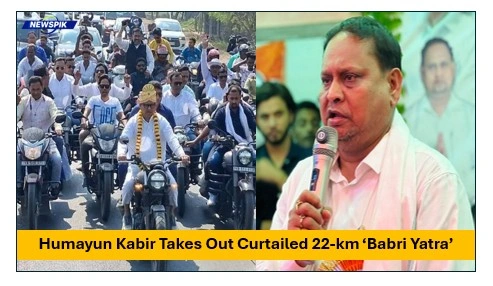

In the minority-dominated district of Murshidabad, at the heart of Bengal, a new and controversial chapter in Indian identity politics is being written. On Thursday, February 12, 2026, Bharatpur MLA Humayun Kabir — a man who has gone from being a suspended Trinamool Congress (TMC) leader to thefounder of the Janata Unnayan Party (JUP) within these past few days — set out on what he is terming ‘Babri Yatra’.
Although initially imagined as a mammoth 265km strong-man show across three districts, the yatra was reduced to a 22 km affair, culminating in more of a motley than motorized cavalcade of exactly 100 vehicles that Kabir had threatened. The reaction is part of a larger pattern of tightening legal and administrative control over communal politics in West Bengal ahead of high-stakes assembly elections.
A Vision in Brick: The Beldanga ”Babri” Model
To understand the yatra, we need to see why it was launched. In Beldanga, a mosque foundation stone was laid by Kabir on Wednesday (February 11). This is no ordinary house of worship; it is deliberately built as a facsimile of the 16th-century Babri Masjid believed to have been destroyed in Ayodhya on December 6, 1992.
The Scale of Ambition
Kabir’s project is grand, symbolically overt:
- The Blueprint: The building is built in the style of a three-domed mosque, like the demolished one in Ayodhya.
- Cost and capacity: The 12,000-capacity mosque across two floors is estimated to cost around ₹55 crore.
- The Gate: An entrance that will be a 14 X 5-metre wide gate with an expected cost of ₹5 crore only building the entrance!
- Timeline: Kabir says he will complete the construction in two to three years, paid for by private donations from around the world.
The Constitutional Argument
Kabir’s voice is the perfect cocktail of religious fervour and constitutional subversion. “If a child is born in my home I shall decide what name to give — whether Babar or Saddam,” he told reporters. If the state can erect a Jagannath temple at Digha or belt Durga Angans, then there is no legal impediment in providing patronage to constructing a mosque modelled on an ancient structure by community members, he argues.
Why the Yatra was Curtailed?
The “Babri Yatra” was intended to be a march from the historic place of Palashi (the battlefield of 1757) in Nadia district to Itahar in North Dinajpur. The actual situation on the ground demanded a major retreat, however.
The Board Exam Barrier
The official explanation being offered for reducing it from 265 km to 22 km is that the West Bengal Higher Secondary (Class XII) examinations are still under way. Authorities were concerned that loud processions may disturb the ongoing examinations and block roads, preventing students from reaching exam centres. Faced with pressure from local police, and the Malda district administration, he was “voluntarily” forced to cut short the route to conclude at Rejinagar in Murshidabad.
Survey Predicts Mamata Banerjee Still in the Lead in West Bengal
Police Permissions and Legal Heat
Though Kabir had attributed the truncation to permission not being granted for a three-district route, police said he did not have clearance for a motorized rally of 600 people in the first place because of security reasons. In addition, Kolkata’s Maidan Police Station charged Kabir under the FIR lodged against him shortly before the march kicked off, with most attention accorded to his value laden remarks on the construction of a mosque.
PM Modi leads Shaurya yatra; dazzling lights, drone, devotion
Conclusion: A High-Stakes Gamble
Humayun Kabir’s 22 km walk may have been brief in terms of distance, but not in symbolic expression. It is, in fact, a risky — some might say desperate — roll of the dice to deploy the memory of the Babri Masjid to build a political constituency in a post-Ayodhya-consecration India.
For the state of West Bengal, the yatra is a precursor to a divisive election season. Even as the bricks are laid in Beldanga, however, it is an open question whether this project will end up resulting in a “reconstruction” of minority political power or simply further dig the communal fault lines that have long pocked the subcontinent.
Even as the construction work goes on and 2021 election dates near, all eyes will remain on Murshidabad to find out if it will be Kabir’s “Babri” vision that takes flight or remains a clipped dream by the banks of Bhagirathi.
I am a versatile content writer from the MP region, covering politics, business, crime, current affairs, entertainment, video games, and sports with clear insights, engaging analysis, and timely, reader-focused updates.