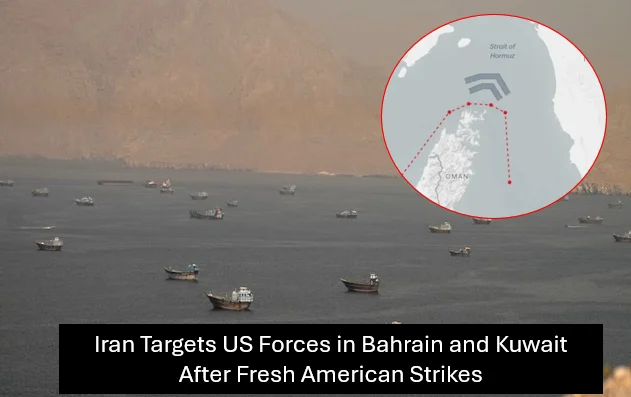

The confrontation between Iran and the United States intensified after American forces carried out another round of attacks on Iran’s southern coastline. The latest military action followed a drone strike on a commercial vessel near the Strait of Hormuz, a key global shipping route.
In response, Tehran announced retaliatory attacks against US military forces stationed in Bahrain and Kuwait. Iranian officials also warned that any further military action would be met with a “crushing response,” signaling a sharp escalation in regional tensions.
US Conducts Second Day of Strikes on Iran
The United States launched fresh military strikes on Iran for a second consecutive day, targeting several strategic locations along the country’s southern coast.
According to reports, the attacks hit Qeshm Island as well as the cities of Sirik and Bandar-e Lengeh. The military operations came shortly after a drone attack targeted a commercial vessel near the Strait of Hormuz, increasing fears of a wider regional conflict.
The latest strikes represent a significant escalation in the already tense relationship between Washington and Tehran. While details regarding the scale of damage or casualties were not immediately available, the attacks marked another major development in the growing confrontation between the two countries.
The targeted areas are located near important maritime routes in the Gulf region, an area that has remained highly sensitive due to ongoing geopolitical tensions and military activity.
Iran Announces Retaliatory Attacks
Iran responded quickly to the American strikes by announcing attacks on US forces stationed in Bahrain and Kuwait.
Tehran described the operations as retaliatory measures following the US bombing campaign against Iranian territory. Iranian officials also issued strong warnings regarding any future military action by the United States.
Authorities in Iran said the country would deliver a “crushing response” if additional attacks were carried out. The statement reflected the increasingly aggressive tone being adopted by both sides as tensions continue to rise.
The retaliatory attacks have heightened concerns among regional observers who fear that continued military exchanges could destabilize the wider Gulf region.
Also read: Iran Declares Strait of Hormuz Closed, US Rejects Claim
Drone Attack Near Strait of Hormuz Triggers Escalation
The latest escalation unfolded after a drone attack struck a commercial vessel operating near the Strait of Hormuz.
The incident immediately drew international attention because of the strategic importance of the waterway. The Strait of Hormuz is considered one of the world’s most critical maritime corridors, serving as a major route for global energy shipments and international trade.
Any disruption or military confrontation near the strait can have serious consequences for regional security and global shipping operations. The attack on the commercial vessel further intensified an already volatile situation in the Gulf.
Following the drone incident, military tensions rapidly escalated, eventually leading to the latest round of US strikes on Iranian coastal areas and Iran’s retaliatory operations against American forces in neighboring countries.
Strategic Importance of the Targeted Coastal Areas
The areas targeted during the latest US military operation are located along Iran’s southern coastline and hold strategic importance due to their proximity to key maritime routes.
Qeshm Island, one of the locations hit during the strikes, is situated near the Strait of Hormuz. The island has long been viewed as strategically significant because of its position overlooking shipping lanes used by commercial and energy vessels.
The cities of Sirik and Bandar-e Lengeh are also located along Iran’s southern coastal region. Military activity in these areas raises concerns over possible disruptions to maritime security and regional stability.
The proximity of these locations to international shipping routes has made the latest developments particularly sensitive for countries monitoring trade and security conditions in the Gulf.
Rising Fears of Broader Regional Conflict
The exchange of attacks between the United States and Iran has intensified fears that the conflict could expand beyond the immediate areas involved.
Iran’s decision to target US forces in Bahrain and Kuwait indicates that the confrontation is no longer limited to direct military operations between the two countries. The involvement of additional Gulf locations has raised concerns about the possibility of a wider regional crisis.
Security analysts and regional observers continue to closely monitor developments as both sides exchange military actions and warnings.
The Gulf region has experienced periods of heightened instability in the past, particularly around the Strait of Hormuz. The latest escalation adds to concerns about regional security, maritime safety, and the risk of additional retaliatory operations.
Also read: 18,000 Indian Sailors Remain in Gulf as 15 Ships Navigate Hormuz
Continued Exchange of Threats
Alongside the military actions, both sides have continued to exchange strong warnings.
Iran’s statement promising a “crushing response” to further attacks underscored the seriousness of the current situation. The warning signaled that Tehran remains prepared to respond forcefully if additional strikes are carried out by the United States.
Meanwhile, the continuation of US military operations for a second straight day demonstrates Washington’s willingness to maintain pressure following the incident involving the commercial vessel near the Strait of Hormuz.
As tensions remain high, international attention is focused on whether further military exchanges could take place in the coming days.
Uncertainty Over Next Developments
The situation in the Gulf remains highly volatile following the latest round of attacks and retaliatory operations.
The US strikes on Iranian coastal locations, combined with Iran’s attacks on American forces in Bahrain and Kuwait, have significantly increased uncertainty across the region.
With both countries continuing to adopt aggressive positions, concerns are growing over the possibility of additional confrontations near critical maritime routes and military installations.
The developments have placed the Middle East on high alert as the international community watches for signs of further escalation.

I am a versatile content writer from the MP region, covering politics, business, crime, current affairs, entertainment, video games, and sports with clear insights, engaging analysis, and timely, reader-focused updates.