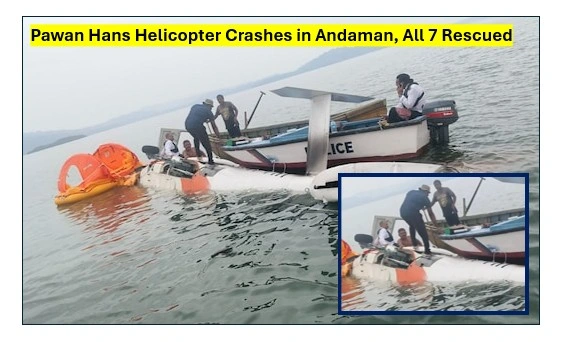

In the turquoise seas of the Andaman and Nicobar Islands, where a sky typically harmonizes with its water in a tranquil horizon, a Tuesday morning flight became one of survival and skill. A Pawan Hans helicopter carrying seven people, including a woman and an infant, crashed into the sea near Mayabunder on February 24, 2026. What could’ve been a devastating tragedy instead became a narrative of a “miraculous” rescue, when all seven people on board were pulled from the waters unharmed.
In a remarkable moment of collective relief amid new fears that have roiled air travel into and out of India in two back-to-back incidents, the incident has sent shock waves through the aviation community — the third high-profile airplane scare involving Indian aircraft on one troublesome day.
The Moments Before the Splash
The flight was a routine service run by the national chopper company Pawan Hans from Sri Vijaya Puram (previously Port Blair), at about 8.45 AM Among them were two veteran pilots — Captain Anil Janu and Co-pilot Captain T.P.S. Gulia — and five passengers.
The Eurocopter Dauphin (S365), registration VT-PHY, flew at a steady altitude of 2,500 feet for the first 45 minutes. The passengers, among them Rajita Devi and her infant child, were minutes from their destination. However, as the aircraft neared the Mayabunder helipad at 9.30 AM, something went amiss.
The Directorate General of Civil Aviation (DGCA) in its initial reports stated that during the aircraft’s descent a “technical snag” developed. Confronted with a catastrophic malfunction at only 300 meters from the runway near Dhobidera, the aviators were left with little choice but to decide in-stant: try and land a hanging-arrival, or “ditch heli” the bird into open water thus limiting high-velocity collision impact.
A Precision “Ditching” and the Race to Save Lives
“Ditching” a helicopter ranks one of the toughest tasks in aviation. To keep the aircraft from flipping on impact or smashing to pieces, it requires the pilot to level it just right with the surface of the water.
The helicopter’s emergency flotation gear deployed when it hit the water, helping keep the craft buoyant enough for its occupants to escape. Local fishing boats and emergency responders arrived at the scene within minutes of the aircraft crashing.
The Survivors
All seven individuals were rescued from the water. The passengers were identified as:
- Rajita Devi and her infant son, Kamal Ch. Das
- Sipra Saha
- Nambi Amma
A fifth passenger in addition to the two pilots
The group was taken to Dr. Rajendra Prasad Hospital in Mayabunder. Although the psychological impact of an event like this is enormous, medical officials said no serious physical injuries were reported. All of them are still under observation and will be moved back to Sri Vijaya Puram once they are stable.
Read more: Poor Visibility Led to Ajit Pawar’s Plane Crash, Pilot Warned
Safety Questions At End Of Dark Week In Aviation
The incident in Andaman ended with a miracle, but it comes at a grim time for Indian aviation. Only 12 hours earlier, a Beechcraft C90 air ambulance had crash-landed in Jharkhand’s Chatra district, killing all seven people on board. Adding to discomfort about regional flight safety, a SpiceJet flight recently declared an emergency.
“Required safety precautions were taken and safety of crew and passengers was taken care off by relevant authorities,” a spokesperson for Pawan Hans said, adding that the “short landing incident” is under full technical inquiry now.
Outdated aircraft operated by some regional carriers have served as a source of contention in parliamentary discussions over the past few weeks. This incident will likely expedite the audit of helicopter services that operate in these remote island territories, where air travel is a lifeline, and not so much a luxury, for medical and logistical purposes.
Conclusion: A Lesson in Resilience
The investigation has now started the recovery of the submerged VT-PHY airframe while attention again returns to survivors. For Rajita Devi, holding her infant in a Mayabunder hospital bed, the finer points of a “short landing” are much less important than that they are both still alive.
The landing in the Andaman sea is a grim reminder of what could go wrong with island connectivity but also speaks volumes about the training imparted to Indian pilots who, when faced with the worst scenario, made use of the water below them to save every soul on board.

I am a versatile content writer from the MP region, covering politics, business, crime, current affairs, entertainment, video games, and sports with clear insights, engaging analysis, and timely, reader-focused updates.