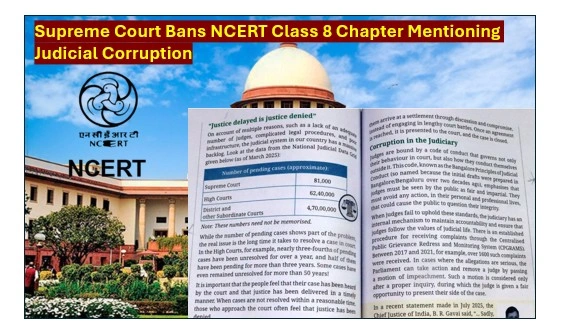

The Supreme Court banned class 8 NCERT books featuring chapters on judicial corruption on Thursday and ordered the confiscation of all physical copies and removal of their digital versions.
The Supreme Court urged the Centre and state authorities to cooperate immediately and threatened serious action if they did not. The top court sent NCERT director and school education secretary show cause letters to explain why they should not be punished.
This is a strong and unprecedented action. The highest court said the book’s content could harm the legal system’s image and trustworthiness and ordered it removed from the market immediately. It was very important to the bench, which was led by Chief Justice Surya Kant. They were very upset about how inappropriate material was allowed for young children.
What Caused the Ban?
The argument began over a section in a new Class 8 NCERT textbook titled The Role of the Judiciary in Our Society. Reports say the chapter discussed problems such as courts failing to be honest, case backlogs, and a shortage of judges.
The issue was brought to the Supreme Court’s attention by leading lawyers who said showing such content to kids could hurt the public’s trust in the legal system. The court heard the case on its own and looked at the evidence.
The bench said during the hearing that discussing corruption in the court in a school guide without sufficient background information could lead students who are easily swayed to view the subject negatively.
The Supreme Court’s Strong Points
During the hearing, the court strongly spoke out, saying that the honour of political institutions must be preserved. Reports say the bench said heads must roll, meaning those responsible for approving the content are seriously at fault.
The judges made it clear that discussing problems with institutions might be acceptable in legal or academic settings, but it’s not acceptable for school textbooks to portray these problems in a way that seems to question the courts’ honesty.
The court said the release could harm the court’s image and emphasised that the public’s trust in political bodies should not be undermined.
Orders sent right away
The Supreme Court gave clear instructions
- The Class 8 workbook that has the controversial part should not be sold at all.
- Getting rid of all paper and digital copies right away.
- Notices to the top officials responsible for clearing and releasing the information.
- Instructions to make sure that all states and schools follow them.
- The court also asked the authorities involved to explain how the chapter was accepted and disseminated.
Read more: Union Education minister praises NEP 2020 to facilitate AI and technology
What NCERT Did
After the court made its strong comments, NCERT admitted what it called an error of judgement. The council said that they had no plans to insult or slander the courts.
According to the chapter, the Supreme Court has 81,000 outstanding cases, high courts 6.24 million, and subordinate courts 47 million, suggesting a countrywide backlog of 50 million cases. It also mentioned constitutional provisions for judicial impeachment and more than 1,600 complaints received by the Centralised Public Grievance Redress and Monitoring System (CPGRAMS) between 2017 and 2021.
Former CJI B.R. Gavai warned that corruption might damage public faith in the court. The court noted that the statements were out of context and may mislead people into thinking nothing was done to punish faulty judges.
The NCERT stated that the guide would be updated and revised after consulting experts and other important authorities. It would then be used again in future school classes.
Also read: 19 year old student argues in Supreme Court for his MBBS seat
What Comes Next
The case is likely to remain under close legal scrutiny while the court reviews the responses from the relevant agencies. The next step in the textbook approval process is likely to be accountability and a review of how things are done.
The banned guide won’t be available for now, and teachers have been told not to use it until further notice. The case has been set for another hearing on March 11, 2026.

I am a versatile content writer from the MP region, covering politics, business, crime, current affairs, entertainment, video games, and sports with clear insights, engaging analysis, and timely, reader-focused updates.