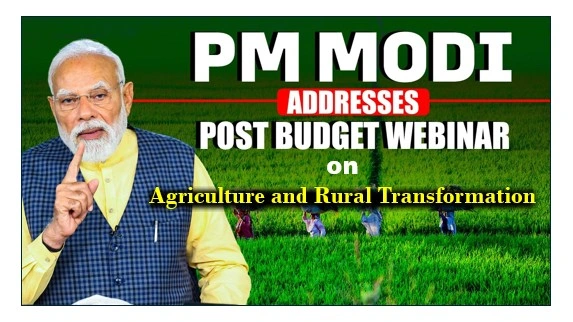

Trying to fill the policy-practice gap, Prime Minister Narendra Modi today, March 6, 2026, participated in the Post-Budget Webinar on “Agriculture and Rural Transformation”. The session is a decisive step towards realizing the vision of the government to bring to life the grand connotations of the Union Budget 2026-27 by placing it within the reality of the lives of the millions of Indian farmers and rural entrepreneurs.
As a combined Agriculture and Rural Development budget now exceeds a record 435 lakh crore, the Prime Minister speech in this regard has been based on the need to stop the traditional approach to farming and move to high value crop production, digital empowerment and rural economy.
Fields to Value Chains: A Paradigm Shift
The Prime Minister underlined that in order to achieve their targets of Viksit Bharat (Developed India), the rural economy needed to be transformed to be more than a source of raw material and should be an innovative and entrepreneurial center. According to him, land is limited, but the value addition that can be made is infinite.
In terms of subsidies, PM Modi observed that the 2026 Budget is not only about subsidies, but it is about creating an ecosystem that is viable, one that is highly diversified, and one that is built on entrepreneurship.
The Emergence of the High-Value Agriculture
A large part of the speech was devoted to the diversification of agricultural products. The government is making a colossal investment bet in so-called niche but high-demand commodities that can multiply the income of farmers exponentially:
- Coastal Areas: Coconut, cocoa and cashew are targeted.
- Hilly Areas: Walnuts, almonds, and pine nuts: High-density cultivation expansion.
- North-East: Advertisement of Agarwood and sandalwood, which is a tapping into the international odor and luxury market.
Coconut Promotion Scheme has been put in the limelight as one of the flagship projects, to replace the old, non-productive trees with high yield varieties, to sustain the close to 30 million people who rely on this tree of life.
Bharat Vistaar: Introducing AI into the Hands of the Farmer
The most futuristic part of the webinar was perhaps the talk about Bharat Vistaar, which is the recently introduced AI-enabled Digital Public Infrastructure on Agriculture. The Prime Minister termed this as a multilingual digital companion of all the farmers. Bharat Vistaar offers:
- Live Advice: Special suggestions on how to handle pests and watered in local languages.
- Market Alignment: Information about the crop planning relying on the global price trends to decrease the market risks.
- Risk Mitigation: Timely alerts on disruption by weather and detection of diseases.
This will be to make sure that scientific knowledge is no longer confined in laboratories but gets up to the last mile which is the smallholder farmer in the farthest part of the country.
Read also: The Digital Harvest: Why Farm Data Privacy is the New Frontier in 2026
Empowering Rural Backbone: Women and allied Sectors
Rural women empowerment is an incomplete vision of the Prime Minister regarding rural transformation. He rejoiced that the year 2026 is chosen as the “International Year of the Women Farmer” which means that there will be a certain push to get more credit to female-led groups.
The Impact of SHE-Marts
The webinar elaborated the growth of SHE-Marts (Self Help Entrepreneurs-Marketing Avenues to Transform rural). These centres will ensure that rural females who own businesses have easy access to the city markets bypassing middlemen and leaving the income earned by the handmade and processed products in the community.
Also read: PM Modi of India Inaugurated Micron Semiconductor Plant
Advancing the Animal Husbandry and Fisheries Sector
The allied industries, which frequently formed the main source of income of the landless workers, were again given attention:
- Livestock: A credit linked subsidy will be introduced which promotes the establishment of Livestock Farmer Producer Organizations (LFPOs).
- Blue Economy: An integrated development of 500 reservoirs and Amrit Sarovars will help enhance the coastal fisheries value chain as well as increase production of inland fish.
Read more: Israel, India sign 16 MOUs on agriculture, tech, at Jerusalem
Cracking the Numbers: A Financial Obligation
In order to make this transformation more human, it is necessary to refer to the fiscal roadmap. The budget of Agriculture Department has had a continuous rise, and this year, it is 1.62 lakh crore, which is 7 percent higher than last year. Better still, there is an increase in Rural Development budget by 21 percent, which ensures that the infrastructure such as roads (PMGSY) and housing (PMAY-G) is in line with economic growth.

I am a versatile content writer from the MP region, covering politics, business, crime, current affairs, entertainment, video games, and sports with clear insights, engaging analysis, and timely, reader-focused updates.