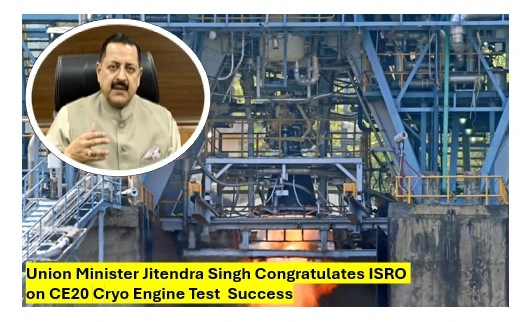

In another move, which marks the dawn of muscularity in the Indian space ambitions, the Union Minister of State, Science and Technology Dr. Jitendra Singh recently congratulated the Indian Space Research Organisation (ISRO). The occasion? A successful 165 second CE20 cryogenic engine hot test to a whopping 22 tonne thrust.
This was not the usual check-up at the ISRO Propulsion Complex (IPRC) in Mahendragiri. It was a demonstration of unrefined strength and native accuracy that was a high-stakes one. Having been able to conduct a test of this engine at an uprated power, ISRO has effectively provided India with a bigger hammer with which to shatter the obstacles of heavy-lift satellite launching and human spaceflight.
The Heart of the Beast: The 22-Tonne Leap
A change of 19 tonnes to 22 tonnes of thrust may appear to the untrained as a minor adjustment. It is a break-through in the field of rocket science. The LVM3 (Launch Vehicle Mark-3)- the heaviest and most stable rocket in the Indian fleet is the beating heart, the CE20. the rocket is also popularly known as the Bahubali of the fleet.
The CE20 had so far a standard thrust level of 19 tonnes. ISRO is priming the LVM3 with payloads much bigger by pushing that envelope to 22 tonnes. This is in the near future C32 cryogenic stage, which is an improved upper end that will provide the LVM3 with the power it needs to propel more than 8 tonnes to the Geostationary Transfer Orbit (GTO).
Read more: PM Modi congratulates ISRO on successful launch of BlueBird Block-2
Taming the Fire: Testing the Sea-Level
Conducted on the ground, the test of a cryogenic engine is controlled chaos. The CE20 is made to be able to move and breathe in space with no atmospheric pressure to push away the exhaust. When you run that same engine on the seashore, the outside air pressure is far greater than the pressure of the gas which is leaving the nozzle.
This results in a threatening occurrence referred to as flow separation. In case of a garden hose, when the water has an air block, the nozzle will shake violently and in the case of a rocket engine, it causes enormous vibrations and thermal stresses that can literally rip the metal open.
In order to overcome this, ISRO engineers have put into use two very vital home-grown pieces of technology:
- Nozzle Protection System (NPS): A special protective cover that enables the engine to execute full 22-tonne of thrust at sea level without the nozzle falling down and disintegrating.
- Multi-Element Igniter: It is a complex type of a spark plug that provides smooth, reliable ignition of the volatile combination of Liquid Hydrogen (by -253 C) and Liquid Oxygen (by -183 C) each time.
The fact that the engine lasted 165 seconds, or almost three full minutes of raging fire, demonstrates that India an engineering is now powerful enough to take the most severe conditions possible.
Also read: BlueBird Block-2 mission: ISRO successfully launches LVM3-M6 rocket
An Engine that is a Record-Breaker of the Veteran type
It is yet another marvel that this particular test takes even more astonishing is the engine. The CE20 unit, which was used in this trial, has already undergone a record breaking 20 hot trials. This engine is an old warrior in the high performance machine industry.
ISRO has been able to validate the following by reusing the same hardware:
- Indigenous Turbopump Bearings: Rotating components that are vital and have to rotate at tens of thousands of RPMs in the presence of freezing liquid.
- Indian-made Sensors: The real-time health check of the rocket.
- Bootstrap Mode: This is the capacity of the engine to start itself on its internal pressure, as opposed to using heavy external start-up gas tanks.
This emphasis on the indigenization is not merely about pride, it is about Atmanirbharta (self-reliance). By developing these elements in India, ISRO will save money and be certain that the Indian space program will never come to a halt due to international sanctions or any other problems with the supply chain.

I am a versatile content writer from the MP region, covering politics, business, crime, current affairs, entertainment, video games, and sports with clear insights, engaging analysis, and timely, reader-focused updates.