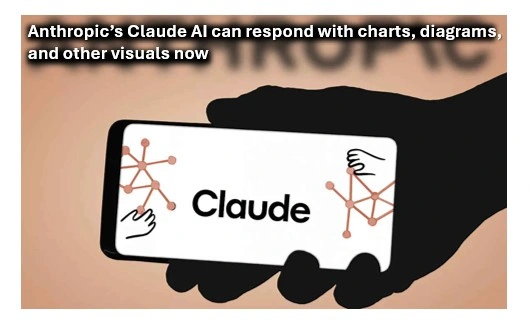

A new paradigm is shifting in the constantly changing environment of artificial intelligence where it is a routine to talk to a machine daily by millions of people. It is an exchange between the verbal and the visual. The subsequent transformative update to the Claude AI was officially released by Anthropic, which allowed the chatbot to leave text-based explanations and provide interactive charts, diagrams, and advanced visual maps in response.
The constraint of Large Language Models (LLM) has long been its verbosity, i.e. the propensity to describe a complicated data pattern or a structural process in the form of a wall of text that demands the entire mental burden of a human to interpret. Under this new beta feature Claude has succeeded in picking up a marker to draw its thoughts on a digital white board and thus the interaction does not seem more like a lecture but rather like a unanimous workshop.
The Whiteboard Effect: Visuals Built Live
The unique feature of this update as compared to those that came before is its technical DNA. Claude is not creating a picture of a static.jpg or.png file like an art piece that has been produced by AI. Rather it employs a mix of HTML and SVG (Scalable Vector graphics) to create interactive, live-rendered elements directly into the chat-thread.
Suppose you put Claude to the task of defining the notion of compound interest. Claude does not merely present you with the formula and a bit of text anymore, but gives you a dynamic growth curve. You can also click on various points of the graph to check the certain values or you ask Claude to show me what will happen when I increase the interest rate and the visual will automatically change in front of your eyes.
This is an inline type of approach, as it does not require a person to move to a side panel or use a special tool such as Canva or Excel. The diagram is present right there in the midst of discussion and it is a thought process in between a complicated concept and the human perception.
Humanizing Data: Spreadsheet to Story
In addition to the cool factor of a moving graph, the actual worth of Claude visual responses is that it humanizes data. To an owner of a small business who has uploaded a sloppy CSV file of his sales each month, Claude now can generate a revenue heat map or even a funnel diagram immediately to tell him where the customers have fallen off.
Read more: Is Claude down? Many users all over the world unable to use
The Difference between Visuals and Artifacts
It should be mentioned where this feature belongs in the larger Anthropic ecosystem. A lot of users are already well-acquainted with Artifacts -the permanent workspace of the side-screen on which Claude constructs code, complete documents, or mini-applications.
The new visuals reactions are supposed to be short-lived and dialogical. They are mental briefs that are meant to make you comprehend a particular point at a given time. Whereas Artifacts could be things you save or share or download as a completed project, these in-line images are more like gestures during a discussion. They fluctuate, develop or vanish with every further discussion of another subject.
Read also: 13 AI Giants Told to Immediately Curb ‘Harmful’ Chatbot
The reason this is important to the AI Vibe
The tech world is getting weary of the so-called AI-speak the overly polite, even overly redundant tone which several models have. By incorporating graphics, Anthropic is tackling one of the basic human realities that we process images 60,000 times more rapidly than text.
A block of text is an obstacle to a student attempting to grasp the concept of the Water Cycle or to an engineer seeking to know why a bridge atop which they are is bearing more weight than it should. A diagram is an invitation. It is by inculcating the incorporation of these images into the reasoning process that Claude will start to act more like a human instructor who will grab the pen whenever you say, I do not quite get it.

I am a versatile content writer from the MP region, covering politics, business, crime, current affairs, entertainment, video games, and sports with clear insights, engaging analysis, and timely, reader-focused updates.