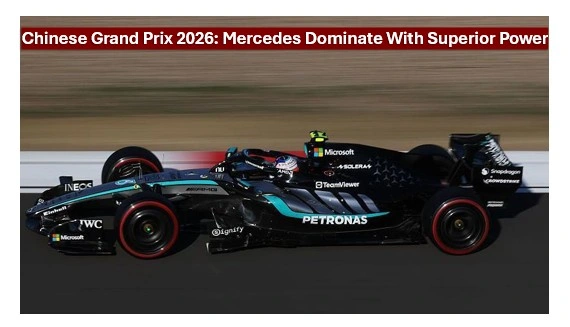

The 2026 Formula 1 race was advertised as a blank slate, an opportunity of the grid to break out of the grip of old dynasties. However, residents at the Shanghai International Circuit saw a common silver shadow on the paddock on the weekend as the sun went down. The Chinese Grand Prix has always seemed like a temple of speed, but now, with the new rules of power units, it turned into a laboratory where Mercedes is already demonstrating to the rest of the world a very painful lesson.
When the 2026 regulations were meant to focus on sustainability and hybrid equality, the Silver Arrows have introduced a Party Mode 2.0 that has seen competitors scampering to breathe on the famous 1.2km back straight of Shanghai. It was not a mere victory but a technological statement.
The Age of the Silver Rocket is Born
It was not only about the winner of the weekend, but it was also about the way the winner did it. Mercedes W17 is actually two of the vehicles: an agile balanced chassis in the winding middle gear, and a battery-powered electric monstrous car on the fast straights.
The regulations of 2026 provide a 50/50 split between the internal combustion engine and the electrical recuperation system. In the case of teams such as Ferrari or the new Red Bull-Ford alliance, the issue of battery running out at the end of a straight and the car slowing down in an ungrateful manner is quite evident, but in the case of the Mercedes power unit, the battery appeared to have an unending supply.
Kimi Antonelli, the 19-year-old star who has taken the vacuum created by Lewis Hamilton joining Maranello, became the youngest-ever pole-sitter on Saturday. Over his lap was a harmony of energy control. When others were lifting and coasting to save juice to last to the last sector Antonelli was free to hold the throttle body to the floor. The statistics in the rest of the grid were horrifying enough: Mercedes-powered vehicles were averaging a top speed of 335.5 km/h, about 10 km/h faster than the Honda-powered Aston Martins.
Read more: Formula 1 2026 Rules Explained- Smaller Cars, Boost Button and Big Changes Ahead
Modern Energy Management Masterclass
The Grand Prix itself was more of a pursuit race only that the pursuers were running in chest-high water. George Russell, who has been leading the current championship, had a kind of engine-whispering, which indicated that he has probably spent more time in the simulator than in his own bed this year.
It is fascinating how human the new cars have become. In 2026, the driver is not merely driving, but he or she is conducting an intricate electrical orchestra. Russell and Antonelli are operating their new Boost Button like a scalpel and unleashing their 350kW of electrical power at the moment it takes to slice the slipstream of any car they are overtaking.
The Russell victory in Sprint was followed by the observation that it was like playing chess at 200 miles per hour. “You can’t just go flat out. You must choose where to pick, where to strike. The car provides you with this much deployment, it means that it is not greedy.
The “Chasm” Behind the Silver Arrows
The best indication of the power of Mercedes is not the distance separating them and the Ferraris, but the distance between themselves and their clients. On the same Mercedes engine, McLaren was almost a second slower than the pace in qualifying. This implies that the “hardware can be accessed by everyone but Mercedes has unlocked the secret of the dark art of thermal management and energy recovery which makes the W17 a step above the rest.
- The struggle of Red Bull: Max Verstappen had a weekend to remember. Punchy in short-run, Red Bull-Ford unit had serious derating of long-run periods. The qualification result of eighth in the grid was the worst in years by Verstappen, which led to the speculation of emergency meetings back in Milton Keynes.
- Ferrari Efficiency Problems: The Scuderia have the downforce, and their car appears the most secure in the Snails of Sectors 1 and 2. They are, however, now limited by their Achilles heel which is power efficiency. Leclerc made the gain on the corners every time, two on the straight.
- The Alpine Surprise: Interestedly, the Mercedes-driven Alpine demonstrated glimpses of greatness, and it was the fastest car in the weekend in single top speed. According to it, the one thing that needs to happen is to remove the drag to realize that the Mercedes engine is a monster that is eager to be released.

I am a versatile content writer from the MP region, covering politics, business, crime, current affairs, entertainment, video games, and sports with clear insights, engaging analysis, and timely, reader-focused updates.