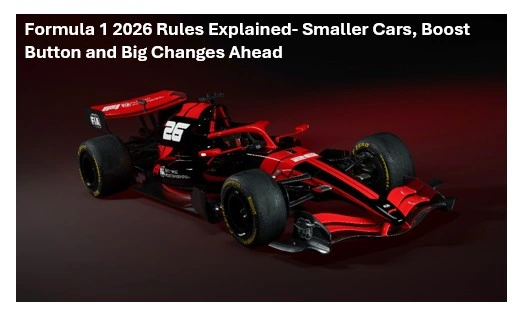

In 2026, big changes will be made to Formula 1’s rules, bringing races closer together, making them more interesting, and extending their duration. After being accepted by the Fédération Internationale de l’Automobile (FIA), the new rules will change how cars are built, how their engines operate, and how races are run, starting in 2026.
These changes are being made to make passing easier, reduce the cars’ weight, and give electric power a larger role in sports hybrids.
Small and Lighter Cars
One big change for 2026 is that cars will be smaller and lighter. Many people have said that the current Formula 1 cars are too big and heavy that makes it hard to race closely. The new rules say cars have to be shorter and smaller, and weigh less, too.
It’s important to make the cars go faster and easier to steer on small tracks. Also, lighter cars should be better at turning and stopping, which could give you more chances to pass.
By reducing the overall size, officials hope that cars will be able to follow each other more closely without slowing down due to rough air. This could lead to more fights between cars during a race weekend.
New Power Units and More Electric Power
The rules for 2026 will bring about a new breed of power units that will focus more on electricity. The turbocharged V6 engine will still be there, but the electricity part will be much more important for speed.
The new combination system will make almost equal amounts of burning power and electric power. At the same time, the complex MGU-H system currently used in engines will be removed to simplify the design and lower costs.
Sustainability is also a big deal. Fuels that are completely renewable will power the new engines. This will help Formula 1 reach its long term goal of becoming carbon neutral. Officials think this move will not only be good for the sport but also for the technology used in cars in the future.
Ferrari Unveils Name and Interior of Its First Electric Sports Car Luce
Boost Button and Overtake Mode
The addition of a new boost button method may be the most exciting thing for fans. With this feature, drivers will be able to gain extra power when passing a competitor.
The new DRS system is more focused on deploying energy, while the old system opened a flap on the back of the wing to lower drag. People who are following another car can use extra electric power to get closer and move.
Not just how well drivers use aerodynamics, but also how skilled and well-planned they are, this way is meant to reward them. It could also make race plans less obvious because teams will have to watch how much energy they use during the race very carefully.
What’s Going to Happen Next
The changes to the rules for 2026 are one of the biggest in recent Formula 1 history. It should bring in new engine manufacturers and strengthen the battle between teams.
The sport hopes to make racing more exciting while still meeting environmental goals by using smaller cars, better electric performance, and new ways to pass other cars. Teams will have to address new issues as they prepare for the new world. For fans, though, the promise is simple- faster races, better strategy, and a new stage in Formula 1’s history.

I am a versatile content writer from the MP region, covering politics, business, crime, current affairs, entertainment, video games, and sports with clear insights, engaging analysis, and timely, reader-focused updates.