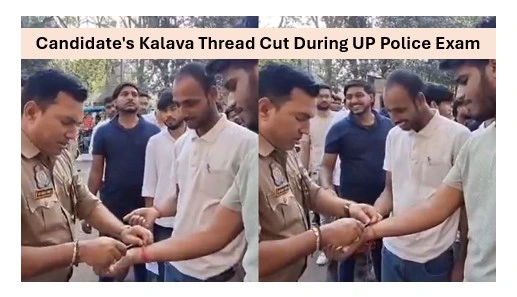

A controversy erupted after a video surfaced online showing a police employee cutting a candidate’s kalava (holy red string) while conducting a security check at an Uttar Pradesh police recruitment test. The footage of this incident took place at a center in Varanasi on March 14th, and was shared on social media, resulting in a debate around how religious symbols should be treated in competitive examinations.
Kalava (also called mauli) is the religious red string tied around the wrist during a Hindu religious ceremony, and is thought by many to represent faith and protection. The cutting of the candidate’s kalava raised concerns and many people expressed their disappointment with the police for cutting the sacred thread.
Viral Video From Varanasi Exam Centre Triggers Controversy against UP Police Recruitment Board
The Uttar Pradesh Police Recruitment Board has responded to this incident and has taken action since the video has gone viral and many people are expressing outrage. An official released a statement advising that police officers should have followed the guidelines provided for conducting recruitment exams when conducting the search.
The Board stated that prior to conducting any examinations at the Examination Centres, clear instructions had been given to all personnel assigned to those examinations regarding the treatment of candidates’ religious symbols (such as kalavas or mangalsutras), including their prohibition from being forcibly removed or disturbed during searches.
In response to the incident, the authorities stated that it was an unfortunate situation, and that disciplinary action will be taken against those found to be responsible for it. Additionally, the Board noted that officials are advised prior to each examination on how to conduct themselves during searches sensibly in order not to offend the religious beliefs or freedoms of candidates.
Concerns about the Security Practices and Religious Freedom
There are very strict security practices in place when conducting competitive examinations throughout all parts of India in order to prevent cheating and/or the use of electronic devices when candidates take examinations. Before candidates can enter an examination hall, they are asked to remove items of clothing such as wristwatches, shoes, jackets and belts, as well as all forms of jewellery and metallic items.
The incident has reignited discussion about how the removal of signs and symbols associated with faith and belief should be handled by security personnel at examinations. Authorities assert that strict security procedures are necessary to preserve the validity of the test, while some critics contend that religious articles (like sacred threads) should be treated with consideration as long as there is no imminent reasonable concern for safety.
According to experts, examination authorities must balance between enforcement of measures designed to prevent cheating, and ensuring that individuals are able to exercise their right to practice their religion. Many have suggested clearer guidelines and adequate training for security personnel as strategies for preventing such occurrences.
Read also: Bihar appoints 17,000 retired personnels in Special Auxiliary police
Similar incidents have occurred at previous examinations
The Varanasi community incident is not the first in which the removal of religious items during examinations has caused controversy in India. In 2025, candidates taking the Karnataka Common Entrance Test (CET) claimed that examination officials required them to either remove or cut their sacred thread (janivara or janeu) prior to being admitted to take the test, prompting protests from various community organisations.
The Government has taken action against many examination authority instances, where exam authorities subsequently clarified, an individual acted independently; i.e., violated the exam regulations without the intent to violate. The Government acknowledges that exam candidates must remove religiously significant items from their person(s) or possession(s) and is willing to hold the responsible parties accountable for their actions.
As the examination authority continues to receive new requests for clarification regarding what constitutes “non-religious items”, the continuing emergence of these issues identifies significant challenges in the ability of examination authorities to establish uniform security procedures throughout India due to the multitude of cultural, religious beliefs represented in the country’s population.
Read more: CBSE Cancels Class 12 Exams in the West Asia Region
Public Discussion About Religious Symbols in Public Spaces
Many people are now talking about religious symbols in public institutions after the recent events in Varanasi; especially, items like kalava (sacred thread), which many religious groups consider integral to their religious practices. As a result, members of these groups see objects like the kalava as representative of a person’s very existence.
Examination authorities are responsible to ensure fair treatment and safe and uniform administration of competitive exams for many millions of male and female candidates across India. Experts believe that examination authorities need to communicate clearly to all examination candidates the established guidelines and procedures concerning religious activities; and to properly train all examination personnel in regards to these established guidelines so as to reduce instances of violation of competing security policies in the future.
The continuing investigation into the incidents at Varanasi is an example of the difficulties that authorities face when enforcing examination security measures versus the need to respect religious beliefs of individuals in public places throughout India.

I am a versatile content writer from the MP region, covering politics, business, crime, current affairs, entertainment, video games, and sports with clear insights, engaging analysis, and timely, reader-focused updates.