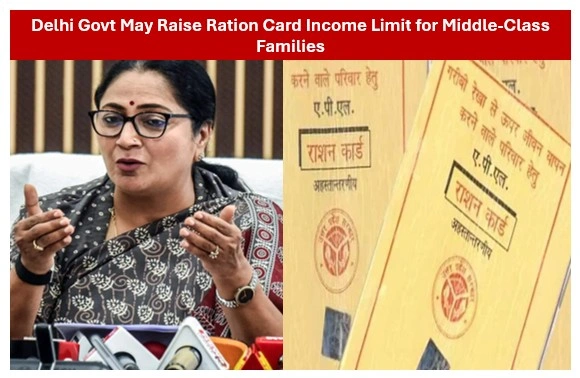

The Delhi government wants to raise the annual income cap for people eligible for a food card. This is a big change that could help thousands of families across the city. The suggested change could raise the cap from 1.2 lakh to 2.5 lakh per year. This would allow many lower middle class families who are having trouble making ends meet to get food benefits.
People think this is one of the most important changes to Delhi’s public transport system in the past few years. Families with low wages are having a hard time right now because of rising prices for things like food, medicine, and other necessities.
Chief Minister Rekha Gupta recently said that the government is trying to make the food security system bigger so that more people who need help can get it. Reports say that after the new rules are put into place, about 7.72 lakh new food cards may be given out.
Why the government of Delhi wants to raise the income limit
Up until recently, the most a person in Delhi could make in a year and still get a food card was ₹1 lakh. The government changed it earlier this year to ₹1.2 lakh as part of the new Delhi Food Security Rules, 2026.
Officials now think that the current limit is too low, though, because of how bad the economy is in the national capital right now. Families making just a little more than ₹1 lakh a year are having a hard time paying their rent, school fees, power bills, and food costs.
It is hoped that the planned rise to ₹2.5 lakh will help families who are not officially poor but still have trouble paying for basic needs. According to people in the government, the plan’s goal is to make sure that discounted food items reach more people who are struggling with prices and job insecurity.
People who make a daily wage, run small shops, drive, do housework, work on contract, or work in the private sector and have unpredictable incomes may gain the most from the change.
read also:
Lakhs of new recipients are expected
The government thinks that about 7.72 lakh new food cards could be given out once the new rules take effect. Officials say that a lot of applications had been held up for years because policies were not clear and requirements for qualifying were very strict.
The government also said that more than 3.89 lakh applications were still being processed because of problems with verification and old rules. At the same time, it was said that more than 11 lakh people in Delhi were waiting to get food security benefits.
With the suggested change, many people who were turned down before because of their low income may now be able to apply.
The government should also start taking new applications again, but this time in a more organised and clear way. Reports say that the entry process could start online on June 15.
Digital Process and More Thorough Checks
The government wants to make more people eligible, but they are also tightening the verification process to prevent abuse. Because of the new rules on food security that were put in place earlier this year, applications are now only done digitally.
Instead of self declarations, applicants must now show proper pay papers. All family members’ Aadhaar numbers, proof of where they live, and other supporting papers may also be needed.
Crackdown on Beneficiaries Who Aren’t Eligible
Along with making the program bigger, the Delhi government has also started a checking drive to find people who might be getting food benefits without being eligible.
According to recent news, almost 25,000 people who had ration cards were reported because they were said to own land, cars, or other assets that were not allowed. Officials warned that recipients who aren’t qualified could lose their cards if they couldn’t show proof of income.
A big step forward has been the cancellation of about 7.72 lakh old or idle food cards as part of the cleanup process.
Help for families who are having a hard time with rising costs
The planned increase in the income cap is likely to help a lot of families who are having trouble paying their bills but aren’t eligible for welfare.
The cost of living in Delhi has gone up a lot in the past few years. Higher prices for food, travel, school fees and rent are putting a strain on monthly family budgets. For many working-class families, having a stable job doesn’t mean they’ll always have money.
If the annual income cap is raised to ₹2.5 lakh, families that make about ₹20,000 a month might also be able to get food help.

A versatile writer mainly works on trending news, daily updates from politics, business, crime, current affairs and entertainment.