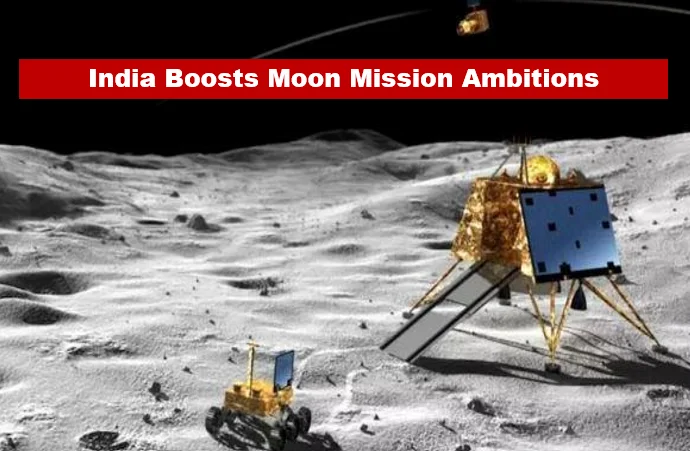

India’s soft-landing near the lunar South Pole in August 2023 was the first time that the country had landed on the moon, but it was a sad failure-of-the-landing. Solar-powered Vikram lander and Pragyan rover of Chandrayaan-3 mission had just 14 earth days to work. Once the sun had set and left the area in a fortnightly cold of minus 120 degrees Celsius to minus 180 degrees Celsius, it was time for unprotected electronics to take a break from the dark. They never woke up.
Under such a context, Indian Space Research Organisation (ISRO) has tied up with the Department of Atomic Energy (DAE) to ensure that future missions do not end up in a similar situation. This valuable collaboration was announced by ISRO Chairman V. Narayanan at CSIR-RISE Conclave in Bengaluru, with the objective of creating innovative radioisotope-based artificial heating systems.
Overcoming the Lethal Lunar Night
In designing spacecraft to go to the Moon, the physics of the Moon create a hard challenge. One lunar day is approximately 14 Earth days, and the following 14 earth days are in complete darkness. Without a heat and power source, fragile silicon computing chips will explode and delicate batteries freeze solid, and structural materials crack.
On that date, 23rd August 2023, India became the first and only nation to successfully soft-land near the south pole of the Moon, ISRO Chief V. Narayanan recalled. The 14 days of lunar night which it would have to endure were not long enough for the Vikram lander to hold up as it relied on the sun’s rays for electricity. In the following 14 day lunar night, it would not be able to survive because it was without power and very cold.
ISRO is looking into nuclear technology in the form of Radioisotope Heater Units (RHUs) and Radioisotope Thermoelectric Generators (RTGs) with the help of the DAE. These systems are based on the natural decay heat from radioactive isotopes, which gives a continuous, fixed amount of heat. They do not need to be in the sun to work or to be affected by a dust storm or the distance the spacecraft travels from the sun.
Read also: NASA Launches First Crewed Moon Mission of the 21st Century
The Technology: How Nuclear Heating Saves Spacecraft
The heart of the partnership is the DAE’s proprietary knowledge on nuclear materials that enables the production of manufactured local thermal units that are suitable for space grade applications. The engineers are aiming to use small, efficient electrical heaters to warm specific parts of the heavy lander, rather than attempting to preserve the whole vehicle’s heat.
| Architectural Element | Chandrayaan-3 Design Standard | Future ISRO-DAE Design Goal |
|---|---|---|
| Primary Power Source | Solar arrays with Li-ion batteries | Solar arrays supplemented by Nuclear Isotopes |
| Night Survival Tech | None (Passive insulation only) | Active Radioisotope Artificial Heaters |
| Target Lifespan | 1 Lunar Day (~14 Earth Days) | Multi-cycle survival (100 to 200 Earth Days) |
| Thermal Environment | Peaks at 121°C | Tolerates plunge down to minus 180°C |
These are atomic heating units, which have no moving parts. Thermocouples generate electrical currents directly as a result of isotopic decay, and capture the raw heat needed to maintain the interior temperature of the lander above the freezing point. It’s completely autonomous and will work perfectly even if it’s in a deep crater at the lunar pole, where the lander is completely shadowed.
A Web of Scientific Alliances
The ISRO-DAE collaborative effort is not a single entity; it’s part of a more ambitious effort for ISRO to establish technical partnerships with other top research institutes within India. In the conclave, Chairman Narayanan revealed a few more such inter-departmental operations that he believed would help them move the boundaries of science:
- ISRO & CSIR: 17 projects have already been approved for immediate implementation with 40 areas of advanced technological cooperation charted by ISRO with the Council of Scientific and Industrial Research.
- ISRO & DBT: In collaboration with the Department of Biotechnology, ISRO is studying the microgravity experiments conducted by Group Captain Subhanshu Shukla during his Axiom-4 mission to the International Space Station (ISS).
- Space Medicine Development: ISRO is directly interacting with the Department of Science and Technology (DST) along with private healthcare startups to develop medical protocols specifically for the Gaganyaan crewed spaceflight missions.
Read also: Union Minister Jitendra Singh congratulates ISRO on it’s success
Why 200 Days Changes Everything
An extension of the life of the lander to 200 days makes India’s lunar mission a long-term operation, rather than a short “scouting run”. A lander can observe seismic activity on the Moon over a period of several months, map reservoirs of underground water-ice changing with the seasons, and measure changes in the plasma environment at the poles.
Moreover, the mastery of bare-metals nuclear thermal technology is an absolute must for India’s long-term space roadmap of developing Bharatiya Antariksha Station by 2035 and landing an Indian astronaut on the Moon by 2040. ISRO and the DAE are thus setting the ground for any future Indian mission to the moon, when the Indians’ feet come in contact with the dust on the moon, the technology that keeps them alive will be of all India’s own making.

A versatile writer mainly works on trending news, daily updates from politics, business, crime, current affairs and entertainment.