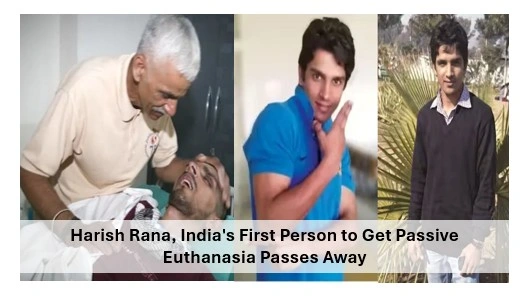

Harish Rana has succumbed to his lengthy and exhausting fight to die with dignity. He was the first person in India to receive a judicially sanctioned order for passive euthanasia, thereby setting a historical and legal precedent that will affect the way in which the country addresses the issue of the right-to-die with dignity moving forward.
Harish’s death also represents the conclusion of an important historical and legal precedent regarding the right to die with dignity within the India as well as an important change in the Indian legal system as it pertains to the ethical and legal issues surrounding euthanasia.
A 13 years old medical ordeal
Harish was in a persistent vegetative state and had no improvement from medical treatment since 2013, due to a traumatic brain injury suffered that year; thus, he completely relied on life support systems to remain alive (13 Years of Unyielding Medical Treatment).
Over the past thirteen years, Harish’s family has suffered enormous financial and emotional hardships as a result of the costs of continuing to care for him, and the inability to improve his condition. Harish’s family petitioned for a court decision allowing them to remove his life-sustaining treatments so he could die with dignity.
Supreme Court of India’s Historic Ruling on Passive Euthanasia
On March 2026, the Supreme Court of India ruled that passive euthanasia is lawful in India, allowing his family to proceed with removing him from life-support.
The court also ruled that when patients cannot survive due to medical conditions, the individual has the right to choose their time of death. Under Canadian constitutional law, provisions exist regarding who is permitted to submit a written grievance if one individual aids the death of another.
Harish transitioned from life-sustaining care; he was cared for compassionately and without suffering and had the emotional and physiological support of family and friends throughout approximately six (6) months of transitions between medical facilities that supported his family through an arduous transitional journey.
Moral and Ethical Issues
Rana’s case was covered extensively in Canada and prompted many people to think about the challenges faced by families with members who are terminally ill or unconscious. While many praised the courage of the family for making such a difficult decision, others, too, condemned the family for having made that decision due to the complicated feelings people associate with hope, suffering, and dignity.
Rana’s case has once again exposed the continuing debate about euthanasia, and the distinction between allowing someone to die by not providing them with treatment versus deliberately ending their life.
Also read: Rinku Singh’s Father Khanchandra Singh Passes Away After Battle With Cancer
Passive Euthanasia
Passive euthanasia is the process of allowing terminally ill patients to die naturally, without going through the formal process of dying by withdrawing or withholding treatment that supports life, such as being placed on a ventilator or feeding tube. Unlike active euthanasia (which remains illegal in India), passive euthanasia has been accepted as a legally viable option since the judicial ruling allowing the use of passive euthanasia in the case of Rana.
A major milestone for the Indian legal framework, the implications of this decision will be felt throughout the Indian healthcare and legal systems. Some of the key implications of this case are:
- It has been confirmed that Article 21 (Rights to Life) provides protection not only for the right for an individual to live, but it also assures that an individual who is dying will be afforded a minimum standard of respect and dignity during the process of dying.
- There is now an urgent need for legislation to address how to make decisions on behalf of patients at the end of life.
- There is little infrastructure for providing palliative care in India at this time.
Read more: Veteran actress Pravina Deshpande passes away at 60
Conclusion
The loss of life by Harish Rana is not just an end to his own personal fight, but is indicative of the changing tide in India in terms of how we view, understand and deal with matters such as living, dying and the dignity associated with each of those things. His passing has created new opportunities for the creation of more compassionate, caring, legal and medical systems surrounding the process of dying; continuing to foster an understanding of the subject of making end-of-life decisions with the necessary empathy; and allowing for more open dialogue on making end-of-life decisions.

I am a versatile content writer from the MP region, covering politics, business, crime, current affairs, entertainment, video games, and sports with clear insights, engaging analysis, and timely, reader-focused updates.