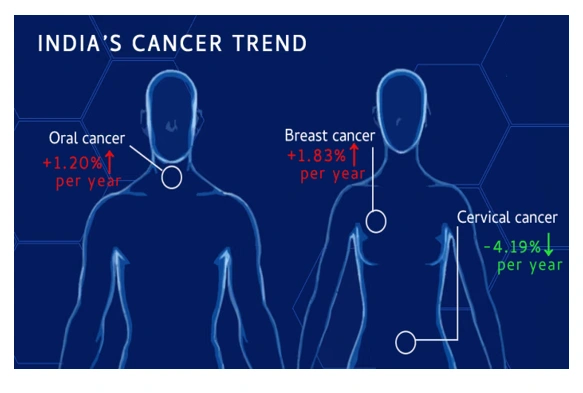

A study by the ICMR shows that India’s cancer rates changed in different ways between 1998 and 2017. This is because people’s lifestyles and health measures have changed.
Between 1998 and 2017, the number of cases of breast cancer and mouth cancer slowly rose in India. This is different from most rich G20 countries, where cases are either staying the same or going down.
New research from the Indian Council of Medical Research (ICMR) released this month in the Journal of Public Health shows that the number of cases of cervical cancer in India dropped sharply during the same time period.
Five scientists at the ICMR-National Institute of Noncommunicable Disease Epidemiology (ICMR-NINE) in Bengaluru—previously called the National Centre for Disease Informatics and Research (NCDIR)—did the study. They looked at how often breast, cervical, and oral cancers happened and how many people died from them in G20 countries from 1996 to 2020.
Researchers used a technique called age-period-cohort analysis to figure out if the rise in cancer risk is real or just because the population is getting older. This technique separates the effect of an ageing population from larger historical trends and generational change.
This is what the numbers say about India
What they found is very bad for India. The number of cases of breast cancer rose by about 1.83 percent per year. The number of cases of mouth cancer in men rose by 1.20 percent each year. But cervical cancer went against this trend. The number of cases in India dropped by 4.19 percent per year, which was one of the greatest drops of any country that was studied.
There were more different trends in high-income countries. The yearly rate of breast cancer went down by 0.44% in the US, which is statistically significant. In contrast, rates went up slightly in Australia, Canada, and France. The number of men getting mouth cancer in France dropped by 2.75 percent per year, which was one of the biggest drops in the study.
Of all the countries in the study, China had some of the greatest falls. The number of cases of breast cancer in China went up by 2.03% per year. The number of cases of cervical cancer rose by 6.11 percent each year. In China, the rate of male mouth cancer also rose at a rate of 1.10 percent per year.
Read also: Apollo Doctor Explains How to Use Black Coffee for Fat Burn Without Harming Liver
India goes against the G20 trend
The study grouped countries by their socio-demographic index, or SDI. The SDI is a measure of general growth that takes into account factors like income, schooling, and birth. India is in the lower middle group of the SDI.
In most high-SDI countries, the death rate picture is generally good. Deaths from breast cancer fell by 2.52 percent a year in the UK, 2.47 percent a year in Canada, and 2.25 percent a year in Australia. South Korea had the biggest drop in cervical cancer deaths, at 3.06 percent per year.
In France, the death rate from mouth cancer in men fell by 4.16 percent each year. But not all high-income countries followed this trend. For example, the death rate from breast cancer went up in Japan and South Korea, and the death rate from mouth cancer went up for both men and women in the UK.
There are no death rates for India in the information, so it is not possible to say how the rise in cases is affecting lives.
The cohort study also shows that India’s cancer risks stay high across generations. This is different from high-income countries, where the risks tend to go down with each generation. The writers said that in India, China, and Turkey, the risks stayed high across all age groups. This was because oral tobacco, betel quid, and booze were still very common.
Oral cancer: a problem with smoking that won’t go away
Oral cancer is the type of cancer that is most affected by India’s unique risk factors. The main things that cause oral cancer, according to the study, are smoking, drinking alcohol, having an HPV infection, and eating betel nuts. The study also says that mouth cancer is a big problem for public health in India. Early identification is very important because most cases are only found when they are already very bad.
In India, the trend of ages is very telling. The rates of mouth cancer in men and women are about the same until about age 40. After that, the rates in men start to rise quickly.
Read also: AI to Drive Singapore’s Next-Gen Cancer Profiling Test
Breast cancer and changes in how people live
The rise in breast cancer cases in India is similar to what is happening in other growing economies. The study connects it to more people adopting what it calls “westernised” habits, such as smoking, drinking alcohol, and being overweight, along with changes in hormones and reproduction, like menstruation starting earlier, having children later, and nursing for shorter periods of time.
Cervical cancer: A rare win, and what it teaches us
India’s cancer statistics shows the biggest difference when it comes to cervical cancer. Breast and mouth cancer rates are going up, but cervical cancer rates are going down. The study’s authors say this difference should teach lawmakers something.
The Union government just started its first national HPV vaccine program. It will give free shots to about 1.15 crore 14-year-old girls in all the states and union territories. Gardasil-4 is used in the single-dose scheme. It protects against HPV types 16 and 18, which are the forms that cause most cervical cancers.

A versatile writer mainly works on trending news, daily updates from politics, business, crime, current affairs and entertainment.