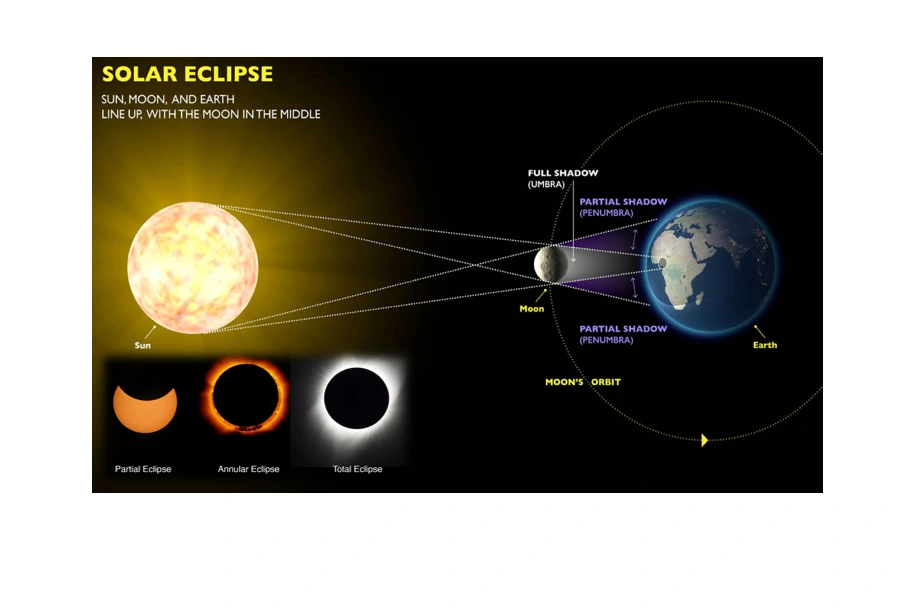

The first solar eclipse of 2026 will happen on February 17, but people in India will not be able to see it. Astronomers say it will be an annular solar eclipse, which is also known as the ring of fire. This type of eclipse happens when the Moon moves between the Earth and the Sun without blocking all of the sunlight.
People all over the world will likely be interested in the eclipse, especially scientists and skywatchers who live in the small band where the circular phase can be seen.
When will the eclipse happen
Astronomical predictions say that the eclipse will start with only a partial cover of the Sun and slowly move toward its full alignment. When it gets to the top, the Moon will slowly move away, ending the event.
People standing right in the middle of the road will only see the ring of fire effect for a short time. The total eclipse lasts for several hours around the world, but the exciting annular stage only lasts for a few minutes.
Experts say timing will vary by area, depending on where they are relative to the road.
Where People Can See the Ring of Fire
The main line of sight is in the very south of the world. Some parts of Antarctica are likely to fall directly in the path of the formation, so viewers can see the whole thing.
Partially covered areas will be those that are not in the center band. Some parts of southern Africa and parts of South America near the southern tip are among these. In those places, the Moon will shade some of the Sun but not enough to make a perfect ring.
People in large parts of the world will not be able to see the eclipse because it will stay in high southern latitudes.
Why can’t people in India see the eclipse?
India is not at all in the path of the eclipse. The Sun will be below the horizon across the subcontinent when the alignment is at its most important point. This means that no Indian city can directly observe.
It won’t be possible to see even the partial stages. So, people will be able to see a regular sky with no signs of the celestial event.
Groups that study astronomy say that Indians who want to see the eclipse will have to rely on pictures and news from countries in the watching zone.
In what ways is an annular eclipse different?
An annular eclipse does not completely cover the area in darkness as a total solar eclipse does. The Moon looks smaller than the Sun in the sky because it is farther away from Earth in its orbit. As it moves in front of you, you can see a thin edge of sunlight that forms a bright circle.
The name ring of fire comes from this bright edge. It is one of the most captured and talked-about sights in astronomy.
Scientists often use these events to learn more about the Sun’s outer atmosphere and to improve their calculations of orbits.
Event Interest Around the World
There aren’t many places where you can see the eclipse, but people are still very interested. Observatories in the Southern Hemisphere are getting ready to record the alignment, and experts expect to get useful information during the short circular window.
Remote viewing via foreign coverage will be the main way many fans around the world see the show.

A versatile writer mainly works on trending news, daily updates from politics, business, crime, current affairs and entertainment.