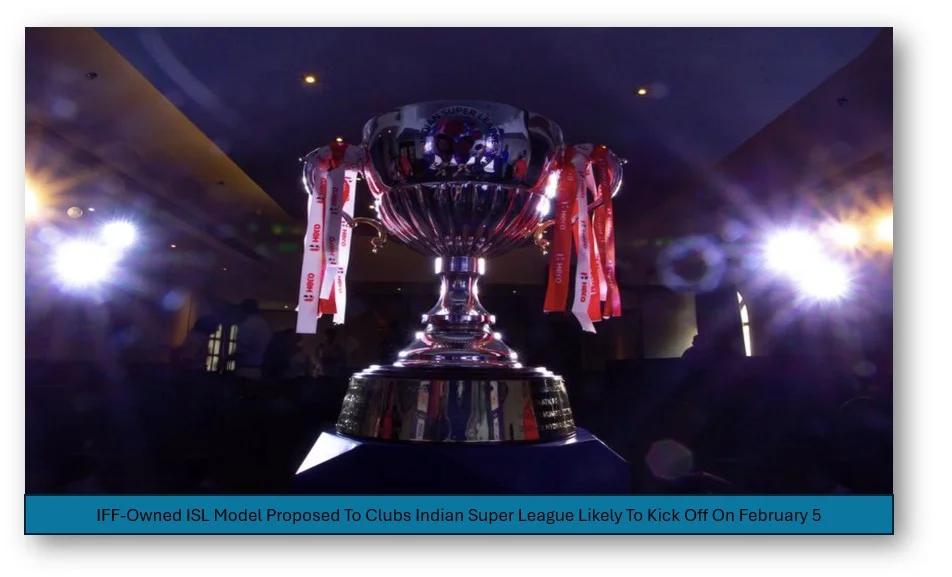

All India Football Federation (AIFF) organized a crucial meeting with all Indian Super League (ISL) clubs to discuss the future of the league after the end of its commercial contract earlier this month. The federation handed out a long-term structural plan during the meeting, suggesting that the ISL should be fully controlled and managed by the AIFF over the next 2 decades, but also sought an early February commencement of the late 2025 26 season.
AIFF suggests 20-Year Ownership and New League Structure
In the tabled proposal, the ISL will become a league that is directly managed by the AIFF, and will be in line with the changed constitution of the federation as instructed by the Supreme Court. Deputy Secretary General M. Satyanaray remarked that the plan will be guided by two priorities that include starting the league as soon as possible and being constitutionally compliant.
The proposed long-term league cycle will change to a June 1-May 31 format, starting with the 202627 season, to align the league cycle with those of the AFC. The issue of promotion and relegation will be incorporated into the competition system in the future.
Latest published:
- The Giant Among Men: Olivier Rioux Makes College Basketball
- Ben Stokes seethes in anger, hurls angry words at himself
Financial Model: Hub Budget and Fees of Participation
The ISL will have a Central Operational Budget of 70 crore to cover its first season in its new structure. Each club participating in it will part an annual standard fee of 1 crore. The AIFF will keep 10 percent of the revenue, with 30 percent allocated to a prospective commercial partner.
The prospective business associate would have a 26 percent share and make payments in 12 crore/ yr and an extra 4 percent of the league earnings in every season, or 12 crore- whichever is higher. The primary pool will be used to draw all operational expenses, such as the prize money. The excess of finances will be distributed among the stakeholders, except a commercial partner.
Club Benefits and Revenue Sharing
When the league breaks even, estimated at 96 crore in income, 60 percent of the revenue will be shared among clubs. Fifty percent of this will go equally to all the participating teams, and the remaining 10 percent will be an incentive to the clubs to invest further in the central revenue pool, even in the case of relegation. Loyalty incentives will benefit legacy clubs:
- Teams that have more than eight years of experience can get their portion of the fixed revenue share (maximum 1%).
- Clubs with three to eight years can get 0.5%
- New entrants might get as much as 0.25%.
When Will ISL 2025–26 Start?
The AIFF hopes to break even and extend the current season through February 5, 2026, assuming club approvals. But the last form of competition is still debated.
It is reported that there are divided opinions about the clubs on whether to have centralisation in terms of logistics and some are against it because of commercial and fans’ involvement issues. It is likely to be decided after their further deliberations, and the meetings have been planned for December 28 and 29.
When the league starts at the end of February, the league officials believe that it will be possible to hold approximately 190 matches. The AIFF will also seek the AFC’s consideration to designate it as special to retain the continental qualification paths.
Dialogue Positive, AIFF Says, Wants Swift Consensus
According to the representatives of AIFF, discussions were positive, as all 14 clubs took part. Goa Football Association President Caetano Fernandes was hopeful of a quick solution and said that clubs have asked to be given a small window to discuss the proposal.
The federation will then invite the stakeholders to provide the operational details, salary limits, and a way to protect long-term investment in clubs. The plan will then need ratification by the AIFF Annual General Meeting after a consensus is reached.
Road Ahead
With Indian football uncertain about its future, AIFF claims that its main focus is initially to restore competitive football as quickly as possible, but also to make the league a viable, regulation-abiding, and commercially sound ecosystem.
As clubs are likely to go back soon, the days to come are essential in deciding how the next age of the Indian Super League will appear- and whether the Indian football top league can enter the new era of governance and finances without any further delay.

A versatile writer mainly works on trending news, daily updates from politics, business, crime, current affairs and entertainment.