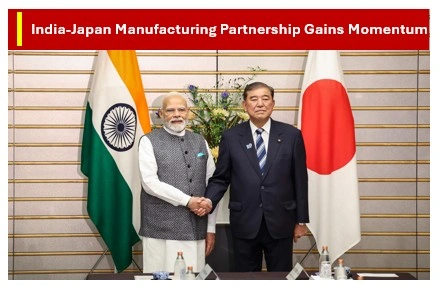

India and Japan are entering a new phase of their long-standing economic partnership, with industry leaders highlighting manufacturing as the next major area of collaboration. During NDTV’s Indo-Japan Strategic Dialogue, experts said India’s growing investment appeal, improved execution capabilities, and skilled workforce position it to become a key global manufacturing base for Japanese companies, provided the country continues strengthening speed, quality, and supply chain ecosystems.
India-Japan Partnership Enters a New Manufacturing Phase
Years of mutual trust and investment have laid the foundation for deeper industrial cooperation between India and Japan. Speaking during NDTV’s Indo-Japan Strategic Dialogue at a session titled ‘Factory to the World: Scaling India as Japan’s Global Manufacturing Hub’, business leaders emphasized that India is well placed to emerge as Japan’s preferred manufacturing destination.
The discussion centered on the need for faster project delivery, higher quality standards, and stronger supply chain networks to fully unlock the partnership’s potential.
Read also: Mukesh Ambani’s Big RIL AGM Vision
Japanese Investment in India Sees Significant Growth
Investment Levels Have Tripled
Faisal Ashraf, Managing Director at Mitsui & Co., said Japanese investment in India has accelerated dramatically in recent years.
According to Ashraf, investment from Japan remained between $8 billion and $10 billion every five years from 2000 to 2020. That level has now increased to $25 billion to $35 billion, reflecting a major shift in investor confidence.
“Now, that 8 to 10 billion rhythm or cadence, whatever you might want to call it, has now shifted into 25 to 35 billion. so it’s gone up 3x it’s a huge shift, especially if you’re associated with the Indo-Japanese space it’s a huge shift which has taken place,” he said.
Ashraf noted that India’s next challenge is not attracting investment but ensuring projects are executed rapidly through efficient infrastructure development.
Introducing this point, he said:
“I think the critical factor that we can bring to the table is speed. Speed of deployment, speed of getting infrastructure projects off the ground,” he said.
Read also: BigBasket Appoints Amazon Veteran Amit Nanda as New CEO
Faster Project Execution Strengthens India’s Position
Infrastructure and Digital Initiatives Highlight Progress
Dr Bharat Kaushal, Corporate Officer at Hitachi Ltd. and Executive Officer of Hitachi India, said India’s ability to execute large-scale projects has improved considerably over the last decade.
He pointed to the expansion of metro rail systems, highway development, renewable energy projects, and Digital India as examples of faster implementation across sectors.
Introducing his remarks, Kaushal said:
“The other thing, and Digital India, which sort of showed the world that scalability, affordability can be done at speed, it surprised even India and Indian people. The other is the consciousness of quality,” he added.
He also observed that India’s manufacturing growth continues to benefit from strong domestic demand, creating significant opportunities for businesses.
India Becomes a Strategic Market for Japanese Manufacturers
Focus Shifts from Cost to Innovation and Quality
Tatsuya Yamada of Deloitte said Japanese companies now view India differently than in the past.
Rather than considering India primarily as a low-cost manufacturing destination, businesses increasingly see it as a location where high-quality products can be developed together with Indian engineering talent.
Introducing his comments, Yamada stated:
“Japan used to be, you know, seeing the place like India and China as the place to produce the things manufacture the things with cost place But now it is the place to co a new product with a quality product India is now for the Japanese companies to produce a quality product together with the Indian talents,” he added.
He further said awareness of India’s skilled workforce is expanding beyond major Japanese corporations and is increasingly reaching mid-sized businesses across regional Japan.
Regional SMEs Could Drive the Next Phase of Collaboration
Joining the discussion virtually, Gen Funahashi, Group CEO and COO of ICMG Group, highlighted the importance of Japan’s regional small and medium enterprises (SMEs).
He said approximately 75% of Japan’s GDP is generated outside major metropolitan areas, while 70% of the country’s workforce is employed by SMEs.
According to Funahashi, many regional Japanese SMEs possess advanced technologies but struggle to enter the Indian market independently.
He explained that ICMG supports Indian startups, facilitates proof-of-concept (POC) projects between startups and Japanese SMEs, and helps establish joint ventures when those collaborations succeed.
Funahashi said this approach could accelerate the transfer of Japanese technology into India’s manufacturing sector while strengthening domestic industries.
Manufacturing Competitiveness Goes Beyond Low Labour Costs
Ashraf said India’s attractiveness as a manufacturing destination is no longer based solely on inexpensive labour.
He explained that logistics, infrastructure, technology, product quality, and the country’s large domestic market have become equally important factors. He also noted that logistics costs in India have declined considerably as infrastructure has improved.
Introducing his observation, Ashraf said:
“Traditionally, low labor cost, India is an LCC, you know, low-cost country, low-cost manufacturing country, has been a story which has been around for about 25 years. And I think that is no more the sole factor,” he added.
Key Priorities for India to Become Japan’s Preferred Manufacturing Hub
The panel identified three areas that require sustained attention for India to strengthen its position as Japan’s preferred global manufacturing base:
- Faster execution and project implementation.
- Greater emphasis on quality and continuous improvement.
- Stronger MSME networks and supply chain ecosystems.
Yamada also said stable and predictable policy frameworks, along with a culture of continuous improvement, would encourage more Japanese companies—especially SMEs—to expand into India.
Creating Early Success Stories
Plug-and-Play Infrastructure Can Build Confidence
Closing the discussion, Dr Bharat Kaushal suggested that India should prioritize creating a handful of successful examples where Japanese companies establish operations quickly using ready-to-use infrastructure.
Introducing his concluding remarks, Kaushal said:
“We can make five or seven big winners from Japan very quickly, just take responsibility for doing the trunk infrastructure, ask them to plug and play. It creates believability at a much faster pace,” he added.
Conclusion
The discussion underscored growing confidence in India’s manufacturing capabilities as Japanese investment continues to rise. Industry leaders agreed that improvements in execution speed, quality standards, and stronger MSME-led supply chains will play a decisive role in transforming India into Japan’s preferred global manufacturing hub while deepening the strategic partnership between the two countries.

A versatile writer mainly works on trending news, daily updates from politics, business, crime, current affairs and entertainment.