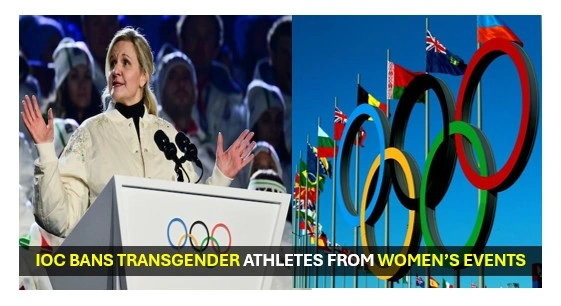

According to a press release from the International Olympic Committee (IOC), beginning with the 2028 Summer Games in Los Angeles and for all future Olympic Games thereafter, transgender athletes who desire to compete in women’s events will no longer be able to do so. This change comes after significant discussion among the IOC and the National Olympic Committees regarding the inclusion of transgender athletes at Olympic level.
The IOC indicated that there will be new eligibility criteria for athletes wishing to compete in the female category. These increases in eligibility criteria are for all of the women’s events, as well as Youth Olympic Games and qualification events in women’s discipline.
To be eligible to compete in women’s events, regardless of age, an athlete must be a biological woman. Further, a one-time SRY gene test (saliva or buccal swab) will be utilized to determine an athlete’s sex. Any athlete who is unable to meet these changing eligibility requirements will still have the opportunity to compete in a men’s division or in open events.
The IOC’s President, Kirsty Coventry, stated that the rationale behind the ban was based primarily on:
- Considerations of fairness in competition
- The safety of athletes participating in all events at the Olympic level
- The integrity of women’s sports.
The IOC has further mentioned that athletes who transitioned after having gone through male puberty could carry with them significant physical advantages (such as strength and/or endurance) that might be unfair for female athletes.
After an 18-month period of consultation, an international consensus has been reached to establish a global policy for every single Olympic sport.
Read more:
- Liensberger to miss Olympics after latest serious skiing accident
- Italy enjoys a record-breaking day at the Winter Olympics
Which athletes will be affected?
The new ban includes:
- Any transgender female athlete.
- Any athlete with differences in sex development.
Additionally, athletes with rare medical conditions such as Complete Androgen Insensitivity Syndrome (CAIS) can be considered for an exemption as well.
The new rule will not be applied retroactively to any athletes participating at a grassroots or non-elite level. Responses and reactions to this policy change are very strong.
Many support the decision, saying it will create a level playing field in women’s sports. Critics, including human rights organizations and scientists, have said the new rules discriminate against Transgender females and that there is no scientific evidence to support the imposition of restrictions on Transgender females regarding their ability to compete.
There are over one hundred organizations, including UN affiliated organizations, who have expressed their concerns about:
- The privacy and ethical implications of using genetic testing to establish eligibility,
- The potential for targeting women athletes in general,
- The lack of scientific consensus regarding an advantage of performance as a result of competing with an artificial/physiological gender.
This policy represents a significant change in how the IOC has treated sports since its inception. Prior to this announcement, the IOC placed a great deal of emphasis on creating inclusive environments for athletes. By implementing a uniform and restrictive central rule for all Olympic sport, the IOC will not only set a precedent for sports policy to be refined and implemented worldwide, but will also generate further debate about the balance between fairness and inclusion in elite sports.

I am a versatile content writer from the MP region, covering politics, business, crime, current affairs, entertainment, video games, and sports with clear insights, engaging analysis, and timely, reader-focused updates.