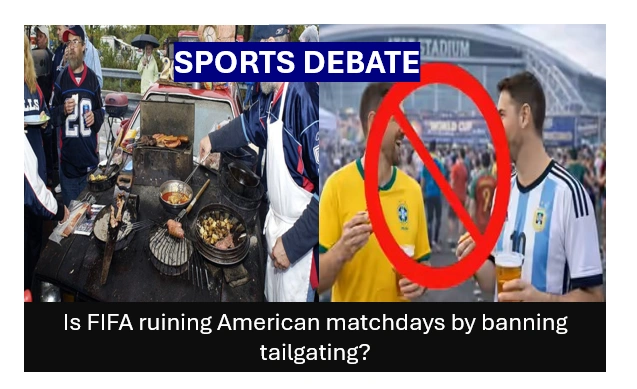

A lot of people going to the US for the World Cup already have an idea of what an American game day is like, thanks to familiarity and experience. There are hot dogs on a grill, coolers full of beer, music playing in the background, tents set up, and trucks lined up hours before the game starts. The TV is placed between the trunk and a folding chair so that, if there is one, earlier games can be played in the background.
That part of the event won’t be there as much at the 2026 World Cup in the US.
Several news outlets report that FIFA wants to ban traditional tailgating at several major US venues, including MetLife Stadium, Arrowhead Stadium, and Gillette Stadium. It’s likely that parking will be very hard to find or unavailable in some places, especially at MetLife. Fans are being guided instead to planned fan zones and hospitality areas, which are places that can be managed, controlled, and even paid.
The way the game is set up and the tricky spots
The 2026 World Cup will be held in three countries and sixteen host cities. The United States will host 11 venues and most of the games, starting with the quarterfinals and continuing through the finals. The first game in the United States will be on June 12, 2026, when the US plays Paraguay at SoFi Stadium. This will be one day after the event in Mexico City starts.
Many American venues, such as AT&T Stadium, NRG Stadium, and Levi’s Stadium, were built in suburbs in the last 20 to 30 years. They are built so that cars can get to them and there are lots of parking places all around them.
People still remember the 2024 Copa América final in Miami, where large crowds outside Hard Rock Stadium blocked entryways and delayed the game’s start. Organisers had to deal with both the crowd inside the stadium and the growing crowd outside.
Read also: Atlético Madrid Stun Barcelona with easy Win in Champions League Quarter Final
What tailgating is and why it’s important in the US
People in the United States do more than just eat before a game when they tailgate. It’s just how the day is.
Fans meet in parking lots and set up informal bars with grills, drinks, music, and sometimes small TVs in the trunks of cars. It starts to get exciting hours before the game even starts. People start to arrive early and settle in. In this well known pre-match practice, people get together, eat and pass the time.
It’s also useful and good for the economy. Tickets are hard to get and cost a lot, especially for shows this big. Going to a game with friends, setting up outside, watching on a small screen, and following the noise from the stadium has been a common way to go for a long time. A lot of people can only be there in this way because it’s the only way they can actually get in.
The habit has been around longer than the venues it’s now around. On July 21, 1861, people from Washington, D.C., took a carriage into Virginia to watch the First Battle of Bull Run. Along the way, they packed food and gathered while listening to the sound of gunfire from afar. This may have been the first American tailgate. By 1869, people were acting similarly at early football games, with people having picnics from waggons at Rutgers–Princeton games. In the 1880s, people at the Yale–Princeton game were said to be eating and drinking from horse drawn carts. This was the first known example of a social watching practice.
The real cost of going to the World Cup
Multiple sources say that transportation costs on game days are also going to go up a lot. This is on top of ticket prices that can go up into the thousands of dollars for big World Cup games, based on the stage and location.
Public transport is going to have to do more, and fares are going up a lot in all major towns. According to The Athletic, the trip from New York Penn Station to MetLife Stadium in New Jersey, which usually costs less than $13, will likely cost more than $100 during the playoffs. From Boston, trips to Gillette Stadium have cost around $80, and bus rides can cost up to $95.
Read also: For their own life and safety: Donald Trump questions
What other World Cups have done to fix the same issue
Qatar held the 2022 FIFA World Cup, which took place in small sites in and around Doha. Transportation was built into the structure of the event. With a Hayya Card, ticket users could use the Doha Metro, buses, and trams for free, and it was easy to get from venues to fan areas.
The same reasoning was used at the 2018 FIFA World Cup, which Russia held in several towns. People who bought tickets and applied for a Fan ID could use free public transport in host towns and more than 700 extra long distance trains that ran between sites. Travel problems that would have been a problem on their own were built into the event so fans could go from city to city and stadium to stadium without having to plan their own travel.

A versatile writer mainly works on trending news, daily updates from politics, business, crime, current affairs and entertainment.