
When you walk into Moscow’s Izmailovsky Market, the rows of wooden stands, bursts of colour, the hum of talking voices, and the quiet glint of Soviet-era artefacts laid out like pieces of another time are all too much to take in at once.
On both sides of the narrow paths, people are selling everything from old military medals to lacquer boxes. But there is one shop that stands out among all the noise and colour.
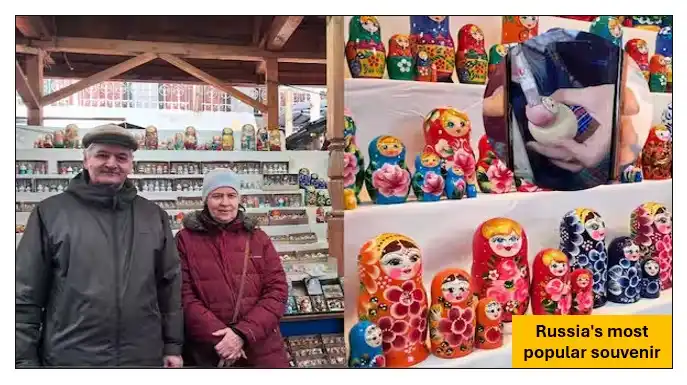
This is where Olga and her husband Rustam sit, with rows of hand-painted Matryoshka dolls all around them.
Some are traditional, with flower designs and women dressed in Russian clothes. Others aren’t, with cartoon characters, animals, and even politicians on them.
When you open one doll, you find a smaller, more complicated one inside. Olga takes one and turns it slowly in her hands.
For the couple, this stall is a new start in life. After the fall of the Soviet Union in the 1990s, Rustam, who had been an electrical engineer, and Olga, who had been an environmental engineer, had to rethink their futures. What began as doubt ended as a small but steady business.
It’s been more than 40 years
What began as Olga’s personal interest turned into their way of life over time. Today, their shop is just one of many in Izmailovsky Market, but it has its own personality thanks to the hard work and dedication of the people who worked there.
Inside of the Izmailovsky market
When you take a step back, you can see how big the market is. One of Moscow’s biggest outdoor markets for gifts and old things is Izmailovsky Market, also known as the Izmailovo Vernissage. It is close to the Partizanskaya metro stop and the Izmailovo Kremlin culture complex.
On the weekends, when more sellers come out and the paths are full of tourists and locals, it’s especially lively.
Traditional Russian crafts are sold next to Soviet-era items like cameras and military patches, giving shoppers a broad view of Russian culture. But Matryoshka dolls are still the most famous and sought-after thing on show.
also read: What Different Colours of Indian Road Markers Mean?
Many tourists feel like they have to buy one; it’s almost a must
The dolls seem to follow you around Moscow as soon as you get there. You can find them in stores at airports, parks, and on the street. But they feel more real here at Izmailovsky Market, and they are often cheaper as well.
There are a lot of things at Olga and Rustam’s stand. Simple dolls cost 300 to 500 rubles, while more complicated ones that take longer to make can cost up to 5,000 rubles.
How Russian dolls came to be
The name Matryoshka comes from the Russian name Matryona or Matriyosha, which comes from the Latin word “mater, which means “mother.
A strong, healthy woman and the thought of a big family were linked to the name in the past. This is shown by the doll, which has many figures inside one body, which is a visual representation of mom and fertility.
Even though it’s famous all over the world, people still don’t understand what it’s called. A lot of people call it a babushka doll, but that’s not really what it is. Babushka in Russian means grandmother. This word has caught on around the world, but it doesn’t really describe the stacked toys.
also read: 5 iconic modern architectural structures in India
Making a Matryoshka is an art form with many levels
Traditionally, the toys are made from trees like aspen, birch, lime or birch. Lime is the wood that is used most often.
In early spring, trees are cut down while they are still full of sap. After that, the wood is left to dry outside for up to two years so that it doesn’t crack.
Simple tools like knives and chisels are used to make each doll on a mill. First, the smallest solid figure is made. Then, bigger hollow figures that fit perfectly on top of each other are made.
Craftsmen use experience more than measures, so the process needs to be precise and based on gut feelings.
Once the dolls are made, they are prepped, painted with gouache, and then varnished to protect the paint.
A practice that lasts
Vasiliy Zviozdochkin made the first Russian Matryoshka doll, and Sergey Maliutin painted it. There were eight figures in all- a girl holding a black rooster, then boys and girls going back and forth, and finally a baby in a nappy.
The dolls became famous around the world when they won a bronze prize at the 1900 Paris Exposition.
Over time, patterns changed. In the early days, dolls often showed Russian peasants, families, and religious people. Later, they grew to include characters from literature, history, and even government leaders, showing how Russian society was changing.
Back at Izmailovsky Market, these stories aren’t always told, but they’re in every stroke of the paint.
Olga grabs another doll and lays the top and bottom halves in the right place before softly clicking it shut. Tourists stop and look at the patterns all around her. Most of the time, they leave with something bought.
It’s not just about selling for her, it’s also about being free
As Olga puts it, we are our own bosses and can run this place on our own terms. That is much more freeing.
They have been making this life together for decades. Their stall jumps out as something alive in a market full of old things. It’s an example of adaptability, strength, and pride.
And just like the Matryoshka dolls, their story has many levels, each revealing something more profound.

A versatile writer mainly works on trending news, daily updates from politics, business, crime, current affairs and entertainment.