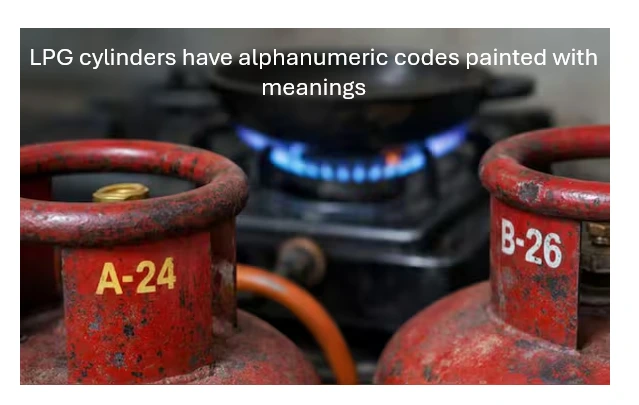

A small code on your petrol tank tells you when it needs to be tested or has expired, which lets you know how safe it is. How to read it.
A small code is stamped on the inside of the stay plate of your LPG tank. You’ve probably seen it before, but never really thought about it. It could be simple to miss or not care about.
But that short string of letters and numbers has a specific job to do. It lets you know when the next safety check for the cylinder is due and, by extension, whether it should still be in use.
According to government figures, more than 30 crore people use LPG, and tanks are renewed and sent out on a huge scale every day. These marks are part of a system that keeps things safe behind the scenes.
What the code actually means
Every LPG tank sold in the United States has a code made of letters and numbers on the stay plate. It looks like an A-25 or C-26 most of the time.
This isn’t a batch or serial number. It tells you when the next required safety test for the cylinder is due.
It’s easy to use once you know how to read it. The letter stands for a part of the year, and the number for the whole year. A means the quarter from January to March, B means the quarter from April to June, C means the quarter from July to September, and D means the quarter from October to December.
So a cylinder with the number B-26 needs to be tested sometime between April and June 2026. If there is a mark like D-24 on the cylinder, it means it should have been tried by the end of 2024.
Read also: Booking an LPG cylinder online- Guide
Why it’s important to test things
LPG tanks are made to handle high pressure, but they shouldn’t be used for a long time without being checked.
They have to go through regular hydrostatic testing, which checks for structural soundness, leak possibility, and the ability to handle pressure. The cylinder’s state can change over time due to rust, normal wear and tear, or being handled a lot.
The testing stage makes sure that any cylinders that aren’t working right are found and either fixed or taken out of service. Without it, the chances (no matter how small) are much higher.
Built to handle a lot of users
India’s LPG network is one of the biggest in the world. Everything from filling plants to distributors to homes and back again is covered by millions of cylinders every day.
The alphabetic code is part of a bigger system for keeping track of things that includes records of inspections, factory information, and weight standards. All of these work together to make sure that cylinders are not only moved around well but also kept an eye on over time.
Even though oil marketing and distribution companies are in charge of upholding these standards, customers can do a quick check on their own thanks to the code being public.
Read also: LPG Supply Relief- BW Tyr Reaches Mumbai After Tough Hormuz
What it means in real life
Most of the time, people don’t need to worry about these marks. Before they get to homes, cylinders should be checked and cleared.
But the facts are right there in plain sight. If a cylinder looks old or the code says that its testing time has passed, it’s a good idea to think about whether it should still be used.
It’s easy to miss the code, but it does a quiet but important job. It boils down a complicated safety system to a few characters and a timestamp that goes with the cylinder wherever it goes. It’s hard not to notice it every time a new cylinder comes in once you know how to read it.

I am a versatile content writer from the MP region, covering politics, business, crime, current affairs, entertainment, video games, and sports with clear insights, engaging analysis, and timely, reader-focused updates.