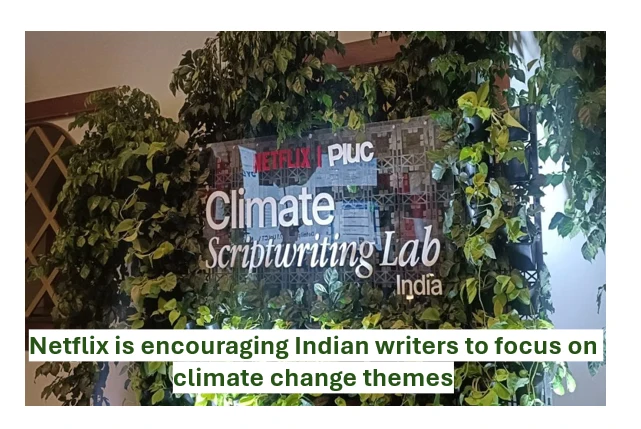

The Climate Scriptwriting Lab will pick 60 writers from all over the country and pair them up with teachers for eight months.
The first climate scriptwriting lab in India invites people to send in stories that aren’t about climate change. Instead, they want to find ways to include climate in stories that aren’t about it.
Netflix India and PLUC started the first-ever Climate Scriptwriting Lab on Thursday
The lab will work with 60 scriptwriters from across India, teach them, and help them bring stories on climate change, sustainability, and related topics to the forefront.
India is full of climate change stories. Every day, in every part of the country, they happen.”Mahima Kaul, Director, Global Affairs, Netflix India, said, “What we haven’t had is a structured way for writers to get those stories into mainstream movies.”
Launched on April 9 at New Delhi’s Ambassador Hotel, the lab brings together people from the artistic, environmental, and environmental fields. People Like Us Create (PLUC), a creative storytelling platform co-led by Tamseel Hussain, held the event. PLUC is the founder and CEO of the lab.
During the launch event, Hussain said, “There are over 350,000 creators at PLUC. They come from all over the country and from small towns. During the day, they fix solar panels, and at night, they write scripts.” “The goal of this lab is to help people tell the world their own climate stories.”
The six teachers who will help the writers through the Climate Scriptwriting Lab for eight months were also presented by Netflix and PLUC. Sumit Roy, who wrote the scripts for Homebound (2025) and Rocky aur Rani ki Prem Kahaani (2023), Akshat Verma, who wrote Delhi Belly (2011), and Saiwyn Quadras, who wrote Mary Kom (2014), Maidaan (2024), and Neerja (2016) are all on the list.
The script school will pick 60 writers from across the country and pair them up with teachers for eight months. The writers will meet in person in four cities: Delhi, Mumbai, Hyderabad, and Guwahati. At the end of their lab, they will present their work to an eight-person panel.
“A climate scriptwriting lab is both a groundbreaking idea and something that has been needed for a long time. One of the teachers, Sumit Roy, said at the event, “Mass media and Bollywood do have the power to tell you a story with emotional depth without lecturing.” “Like how Toilet Ek Prem Katha and Taare Zameen Par helped people who have trouble reading, we can do the same thing for climate issues.”
read also
- 12 OTT Releases This Week Bring Big Stars, Fresh Stories
- Netflix buys Warner Bros. for $72 billion, including HBO
Why write now about climate?
Before she talked about the lab, Kaul said that when she was on Netflix, she often watched movies about nature and the environment. She said that Netflix’s own data showed that people want to learn more about climate change than just through films, since it “is now integrated in our daily lives.”
“This lab is our promise to build that,” Kaul said. “We will find voices from all over India and give them the tools, mentorship, and industry connections they need to tell stories that millions of people will watch.”
This isn’t the first time Hussain has tried writing about the environment. He began LetMeBreathe in 2017 as India’s main platform for stories about climate change and sustainability. He had been thinking about the Climate Scriptwriters Lab for a while. Netflix was the right partner at the right time and with the right tools.
Netflix has a Fund for Creative Equity that helps writers and artists who aren’t getting enough attention. Kaul said, “They can join labs like this and get the tools and support they need to tell their story.” “The writers will get help to make their scripts better for both full-length movies and short stories.”
A group of Kaul, Hussain, Roy, and Verma talked about how important it is to look at climate stories in a variety of film styles. The speakers talked about surprising climate themes in Fukrey 3 (2023) and Delhi Belly, as well as the value of feature films as a form of art. They looked at climate change beyond what people think they know about it.
Kaul, Hussain, and Suman Chandra, Director, Ministry of New and Renewable Energy (MNRE), opened up the applications for the lab to everyone at the start of the evening. By the end of the night, 21 stories from writers all over the country had been sent in.
I am a versatile content writer from the MP region, covering politics, business, crime, current affairs, entertainment, video games, and sports with clear insights, engaging analysis, and timely, reader-focused updates.









