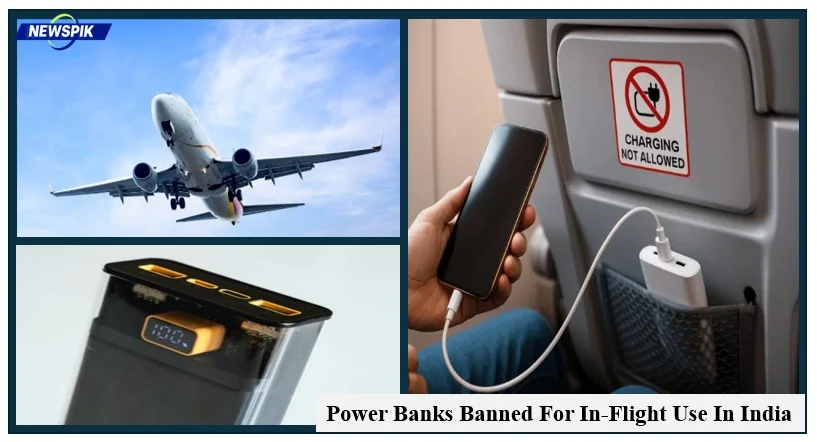

India has introduced stringent aviation safety requirements regarding Lithium battery-powered devices by introducing blanket restrictions regarding the usage and possession of power banks on board aircraft. In a recent advisory circular on Dangerous Goods, the Directorate General of Civil Aviation (DGCA) said that passengers will now not be allowed to charge their mobile phones or electronic gadgets using their power banks even using the in-seat charging ports. The action follows an increase in aviation accidents worldwide, with overheating and fire risks associated with lithium batteries.
The DGCA has made it clear that power banks and spare lithium-ion batteries will continue to be allowed onboard flights, but should be kept as hand baggage and should never be stored in overhead bins. The regulator rationalised that overhead compartments complicate the rapid identification, access or extinguishing of any possible fire event in the event of some malfunction, which may increase the potential threat to passengers and aircraft.
Choosing Lithium Batteries as a significant Aviation risk
Another popular application of lithium batteries is in smartphones, laptops, tablets, portable chargers and other rechargeable devices. They, however, have a fire hazard attached to them, particularly when they are damaged, overheated or improperly made. The DGCA emphasised that battery fires are highly energetic, can be self-sustaining, and may even cause explosions under extreme circumstances.
The advisory reported that such fires are usually caused by internal short circuit, overcharging, crushing or ageing of lithium batteries. As opposed to regular onboard fires, lithium battery fires demand special handling methods and materials in order to contain and eliminate them. The regulator cautioned that late discovery, especially where the batteries are kept in places that are not easily accessible, is a significant risk to flight safety.
After IndiGo crisis, aviation ministry gives nod to two new Indian airlines
Airlines Urged To Increase Checks, Train Staff Improvement
The DGCA has ordered airlines to re-examine their existing lithium battery safety procedures in order to reduce risk. Carriers should upgrade prevention systems, improve fire response systems within cabins and make sure that they are capable of detecting it early.
Cabin crew employees have also been requested to undergo intensive refresher training so they can spot overheating equipment, smoke, and abnormal odours within a few seconds. They should be ready to use specialised firefighting equipment immediately and adhere to the exact safety protocol in order to reduce risks as much as possible. The DGCA has also stressed the importance of maintaining all safety equipment that is in good condition, and readily available and properly stocked on board.
Increase in Incidents of Battery Fire Sparked Rule Overhaul
The DGCA order is informed by an apparent increase in the number of incidents involving lithium batteries across the world, with the air travel industry ever growing and with passengers carrying an increasing number of electronics than ever, the aviation regulators worldwide are re-evaluating and strengthening safety frameworks. Some of the major airlines in the world, such as Emirates and Singapore Airlines, have already adopted such stringent measures.
India has also had some disturbing incidents in the recent past. In October of last year, one of the power banks on an IndiGo flight burst into flames as the plane was taxiing at Delhi airport, but no one was injured. In South Korea, the investigation of a plane fire at Air Busan earlier revealed that battery failure was a possible cause of fire, highlighting how dangerous such devices can be.
118 flights cancelled,16 diverted at Delhi airport as dense fog disrupts operations
Government says the Safety of the Passengers is of the first priority
Union Aviation Minister K Ram Mohan Naidu requested the move by saying that all the decisions of the DGCA are evaluated and consulted internationally before being implemented. He underlined that aviation safety was the paramount concern, and it was important to synchronise with internationally accepted standards as implemented by ICAO to ensure safety to passengers and aircraft.
Such safety structures, the minister said, should be adhered to to ensure that operational security is upheld to the best, and airlines and passengers should collaborate.

I am a versatile content writer from the MP region, covering politics, business, crime, current affairs, entertainment, video games, and sports with clear insights, engaging analysis, and timely, reader-focused updates.