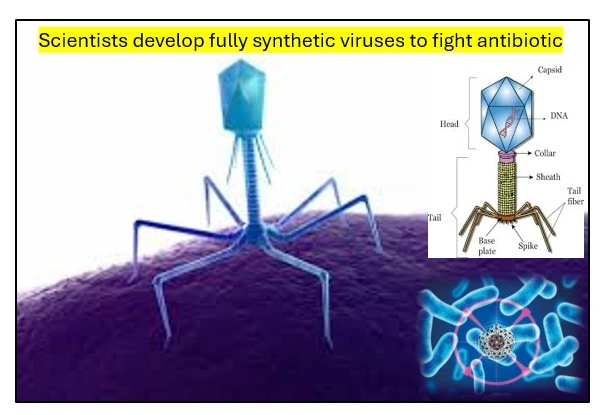

A development seems to be emerging in a calm revolution within the laboratory, which also feels more like being in a software-engineering office next to anything like conventional life sciences. January 2026 — In a remarkable turn of events, researchers at New England Biolabs (NEB) and Yale University have broken into what was previously the realm of science fiction: they have developed the world’s first fully synthetic bacteriophages, tailored to hunt down and obliterate the planet’s most lethal “superbugs.”
This is a critical breakthrough. Engineers have been calling for decades for greater attention to address what the medical community has warned of as a “post-antibiotic” era — one in which the threat of common infections from routine surgeries or minor scrapes again becomes potentially fatal. Now, by writing new viruses from the ground up based on digital DNA sequences, researchers are not only seeking cures in nature — they’re reprogramming it.
The Coming of the Programmable Predator
Bacteriophages, or “phages” for short, naturally occurring viruses that eat bacteria, have been known to doctors for more than a century. But using them as medicine has never been neat or precise. In the past, phage therapy as it was practiced would have scientists combing through sewage or soil to seek out a “wild” virus that might — might, with some luck and trial and error — kill a specific patient’s infection.
The new study, published in PNAS on January 23, 2026 shifts the game. On the platform, called High-Complexity Golden Gate Assembly (HC-GGA), they managed to construct a phage that homes in on Pseudomonas aeruginosa — a common and multidrug-resistant pathogen frequently identified in hospitals — using nothing but 28 synthetic DNA fragments and a digital blueprint.
Why “Synthetic” Changes Everything
Where natural phages can be a bit unwieldy or have certain unwanted genetic baggage, synthetic phages are manipulated with surgical precision.
- Speed: Conventional engineering might have taken a scientist or engineer an entire career to understand for one virus. Such an approach is enabling quick assembly and testing in days.
- Safety: Since it is made from scratch, researchers can make sure the virus does not accidentally pick up “resistance genes” that would make the bacteria even stronger.
- Customization: Researchers can now “swap” components of the virus, as if replacing tires on a car, in order to target specific strains of bacteria.
The Engineering of Viruses: How You Build a Virus
Creating a virus is an exercise in extreme miniaturisation. The scientists didn’t merely “edit” an existing virus; they constructed an entire viral genome from scratch outside a living cell.
Digital DNA to Living Weapon
It starts on a computer. Scientists take an existing phage’s genetic sequence and decide what parts to retain and what is “upgraded.” They sew small pieces of man-made DNA together, using the Golden Gate Assembly technique.
- The “Warhead”: The DNA that instructs the virus how to make copies of itself and explode the bacterial cell.
- The “GPS”: The tail fibers, which are sensors for locating the particular bacteria. In this experiment, the team was able to swap these fibers so that the virus could “sense” and attack different classes of pathogens.
- The “Tracker”: They even placed fluorescent markers, allowing doctors to see the infection being nullified in real-time under a microscope.
Once the DNA “instruction manual” has been constructed, it is put into a harmless laboratory strain of bacteria for them to use as a factory that fabricates millions of active, synthetic phages ready for battle.
Six Physical Signs of Reduced Blood Flow That Should Not Be Ignored
A New Weapon Against Superbugs
The Pseudomonas aeruginosa used in this study, the key pathogen targeted here is a global health menace. It is a major cause of pneumonia and sepsis, especially in people with cystic fibrosis or who are on ventilators. And because it produces a “biofilm” — an invisible slimy shield that protects its colonies — standard antibiotics bounce right off.
Synthetic phages, however, are dynamic. They evolve alongside the bacteria. Should that bacteria develop a new type of defense, scientists can simply adjust the digital code and “re-print” the synthetic phage in versions better equipped to destroy. This sets up an evolutionary arms race in which, for the first time, humans have the advantage.
Clinical – The Human Factor: Towards “Personalized” Medicine
Its most tantalizing potential application is Personalized Phage Therapy. Consider a patient in 2027 with a life-threatening infection. Treating instead of testing Doctors would not have to try one antibiotic after another.
- Sample the patient’s bacteria.
- Map the bacteria’s “valleys of vulnerability” in hours.
- Develop a personal phage cocktail, a tailored mix of bacteriophages selected for fire power against that individual’s bacteria.
- Administer the treatment, which clears the infection without any of the toxic downsides of heavy-duty antibiotics.
This isn’t just a theory. Force-based building blocks In November 2025, related research demonstrated that the same technique can be applied to “high-GC” mycobacteriophages, known for being hard to engineer and which are used to treat infections such as tuberculosis.
Challenges and the Path Forward
Positive as this news is, we are not out of the woods yet. Bridging the gap between a laboratory discovery and a bedside therapy is no small task:
- Regulatory Frameworks: Current Drug Approval Laws were written for “static” drugs ( they are pills that remain unchanged). An “alivingS,’ synthetic drug that can be updated like software creates a headache for the FDA and EMA.
- Public Perception: The phrase “synthetic virus” can sound scary. It’s important to inform the public about what makes a bacteriophage, which can’t infect human cells, different from a virus that infects humans (like the flu).
- Scalability-Printing a single dose is one thing, but being able to scale your system to serve thousands of patients at once takes massive infrastructure.
“My lab builds ‘weird hammers’ and then finds the right nails,” says Greg Lohman, one of the lead researchers on the project. “In this case, the medical community said to us: ‘This is exactly the hammer we’ve been looking for. “
How to Increase Blood Oxygen Levels with Exercise, Diet, and Lifestyle Changes
Conclusions: A New Biology
The creation of fully synthetic viruses is the time when biology finally became an engineering discipline. We are shifting from haphazardly “gathering” medicine — in hopes of stumbling upon a miracle growing in a petri dish overrun with mold or deep inside the tissue of one of Earth’s trillions of sponges — to deliberately “architecting” medicine.
Using the natural predatory power of viruses and fine-tuning it via synthetic biology, we are now catching up in the battle against antibiotic resistance. The “superbugs” are not gone, but for the first time in a century, they find themselves hunted.

A versatile writer mainly works on trending news, daily updates from politics, business, crime, current affairs and entertainment.