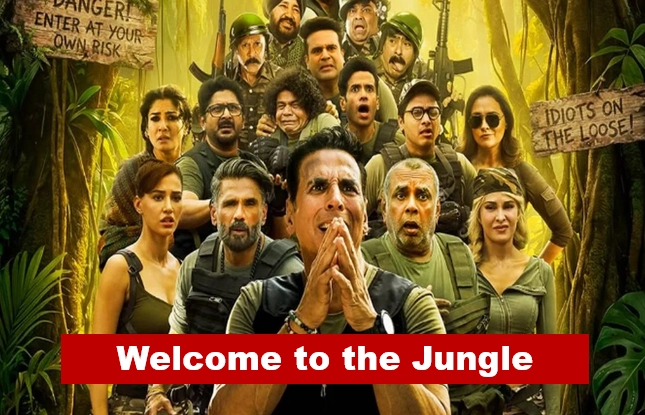

Ahmed Khan’s Welcome To The Jungle attempts to expand the popular comedy franchise into a large-scale meta entertainer packed with Bollywood references, slapstick humour, and an enormous ensemble cast. Built around a story by late writer Neeraj Vora, the film initially teases a sharp satire on the film industry before drifting into an exhausting mix of disconnected sketches and overblown spectacle.
Despite the uneven screenplay and excessive runtime, Akshay Kumar and Johny Lever emerge as the film’s strongest assets, delivering moments of improvisational humour that keep the chaotic narrative from completely collapsing.
Ahmed Khan Expands the Franchise Into a Meta-Comedy
The third installment in the Welcome franchise unfolds less like a tightly written comedy and more like an extended variety show stretched across 164 minutes. Director Ahmed Khan leans heavily on scale, celebrity appearances, and visual chaos, assuming that a bigger cast and larger production automatically translate into bigger entertainment.
The film draws from a meta-story conceived by late writer Neeraj Vora. At its core is a satire about the film industry itself. A corrupt corporate businessman, played by Zakir Hussain, decides to finance a deliberately bad film in order to launder money after shifting political conditions put him under pressure.
What begins as a clever setup filled with self-aware industry commentary slowly loses direction. Instead of fully developing the irony surrounding a fake film production designed to fail, the screenplay moves toward fragmented humour and loosely connected comic situations.
Akshay Kumar and Johny Lever Carry the Film
Much of the film’s entertainment value depends on Akshay Kumar and Johny Lever, whose performances provide energy to an otherwise uneven script.
Lever portrays the anxious assistant of the wealthy businessman. His character loses his voice under pressure and recruits two struggling filmmakers, played by Paresh Rawal and Rajpal Yadav, to create the intentionally disastrous movie.
Akshay Kumar appears as Rajeev, a fading film star looking for a comeback. Disha Patani is cast as his former love interest, while Jacqueline Fernandez joins the fictional production as the producer’s daughter, included mainly for glamour appeal.
The film also attempts to retain connections with the original Welcome universe. Suniel Shetty and Arshad Warsi take on roles reminiscent of characters earlier associated with Nana Patekar and Anil Kapoor, adding rogue elements to the fictional production taking shape inside the narrative.
Read also: Assi movie review: A courtroom drama featuring Taapsee
Bollywood Satire Gives Way to Action Chaos
As the film progresses, the inside jokes about Bollywood begin to dominate the screenplay. Eventually, Ahmed Khan shifts the story to a village in Pakistan-Occupied Kashmir named Azad Nagar.
There, Jackie Shroff appears as a terrorist figure portrayed with shades of the iconic Gabbar Singh archetype. The narrative transforms into a bizarre meta-action showdown between Akshay Kumar’s “filmy Khiladi” persona and Shroff’s character, Zatara.
However, the jungle setting fails to create any genuine atmosphere. Heavy dependence on green-screen visuals removes texture and realism from the environment, making the action sequences feel artificial and repetitive.
The review notes that several large-scale set pieces appear poorly planned, resembling generic placeholders for chaos rather than properly constructed action scenes. As the runtime progresses, the scale itself becomes tiring rather than entertaining.
Neeraj Vora’s Storytelling Spirit Is Missed
The review points out that Neeraj Vora’s earlier stories succeeded not because of random silliness, but because they trapped flawed characters inside escalating situations built with logical comic progression.
While Welcome To The Jungle occasionally hints at that style through its parody elements, the screenplay struggles to maintain momentum. Writer Farhad Samji’s rhyming dialogues and disconnected sketch-style humour dilute the stronger ideas hidden within the concept.
Still, the film occasionally delivers moments that encourage viewers to embrace its absurdity and simply anticipate what outrageous situation might arrive next.
Farida Jalal and Kiran Kumar Deliver Unexpected Depth
Amid the loud comedy and exaggerated performances, the film unexpectedly introduces a more layered social commentary through the characters played by Farida Jalal and Kiran Kumar.
Their dynamic functions as a satirical observation on how Muslims are frequently misunderstood and mocked in modern society. In the film, Jalal speaks seemingly incomprehensible gibberish, while Kumar interprets it into refined Urdu.
According to the review, Ahmed Khan transforms this recurring joke into an allegorical device hidden beneath slapstick humour, adding an unexpectedly thoughtful dimension to the film.
Read also: Sapne Vs Everyone Season 2 Review
Ensemble Cast Works Best Through Self-Referential Humour
The movie finds some of its strongest comic moments when it uses the actors’ real-life public images as part of the joke.
Jacqueline Fernandez’s character openly plays on her glamorous screen persona and Bollywood’s fascination with Western aesthetics. Similarly, singer Daler Mehndi turns his own public identity into comic material.
Akshay Kumar’s role as an ageing star seeking another successful phase in his career also works as a playful nod to his real-life box office journey. One of the film’s more anticipated moments comes when Raveena Tandon shares screen space with Kumar, reviving nostalgia linked to their popular pairing from the 1990s.
These self-aware references briefly transform the massive ensemble cast from a burden into an entertaining playground of industry satire.
Overcrowded Scenes Hurt the Film’s Comedy
The review argues that Ahmed Khan eventually pushes the ensemble cast into excessive overacting and overcrowded staging, weakening the balance required for successful slapstick comedy.
Rather than creating natural humour, many scenes aggressively demand laughter. With so many familiar faces squeezed into single frames, the film often resembles a crowded waiting room where actors appear disconnected from the actual scene, standing by only to deliver isolated punchlines.
Krushna Abhishek and Yashpal Sharma, in particular, are described as being reduced to little more than background presence with minimal impact on the story.
Designed More for Viral Clips Than Cohesive Storytelling
The review concludes that many sequences feel specifically engineered as short conceptual moments designed for social media virality rather than narrative cohesion.
While censorship cuts by the CBFC may have contributed to the film’s uneven structure, the makers appear more focused on generating Instagram reel-worthy clips than building a strong theatrical experience.
As a result, the trailer creates greater excitement than the film itself. By the end, the actors appear stranded within a production struggling to balance spectacle, parody, nostalgia, and coherent storytelling.
Read also: Ek Din Review: A Simple Film That Underserves Sai Pallavi and Junaid Khan
Conclusion
Welcome To The Jungle begins with the potential to become a sharp meta-commentary on Bollywood and commercial filmmaking, but the film gradually loses focus beneath excessive chaos, overextended comedy, and visual overload. Ahmed Khan’s ambitious ensemble entertainer delivers occasional flashes of clever satire and nostalgic humour, particularly through Akshay Kumar and Johny Lever’s performances.
However, the lack of narrative discipline and reliance on fragmented viral-style moments prevent the film from fully realizing the promise hidden inside Neeraj Vora’s original concept.

A versatile writer mainly works on trending news, daily updates from politics, business, crime, current affairs and entertainment.