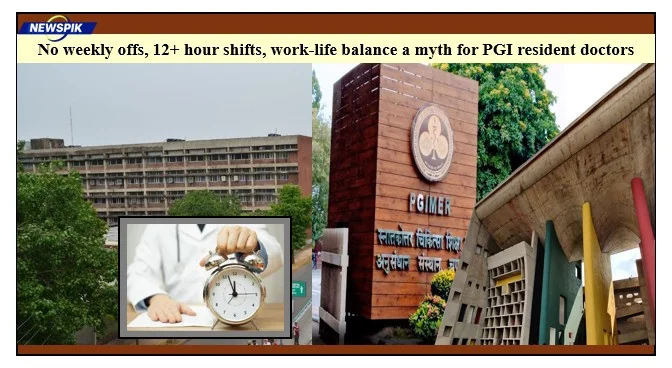

Time does not seem to stop in the sterile, fluorescent-lit halls of the Post Graduate Institute of Medical Education and Research (PGIMER) in Chandigarh. For the thousands of patients who come here from across North India, the hospital is a ray of hope. But for the resident doctors who keep the gears turning, it is feeling more and more like a glorified gilded cage of fatigue.
A mere three years after association, Kabir knew that my bringing the patients was inadequate proof of his capabilities as a plastic surgeon at PGI’s Department of Reconstructive and Plastic Surgery where I worked; he also needed some published work to glitter on his resumé.
The 90-Hour Reality: When There Are No Shifts to End
On paper, the 1992 Central Residency Scheme is unambiguous: duty hours must not exceed 12 hours per day, and the workweek must not exceed 48. In reality, these numbers are just guidelines. At PGIMER, resident doctors often work 80 to 90 hours a week.
For a lot of people, “the 12-hour shift” is something like business hours: It’s a mean you often work over, thanks to emergent admits, CSRPs or administrative reports. Anesthesiologists can work long days and nights, but sometimes they get downtime between procedures; not so with general residents, a group that in other departments — internal medicine, surgery — have one often fully occupied shift cascade directly into the next until there is no time to do more than sleep and eat before returning to the ward.
“We have to apply for leave in advance if we even want one day off,” said a post graduate student of the paediatric surgery department. We push through because it’s ‘training,’ but at what expense to our health?”
A Myth Called “Weekly Off”
Lack of weekly holiday is the most blatant labor standard violation in this institute. Although the PGI Director had in September last year issued a circular, directing the heads of departments to grant one weekly off to faculty members on administrative or non emergency duties in order to prevent mental and physical stress, there has been no application of mind for even most critical high-pressure units.
The Departmental Divide
A resident’s experience varies significantly by posting:
Emergency and Trauma: Residents here tell me that they work 15 to 20 days in a row before getting even one day of rest.
Internal: without ward of their own and being circulated amongst various disciplines, so ” the busiest” % to have leave requested.
Super-Specialization: Even if cases are highly specialized, vigilance and 24/7 monitoring imposed on patients imply that doctors are essentially “on-call” even during their theoretical times of relaxation.
The Human Toll: Burnout and Health Risks
This culture of overwork isn’t merely a problem of unhappy employees; it’s a public health crisis. Medical mistakes can happen more frequently if a doctor is tired and exhausted. In addition to the patients, there are also the doctors themselves becoming victims of the environment in which they work.
Occupational Hazards: In the overcrowded emergency wards, where patients are frequently treated on trolleys in corridors, the risk of infection is immense. Many tenants report having been infected with extrapulmonary tuberculosis during a previous stay, an outcome of long exposure in low-ventilation, high-traffic space.
Nutritional Neglect: With barely enough time to sit down for a meal, most residents subsist on ready-made food or hospital canteen snacks. The result is a chronic cycle of poor nourishment and exhaustion.
Mental Health Crisis: The absence of a personal life — not finding time to attend a family member’s big celebration, do hobbies or get even eight hours of sleep — has driven an increase in burnout. In the past, even the institute has seen unfortunate cases of suicide attempts related to job pressure.
Pune Techie Kills Himself in the Office Bathroom While Using a Cell Phone Charger
Why Is This Still Happening?
The problem’s root is a “perfect storm” of systemic issues:
Uncontrolled Referrals: PGIMER is the a tertiary centre, meant for complicated cases, but it is now getting submerged under “general care” patients. Patients with minor issues that could be treated at local civil hospitals are referred to the PGI, both from neighboring states and Punjab itself, pressuring its emergency ward— which was meant for 109 beds—to accommodate more than 400 patients.
Staffing shortages: Even as the patient load has soared during the last two decades, the number of authorized resident positions hasn’t kept up.
The “Training” Defense: There still persists an institutional culture that sees absurd overwork as a “rite of passage” for medical staff. This attitude silences junior doctors who don’t dare speak out for fear of being branded ‘unfit’ to be a doctor.
xAI Work-Culture Row Gets Worse After Engineer Claims 36-Hour Shift
The Path Ahead: More Than Bunker Beds
The administration has taken some small measures, like adding bunker beds to the bathrooms for catnaps. Yet these are “band-aid” remedies for a profound systemic injury.
A truly transformative change would entail enforcing a strictly 48-hour work week, implementing a flexible referral system to prevent bottlenecks and immediately augmenting the number of non-academic residents with support staff to carry some of the weight. Until then, for the fledgling doctors at Chandigarh’s top medical institute if there is such a thing, “work-life balance” will only ever be one more white coat fantasy.

I am a versatile content writer from the MP region, covering politics, business, crime, current affairs, entertainment, video games, and sports with clear insights, engaging analysis, and timely, reader-focused updates.









